
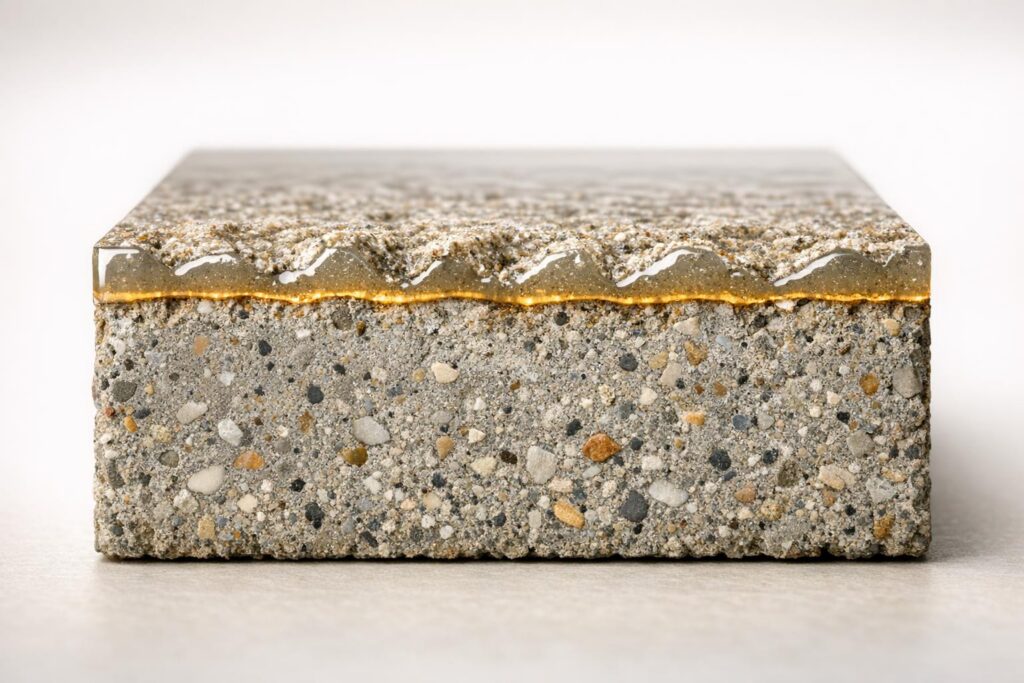
Surface profiling is essential for ensuring coatings last longer and adhere properly to concrete surfaces. Without it, coatings can fail prematurely, leading to costly repairs. Here’s why profiling matters:
- 83% of coating failures are due to poor surface preparation.
- Correct profiling increases bond strength by 50% to 300% and enhances bonding areas by 16–18%.
- Matching the Concrete Surface Profile (CSP) to the coating thickness prevents peeling and separation.
- Replacing a failed floor can cost up to $12 per square foot, 8–10 times more than proper preparation.
Surface profiling creates tiny peaks and valleys, allowing coatings to anchor securely, much like Velcro. For polyurea and polyaspartic coatings, achieving the right CSP (usually CSP 3–5) is critical for durability. Proper preparation ensures bond strengths over 900 psi, lasting 15–20 years, compared to 500 psi, which often fails in just 2 years.
What is CSP – Concrete Surface Profile?
sbb-itb-4b4bb37
Concrete Surface Profiles (CSP) and How They Affect Adhesion
Concrete Surface Profile (CSP) Levels Guide for Coating Applications
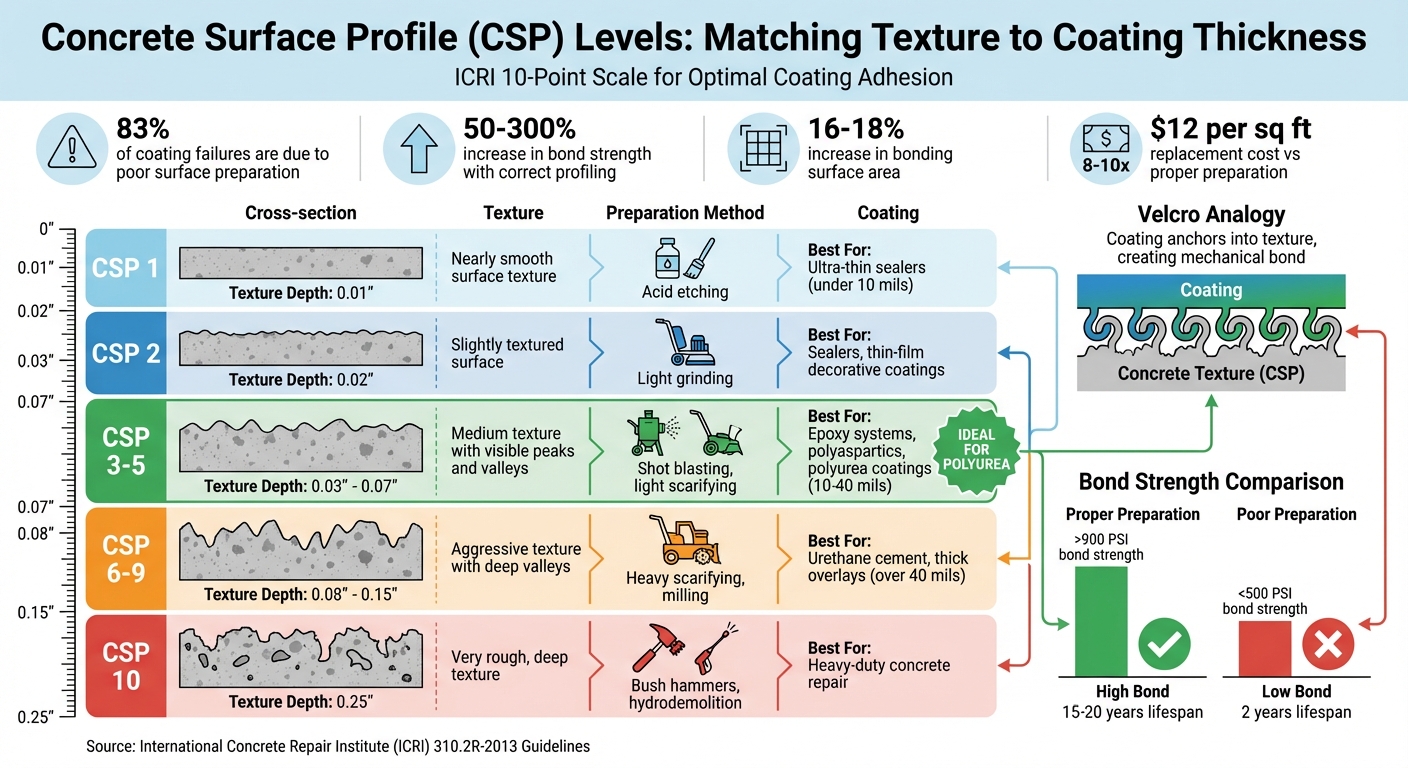
The International Concrete Repair Institute (ICRI) developed a standardized way to measure surface roughness, known as the Concrete Surface Profile (CSP). This system uses a 10-point scale – ranging from CSP 1 to CSP 10 – so contractors and property owners can clearly communicate how rough a concrete surface needs to be before applying coatings. The ICRI 310.2R-2013 guideline even includes rubber comparator chips, which allow you to physically see and feel the texture of each CSP level.
CSP essentially describes the peaks and valleys formed during concrete preparation. These small textures give coatings a chance to anchor securely through mechanical interlocking. Instead of sitting flat on a smooth surface – where peeling is more likely – the coating flows into these tiny depressions, creating a much stronger bond.
"Surface profiles describe the roughness created during cleaning or grinding. Like Velcro® hooks catching fabric loops, these textures let coatings anchor securely."
- Chris Lavin, Owner, National Concrete Polishing
CSP Levels Explained
The CSP scale measures texture depth from 0.01 inches to 0.25 inches. Lower CSP numbers represent smoother surfaces, while higher numbers indicate rougher, more aggressive textures. Choosing the right CSP level for your coating thickness is critical, as mismatched profiles are a leading cause of coating failures. Getting this right ensures the coating adheres properly and lasts as intended.
| CSP Level | Texture Depth | Common Preparation Methods | Best Coating Applications |
|---|---|---|---|
| 1 | 0.01" | Acid etching | Ultra-thin sealers |
| 2 | 0.02" | Light grinding | Sealers, thin-film decorative |
| 3-5 | 0.03" – 0.07" | Shot blasting, light scarifying | Epoxy systems, polyaspartics |
| 6-9 | 0.08" – 0.15" | Heavy scarifying, milling | Urethane cement, thick overlays |
| 10 | 0.25" | Bush hammers, hydrodemolition | Heavy-duty concrete repair |
For polyurea coatings, which are typically 10 to 40 mils thick, CSP 3-5 is usually ideal. Thin sealers under 10 mils can work with CSP 1-2, while thicker industrial coatings over 40 mils require CSP 6-9 for proper adhesion. As Tom Dassie from CustomCrete explains: "A smooth surface (CSP 1 or 2) might be fine for a thin sealer, but it won’t allow a thick epoxy or urethane cement to bond securely".
By matching the surface profile to the coating thickness, you create the mechanical anchors necessary for a strong, lasting bond.
How Surface Texture Creates Stronger Bonds
Surface roughness does more than change the concrete’s appearance – it fundamentally improves how coatings adhere. When coatings settle into the depressions of a rough surface, they form mechanical anchors that resist separation. This bond helps coatings stand up to thermal expansion, heavy foot traffic, and everyday wear without breaking down.
Research shows that proper surface profiles can significantly improve bond strength, which directly impacts durability. Coatings with adhesion strengths over 900 psi often last 15-20 years, while those below 500 psi may fail within just two years. Without enough texture depth, thermal expansion can cause micro-fractures, allowing moisture to seep in and eventually leading to delamination.
Matching the surface profile to the coating prevents about 70% of premature adhesion failures. For polyurea systems, achieving bond strengths of 800-1,000+ psi is common when the surface profile is correctly optimized. The added texture increases the bonding surface area by 16-18%, further enhancing adhesion.
To ensure your surface profile is accurate, use ICRI rubber comparator chips to compare your prepared surface to the specified CSP level. These chips let you visually and physically confirm the roughness. Once the surface is ready, apply primers within 4 hours to keep the pores clean and primed for bonding.
Research Findings on Surface Profiling and Adhesion
Studies reveal that the roughness and porosity of concrete surfaces play a significant role in how effectively polyurea coatings adhere to their substrates. The Concrete Surface Profile (CSP) analysis emphasizes the importance of precise surface preparation, and recent findings quantify its impact on adhesion. With optimized surface profiles, bond strength can increase by 50% to 300% compared to inadequately prepared surfaces, underscoring the importance of proper preparation. Poor adhesion, often below 500 psi, is linked to failures under stressors like freeze-thaw cycles – which can weaken materials by up to 50% – and heavy forklift traffic, which accelerates surface wear by 40% over five years. These findings highlight the necessity of defining ideal surface parameters for polyurea applications.
Best Surface Roughness Range for Polyurea Coatings
Building on these insights, identifying the optimal surface roughness is crucial for enhancing adhesion. Research confirms that higher roughness and porosity significantly improve the bonding strength of polyurea systems. For polyaspartic coatings, a specialized polyurea variant, adhesion typically ranges from 800 to over 1,000 psi with proper surface preparation. In comparison, 100% solids epoxy systems achieve an average pull-off strength of about 925 psi.
The goal is to create enough texture depth for effective mechanical interlocking. Studies indicate that aggressive profiles in the CSP 3–5 range (approximately 0.03″ to 0.07″ in depth) provide the necessary anchoring for polyurea coatings in heavy-duty applications. Additionally, modern formulations with nanoparticle additives can enhance mechanical interlocking by 15% to 20%.
How Pore Size and Distribution Affect Adhesion Strength
Beyond roughness, the size and shape of surface pores also play a critical role in adhesion performance. Research highlights that pore shapes like "ink-bottle" or parallelepiped are far more effective for anchorage compared to shallow or irregular shapes.
"The shape of the surface should guarantee a good anchorage of the new layer; parallelepiped or ‘ink-bottle’ shapes are greatly preferable."
- European Standard EN 1504-10:2003
Polyaspartic coatings, with their low surface tension, excel at penetrating texture valleys, enhancing adhesion. This ability helps explain why facilities using polyaspartic systems report 70% fewer repairs over a 10-year period compared to those relying on traditional epoxy systems. Interestingly, while the density of peaks and valleys (peak count) does not significantly impact adhesion as long as a minimum profile threshold is met, achieving the right surface texture remains essential.
Surface Preparation Methods for Better Adhesion
When it comes to ensuring coating adhesion, picking the right surface preparation method is just as important as creating the optimal surface profile. The choice of method directly affects the durability of the coating. For example, using a surface that’s too smooth for a thick coating can lead to premature failure.
Shot Blasting for Medium to Thick Coatings
Shot blasting is a process where steel beads are propelled at high speeds to create a textured surface with depths ranging from 0.03″ to 0.15″, corresponding to CSP levels 3-7. This technique not only removes contaminants but also provides a uniform roughness that ensures strong mechanical bonding for coatings between 10 and 40 mils in thickness. Its reliability makes it a go-to method for industrial settings requiring durable coatings over large areas.
A great example of its effectiveness comes from a Midwest distribution center. In July 2025, they upgraded their floor preparation process, achieving an adhesion strength of 1,100 psi with industrial epoxy. This improvement cut their repair costs significantly, from $9.50 to $1.20 per square foot annually, saving them $78,000 in maintenance costs. Previously, their coatings had failed within 18 months due to an insufficient CSP 2 surface profile. However, shot blasting isn’t ideal for thin-mil coatings or decorative finishes, as its aggressive texture can show through the surface.
Grinding for Thin Coating Applications
Grinding uses diamond-tipped discs to create smoother profiles with texture depths of 0.01″ to 0.02″, aligning with CSP levels 1-2. This method is particularly suited for thin coatings under 10 mils, such as sealers, polished concrete, and decorative finishes often found in residential garages or showrooms. Its precision ensures that delicate finishes remain smooth, without over-profiling. For these applications, low-viscosity primers are typically used to enhance bonding by penetrating the relatively smooth surface.
Scarifying for Heavy-Duty Industrial Coatings
Scarifying involves using rotating blades to carve deep grooves into concrete, producing texture depths of 0.07″ to 0.12″ and achieving CSP levels 4-9. This aggressive method is designed for heavy-duty coatings over 40 mils thick, providing the mechanical anchor needed for demanding industrial environments. Facilities like food processing plants and those exposed to extreme thermal expansion benefit greatly from this approach.
For instance, a waterfront facility in South Florida extended the lifespan of its coatings from 2 years to 9 years by adopting a modified shot-blasting technique to achieve a CSP 4-5 profile. This method effectively removed salt contaminants and created a robust anchor to withstand the area’s 30°F daily temperature swings. Scarifying is reserved for situations that require deep, aggressive profiles to handle tough conditions.
These methods, summarized in the table below, highlight how specific preparation techniques are matched to different applications for optimal adhesion:
| Method | CSP Level | Texture Depth | Best Coating Thickness | Primary Applications |
|---|---|---|---|---|
| Grinding | 1-2 | 0.01-0.02″ | Under 10 mils | Sealers, polished concrete, residential garages |
| Shot Blasting | 3-7 | 0.03-0.15″ | 10-40 mils | Industrial epoxy, warehouses, heavy traffic zones |
| Scarifying | 4-9 | 0.07-0.12″ | Over 40 mils | Heavy-duty industrial, food processing, thick overlays |
Tools for Measuring Surface Profiles
Accurate surface profile measurement is crucial for ensuring coatings achieve the bond strength needed for durability. There are two main ways to measure surface profiles: qualitative tools, which rely on visual and tactile comparisons, and quantitative instruments, which provide precise numerical data.
ICRI Rubber Comparator Chips
Matching the surface profile to the correct coating system starts with reliable measurement. ICRI CSP Chips are rubber replicas representing 10 profile levels, ranging from CSP 1 (nearly smooth) to CSP 10 (extremely rough), each covering a 16-square-inch area. To use them, press the chip against the prepared concrete and compare textures to determine the closest CSP level.
"The CSP Chips produced by ICRI are arguably the most widely recognized and most frequently specified method to assess concrete roughness; however, this method… is qualitative and requires some judgement." – Bill Corbett, KTA-Tator, Inc.
The simplicity and speed of these chips make them a popular choice – there’s no need for calibration or electronic devices. However, this method is subjective, relying heavily on the inspector’s experience. For polyurea coatings on concrete, SSPC-PA 14 standards typically specify a CSP range of 2-6. Studies have also linked certain CSP levels to specific mil values when measured digitally.
Digital Laser Scanning for 3D Surface Analysis
While rubber chips are great for quick checks, digital tools are indispensable for projects requiring precise data. Digital measurement eliminates guesswork by providing exact numerical values. For instance, digital depth micrometers, following ASTM D8271 standards, can measure profiles up to 250 mils (around 6 mm) deep and record over 50 readings per minute, with built-in memory for analysis. These devices measure the distance between surface peaks and valleys, offering reliable data for quality control and contract compliance.
"Unlike subjective visual assessments, the digital PosiTector SPG TS Concrete Surface Profile Gage provides real quantitative analysis in the field of roughness measurement." – DeFelsko Corporation
For even greater precision, three-dimensional optical profilometry can map surface roughness and morphology to create detailed 3D profiles. When using digital micrometers, take at least 15 readings within a 6″ x 6″ area to accurately characterize the surface. Always verify the instrument’s accuracy with a known metal shim and avoid calibrating directly on soft materials to prevent errors.
To maintain consistency, stick to one measurement method throughout your project. Mixing methods can lead to discrepancies in results. Use ICRI chips for quick field checks when specific CSP numbers are required, and rely on digital tools for precise data, statistical analysis, or permanent documentation. Proper surface measurement ensures the ideal profile for maximum coating adhesion, giving contractors confidence in their results and a strong foundation for polyurea coatings.
Real-World Examples and Case Studies
Residential Garage Floor Coating Results
Proper surface preparation is the backbone of durable garage floor coatings. When installers achieve bond strengths exceeding 900 psi, the coating can last 15–20 years. Compare that to poorly prepared floors, which may fail in just two years. The key lies in the textured surface created during profiling, which allows the polyurea coating to securely anchor into the concrete. This mechanical interlock is what prevents premature adhesion failures. In fact, about 70% of early breakdowns can be avoided with strategic surface profiling, saving homeowners from expensive replacements.
These residential results serve as a foundation for even more demanding industrial applications, where coatings face much harsher conditions.
Industrial Flooring Performance Under Heavy Traffic
In industrial environments, where heavy forklift traffic and chemical exposure are daily challenges, precise surface profiling is just as critical. Take the example of a Midwest distribution center that replaced a failed floor with a high-adhesion epoxy system. Achieving a bond strength of 1,100 psi, this upgrade slashed annual repair costs from $9.50 to $1.20 per square foot, resulting in savings of approximately $78,000.
"A single industrial floor coating with 1,200 psi adhesion strength can outlast three weaker installations combined." – Chris Lavin, Owner, National Concrete Polishing
High-adhesion coatings, with bond strengths between 800 and over 1,000 psi, outperform standard options by 25–30% in resisting wear from forklifts and chemical exposure. Forklift paths, for example, wear out 30% faster than storage zones. Daily forklift traffic accelerates the breakdown of poorly bonded coatings by 40% within five years. The cost of repairing floors with inadequate preparation can be eight to ten times higher than the expense of proper preventive profiling.
These examples highlight how precise surface profiling ensures long-lasting durability in both residential and industrial flooring – an approach that Atlas Concrete Coatings has made a standard practice for superior results.
Conclusion
Thorough research and careful preparation clearly show that proper surface profiling is essential for durable coatings. The lifespan of a concrete coating – whether it lasts 2 years or 20 – depends heavily on this step. Microscopic peaks and valleys in the surface act as mechanical anchors, securing polyurea coatings to the substrate with bond strengths that can exceed 900 psi. On the flip side, 83% of premature coating failures occur because the surface was too smooth, leaving adhesion strength below 500 psi.
Studies highlight that matching the Concrete Surface Profile (CSP) to the coating’s thickness significantly enhances bond strength and reduces the risk of early failures. Whether the project involves a residential garage or a large industrial warehouse, the chosen preparation method – be it grinding, shot blasting, or scarifying – must meet the specific needs of the job.
Environmental conditions also play a critical role in successful surface preparation. Monitoring factors like temperature and humidity ensures the surface is ready for bonding. For example, maintaining the surface temperature at least 5°F above the dew point and applying primers within 4 hours of profiling are key practices that separate durable installations from those prone to failure.
At Atlas Concrete Coatings, proper surface profiling is a core principle. The difference between a floor that requires minimal upkeep and one that demands costly repairs often comes down to getting it right from the start. By investing in professional preparation, you’re ensuring a floor that’s built to last and withstand the challenges of daily use.
FAQs
How does surface profiling improve coating adhesion and prevent failures?
Surface profiling plays a key role in improving coating adhesion by creating a textured surface that promotes stronger mechanical bonding. This added texture helps coatings hold up better over time, minimizing problems like blistering, delamination, or early failure that often stem from poor surface preparation.
In fact, proper surface profiling can boost adhesion strength by an impressive 50% to 300%, making it a critical step for ensuring durable and reliable coatings. This is especially important for high-performance applications like garage floors, pool decks, and industrial areas where long-lasting results are a must.
What is the recommended Concrete Surface Profile (CSP) for polyurea coatings?
The recommended Concrete Surface Profile (CSP) for polyurea coatings usually falls between CSP 2 and CSP 3. This level of texture is key for ensuring the coating adheres well to the concrete, which directly impacts its durability and performance.
To reach the ideal CSP, techniques such as grinding or shot blasting are commonly used. These preparation methods are essential for creating a surface that allows polyurea coatings to bond effectively, ensuring long-lasting and reliable results. Proper preparation is especially important for high-performance coatings like polyurea.
Why is it important to match the Concrete Surface Profile (CSP) to the coating thickness?
Matching the Concrete Surface Profile (CSP) to the coating thickness is key to achieving strong adhesion and durability. A proper surface profile helps form the mechanical bond needed between the substrate and the coating, reducing the risk of peeling or delamination over time.
If the CSP is either too rough or too smooth for the coating thickness, it can weaken the coating’s performance and lifespan. Choosing the correct CSP for your polyurea or other coating ensures a dependable, professional finish that can handle daily wear and tear effectively.