
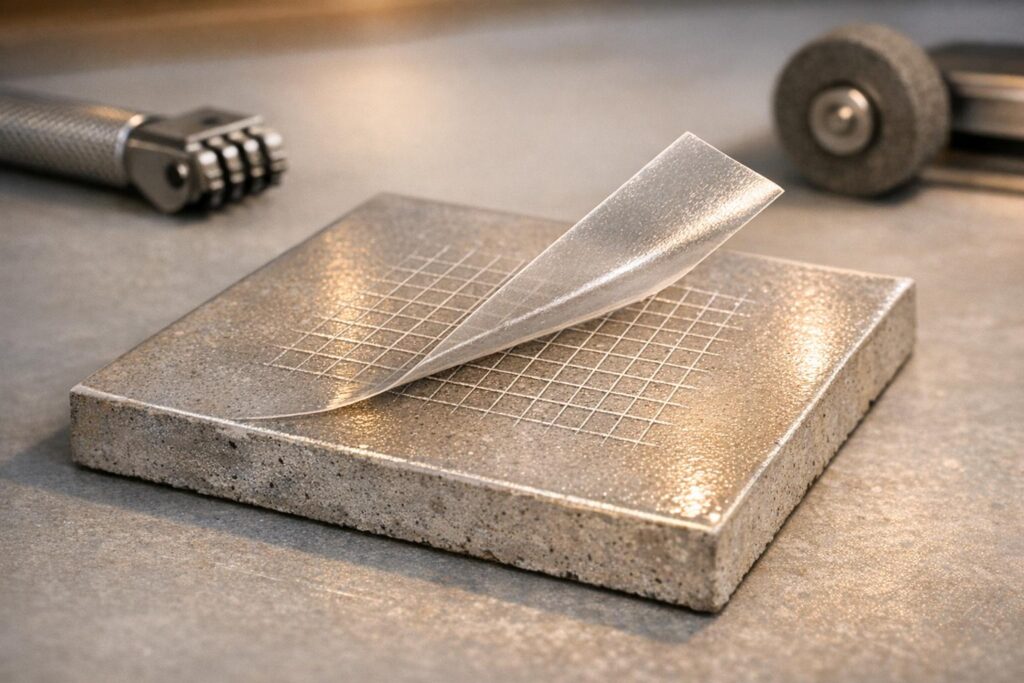
Polyurea coatings are known for their durability, making them a popular choice for protecting floors in demanding environments like warehouses, garages, and industrial facilities. This article dives into how these coatings are tested to ensure long-term performance. Key tests include:
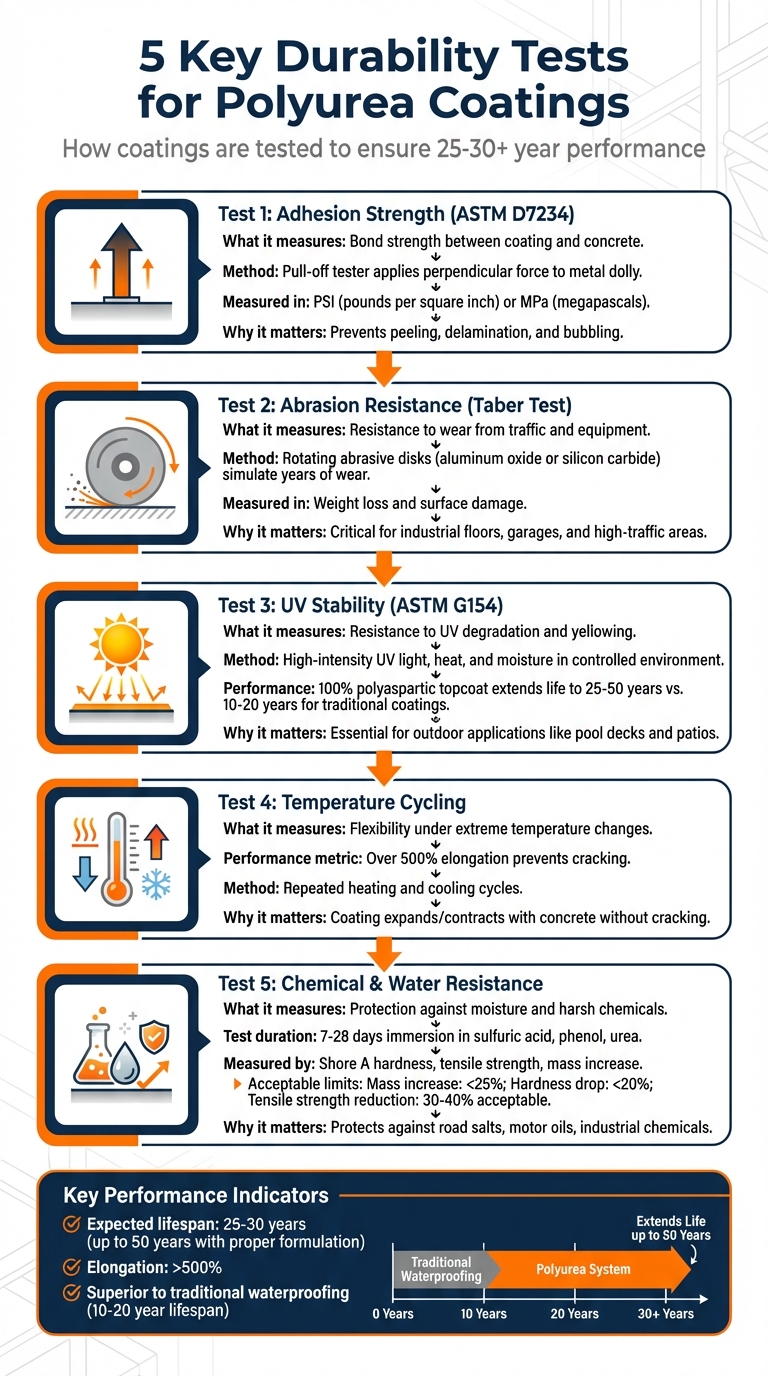
- Adhesion Strength: Ensures the coating bonds well to surfaces like concrete, preventing peeling or delamination.
- Abrasion Resistance: Measures the coating’s ability to withstand wear from traffic and equipment.
- UV Stability: Assesses resistance to sunlight, crucial for outdoor applications.
- Temperature Cycling: Evaluates flexibility under extreme temperature changes to prevent cracking.
- Water Absorption & Chemical Resistance: Tests protection against moisture and harsh chemicals.
These tests simulate years of wear and stress, proving polyurea’s reliability for up to 30 years or more with proper application. Atlas Concrete Coatings, for example, conducts rigorous testing and offers lifetime warranties for their systems, ensuring long-lasting protection tailored to various needs.
5 Key Durability Tests for Polyurea Coatings
Epoxy, Polyurea, & Polyaspartic Adhesion Tests – UDT Coatings Corner #1
sbb-itb-4b4bb37
Testing Adhesion Strength (ASTM D7234)
When a polyurea coating fails, the culprit is often a weak bond between the coating and the concrete surface. Adhesion testing steps in to measure how securely the coating sticks to the substrate, providing crucial insights into its performance.
How Adhesion Strength is Measured
ASTM D7234 outlines the standard procedure for testing pull-off adhesion strength on concrete surfaces. The process is straightforward yet precise. After the coating has cured, a metal dolly is attached to it using a strong adhesive. Once the adhesive solidifies, a portable pull-off tester applies upward force, perpendicular to the dolly, gradually increasing pressure until the bond fails.
The recorded maximum force before failure represents the pull-off strength, typically expressed in pounds per square inch (psi) or megapascals (MPa). Equally important is identifying where the failure occurs. If the concrete itself breaks, it means the bond is stronger than the substrate. However, if the coating separates, it points to issues like poor surface preparation or improper application techniques.
"Fracture will occur along the weakest plane within the system comprised of the test fixture, glue, coating system, and substrate, and will be exposed by the fracture surface."
This testing method is essential for predicting the coating’s durability. The precise measurements help evaluate how well the polyurea coating will perform over time, especially in demanding conditions.
Why Adhesion Matters for Longevity
Strong adhesion is non-negotiable for coatings in environments with heavy equipment, constant traffic, or fluctuating temperatures. Think of industrial warehouses or busy garages – these floors endure intense wear and tear. Heavy machinery, thermal expansion, and daily traffic exert forces that can pull the coating away from the concrete. Without a strong bond, the coating risks delaminating, forming bubbles, or peeling at the edges.
"The pull-off strength of a coating is a performance property that may be referenced in specifications."
ASTM D7234 simulates the tensile forces that coatings face in high-traffic scenarios, offering a more accurate assessment than scratch or knife adhesion tests, which measure shear stress instead. For polyurea coatings on concrete, this test provides the clearest picture of long-term performance. Achieving strong adhesion starts with proper surface preparation – methods like shot blasting or grinding are essential to ensure the bond holds up under tough conditions.
Abrasion Resistance Testing
Abrasion resistance testing is a key step after adhesion strength tests, confirming whether a coating can handle the mechanical stresses it faces daily. This process assesses how well a coating withstands constant friction from foot traffic, vehicles, equipment, and other wear-inducing forces.
Methods for Evaluating Abrasion Resistance
The Taber Abrasion Test is widely recognized for evaluating a coating’s ability to resist wear. In this method, a coated material is placed on a rotating platform while abrasive disks – typically made from aluminum oxide or silicon carbide – apply controlled friction. The spinning platform mimics years of wear in a much shorter time.
"The Taber Abrasion Test measures how much a material wears and the extent of surface damage by continuously applying a rotating abrasive disk to the surface." – Devotrans
The test measures wear resistance by noting weight loss and visible surface changes, such as scratches, roughness, or color alterations. The type of abrasive disk used plays a huge role: silicon carbide disks simulate harsher conditions than aluminum oxide ones, making it essential to align testing conditions with real-world applications for accurate results.
"The Taber test objectively measures the abrasion and durability properties of materials, helping predict the product’s lifespan." – Devotrans
This approach provides not just wear data but also insights into how coatings might perform in demanding environments.
Where High Abrasion Resistance is Needed
In high-stress environments, abrasion resistance is non-negotiable. Industrial floors, commercial garages, and parking decks see constant mechanical wear, especially elevated parking lots where vehicle traffic accelerates surface erosion. Durable coatings are crucial for protecting these surfaces over time.
Mining operations face even harsher conditions. Conveyor belts, buckets, and silos are exposed to abrasive materials daily, speeding up wear. Polyurea coatings, thanks to their molecular structure, offer exceptional mechanical resistance, outperforming many alternatives. They endure these intense conditions without thinning or peeling. Without such protection, underlying concrete can suffer from infiltration, corrosion, and impact damage – issues that are far costlier to fix than investing in proper abrasion resistance testing upfront.
UV Stability and Accelerated Aging Tests
UV Stability for Outdoor Applications
UV stability is all about a coating’s ability to resist damage from UV rays – something that’s critical for outdoor areas like pool decks, patios, and driveways. Standard polyurea coatings tend to yellow and degrade when exposed to direct sunlight. To combat this, a 100% polyaspartic topcoat is often added over the polyurea layer. This combination can extend the service life to an impressive 25–30 years, and in some cases, even up to 50 years. For comparison, traditional waterproofing coatings usually last only 10 to 20 years.
"natural climatic factors can lessen their durability, making surface protection from UV radiation essential" – Scientific Reports
This UV protection is not just about maintaining the coating’s look – it’s a key part of ensuring long-term durability and structural integrity.
How Accelerated Aging Tests Predict Longevity
Accelerated aging tests, like ASTM G154, are designed to mimic years of outdoor exposure in a controlled environment. By using high-intensity UV light, heat, and moisture, these tests simulate real-world wear and tear. The equipment can replicate either direct sunlight or sunlight filtered through glass, depending on the scenario being tested. Labs typically run these tests on multiple samples, including controls with known performance, to get reliable data.
While ASTM G154 gives a fast way to predict long-term performance, it doesn’t factor in specific localized conditions, like saltwater or pollution. For this reason, it’s best used alongside other tests, such as extreme temperature cycling, to get a complete picture of how a coating will hold up over time.
These combined evaluations help ensure coatings can withstand not just UV exposure but also other environmental stresses.
Extreme Temperature Cycling Simulations
Testing for Thermal Expansion and Contraction
Temperature cycling tests push polyurea coatings through repeated heating and cooling cycles to evaluate how well they handle thermal stress. Thanks to their unique micro-phase separation – blending soft and hard segments – these coatings boast over 500% elongation and outstanding crack-bridging ability. This flexibility allows the coating to expand and contract alongside the concrete substrate without cracking. By reducing thermal-induced cracking, polyurea coatings contribute to a longer service life, especially in environments with fluctuating temperatures.
What Temperature Cycling Tests Mean for Your Floors
These tests are more than just technical experiments – they provide real-world insights into floor performance. The results show that polyurea coatings maintain their watertight properties and mechanical strength, even under tough climatic conditions. For areas with significant temperature swings, composites containing oxidized ceramic fillers offer added thermal insulation and resistance to fatigue caused by temperature changes. Strong adhesion to the substrate, achieved through meticulous surface preparation, ensures that the coating moves seamlessly with the concrete. Atlas Concrete Coatings prioritizes these details during installation, ensuring your floors can withstand extreme temperature variations without compromising durability or functionality.
Water Absorption, Chemical Resistance, and Immersion Testing
Moisture and Water Absorption Testing
Water resistance testing plays a key role in assessing how well polyurea performs when exposed to moisture over long periods. To measure this, samples are weighed both before and after being immersed in water, with the difference revealing how much water they absorb and whether swelling occurs. High levels of absorption often indicate that the polymer structure is beginning to degrade. This is especially relevant for areas like pool decks or garage floors, where constant exposure to water is a given. If too much moisture is absorbed, the protective coating can fail, allowing water to seep through and damage the concrete beneath.
Once water absorption testing is complete, chemical resistance tests are performed to evaluate how well the coating holds up against harsh substances.
Chemical Resistance Testing
Chemical resistance testing subjects polyurea samples to harsh solutions, including sulfuric acid, phenol, and urea, for periods ranging from 7 to 28 days. The results are measured using methods like Shore A hardness tests, tensile strength evaluations, and visual inspections. These assessments are conducted in line with international standards such as EN 13529 for chemical resistance, EN ISO 868 for hardness, and EN ISO 527-3 for tensile properties.
For example, exposure to phenol solutions has been shown to increase polyurea mass by up to 30% and reduce hardness by as much as 40 Shore units. Similarly, 3% urea solutions can decrease tensile strength by 10% to 30%. Such testing is vital for industrial environments, like wastewater treatment plants, where sulfuric acid concentrations can reach 5% to 10% with a pH below 1. In residential garages, strong chemical resistance is equally important, as it helps protect floors from road salts, motor oils, and fuels that could otherwise stain or degrade unprotected concrete.
Unlike rigid epoxy coatings, which are prone to cracking and allowing chemicals to seep through, polyurea stands out due to its high elongation properties – often exceeding 300%. This flexibility enables it to bridge cracks and maintain its protective barrier, even when the concrete underneath shifts or moves. These chemical resistance tests confirm polyurea’s durability in aggressive environments, building on earlier evaluations of its mechanical and thermal properties. Atlas Concrete Coatings ensures its polyurea systems are rigorously tested to withstand common chemical exposures, offering long-lasting protection for residential, commercial, and industrial floors.
Predicting Coating Lifespan from Test Data
How to Interpret Test Results
Test results play a crucial role in selecting the right coating. Key factors to monitor include mass increase, hardness, and tensile strength. For instance:
- A mass increase over 25% signals swelling issues.
- A hardness drop exceeding 20% indicates a loss of mechanical integrity.
- A tensile strength reduction of 30–40% is considered within safe limits, but anything beyond 60% suggests significant structural damage.
To better understand durability, researchers use mathematical tools like the Integrated Resistance Index (IR). This index rates a coating’s durability on a scale from 0% (complete failure) to 100% (intact). Additionally, accelerated testing – which involves exposing coatings to concentrated aggressive agents – compresses years of wear into a much shorter timeframe. This approach provides a reliable glimpse into how coatings will hold up under actual conditions.
These standards guide the development of coatings, ensuring they meet high durability expectations.
How Atlas Concrete Coatings Ensures Longevity
Atlas Concrete Coatings takes these insights seriously, creating polyurea systems that deliver measurable, long-term results. By aligning test data with real-world performance, the company designs coatings that exceed durability standards. While most traditional waterproofing coatings last between 10 and 20 years, Atlas Concrete Coatings’ polyurea systems are built to last 25–30 years, with some formulations reaching up to 50 years. These coatings also boast over 500% elongation, allowing them to bridge cracks effectively and reduce repair and maintenance costs.
Their polyurea-based chip floor coatings are specially designed to maintain protection even when the underlying concrete shifts or forms minor cracks. To back their quality, Atlas Concrete Coatings offers a lifetime warranty on chip systems. They also provide free consultations to help clients choose the best formulation for residential, commercial, or industrial needs.
Conclusion
Key Takeaways on Polyurea Coating Durability Tests
Understanding how polyurea performs under various stress conditions is essential when deciding on floor protection solutions. The tests discussed – ranging from mass change, hardness, and tensile strength evaluations to chemical exposure assessments – highlight critical durability factors, such as water resistance and structural stability.
The most dependable evaluations go beyond surface-level inspections. Instead, they combine data on mass change, hardness, and tensile strength, as these factors are deeply interconnected. The results from these tests play a crucial role in shaping effective maintenance strategies for floors in commercial, industrial, and residential settings. This knowledge is invaluable when choosing coatings that can handle demanding, real-world environments.
Why Choose Atlas Concrete Coatings
Atlas Concrete Coatings incorporates these rigorous testing standards into every project, ensuring their polyurea systems deliver consistent and reliable performance. Their coatings are built to endure heavy traffic, exposure to industrial chemicals, and harsh outdoor conditions. With formulations offering over 500% elongation, they effectively bridge cracks, minimizing the risk of secondary cracking and coating failure.
With a lifetime warranty and free consultations, Atlas Concrete Coatings provides solutions tailored to meet your specific needs. Whether protecting a residential garage or an industrial workspace, their polyurea coatings are engineered for long-lasting durability, far outlasting traditional waterproofing systems.
FAQs
What causes polyurea coatings to fail on concrete?
Polyurea coatings on concrete can encounter problems like UV degradation, which causes yellowing and fading when adequate protection isn’t applied. Another frequent issue stems from insufficient surface preparation. Without proper prep work, the coating might suffer from poor adhesion, leading to peeling, blistering, or even delamination. Ensuring the surface is well-prepared and protected from UV exposure is key to achieving durable and reliable results.
Which durability tests matter most for my floor’s use?
The durability tests you need to consider largely depend on where your flooring is located. For outdoor areas, UV resistance and weather resistance are crucial. These tests ensure the coating won’t fade, crack, or peel under constant exposure to sunlight and varying weather conditions.
In spaces like garages, warehouses, or other high-traffic zones, the focus should shift to testing for chemical resistance, temperature changes, and physical impact. These factors are essential to ensure the coating can handle heavy use and tough conditions without breaking down over time.
Do I need a UV-stable topcoat for outdoor polyurea?
Yes, applying a UV-stable topcoat is a smart choice for outdoor polyurea applications. It helps guard against yellowing, fading, and damage caused by UV exposure. Aliphatic polyurea is especially well-suited for this, as it provides strong UV resistance and maintains color stability. This approach ensures the coating stays durable and visually appealing for years to come.