
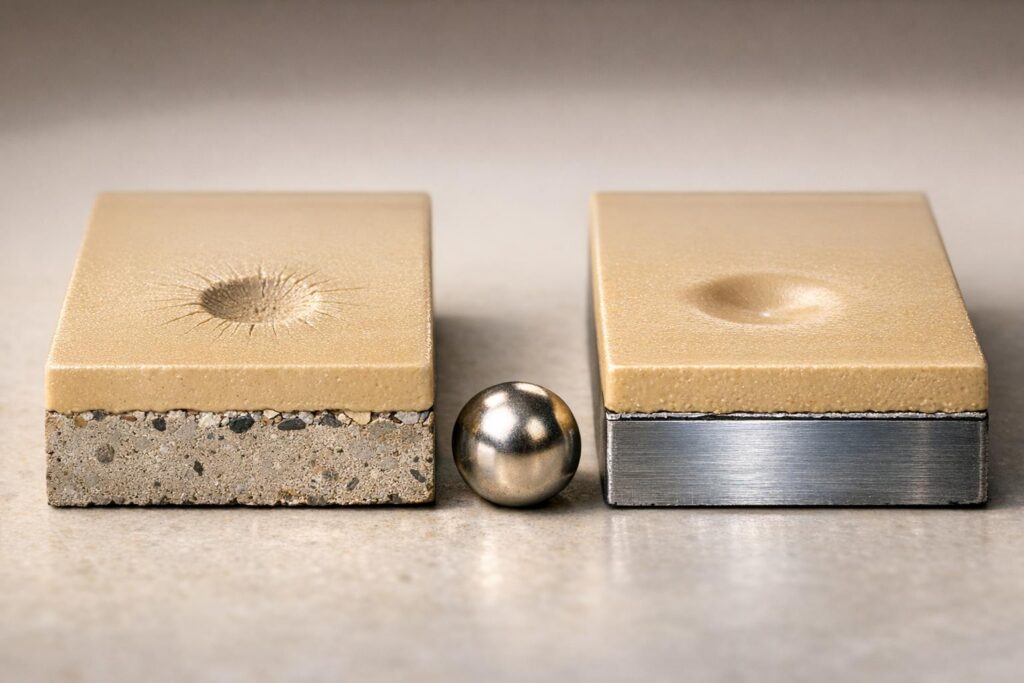
Polyurea coatings are widely used to protect concrete floors in high-impact environments like garages, warehouses, and industrial sites. Their unique composition – combining strength with flexibility – allows them to absorb and dissipate energy from impacts effectively. These coatings cure quickly, resist cracking under stress, and remain durable under extreme conditions. Key highlights include:
- Strength and Elasticity: Tensile strength up to 60.7 MPa and elongation up to 1,000%.
- Impact Resistance: Average resistance of 32.52 J/mm⁴, with increased durability at greater thicknesses.
- Applications: Used in pool decks, parking lots, bridge membranes, and more for long-term protection.
- Testing Standards: Methods like ASTM D2794 and ISO 6272-1 assess resistance to cracking and adhesion strength.
Research shows polyurea coatings significantly improve the durability of concrete and steel surfaces, even under explosive or high-impact scenarios. Their ability to protect against damage while maintaining flexibility makes them a reliable choice for various applications.
IT’S INDESTRUCTIBLE Polyurea Hammer & Impact Test on Besser Brick Cinder Block –
sbb-itb-4b4bb37
Standard Testing Methods for Impact Resistance
Polyurea Coating Impact Testing Methods Comparison: ASTM D2794 vs ISO 6272-1 vs ASTM D7234
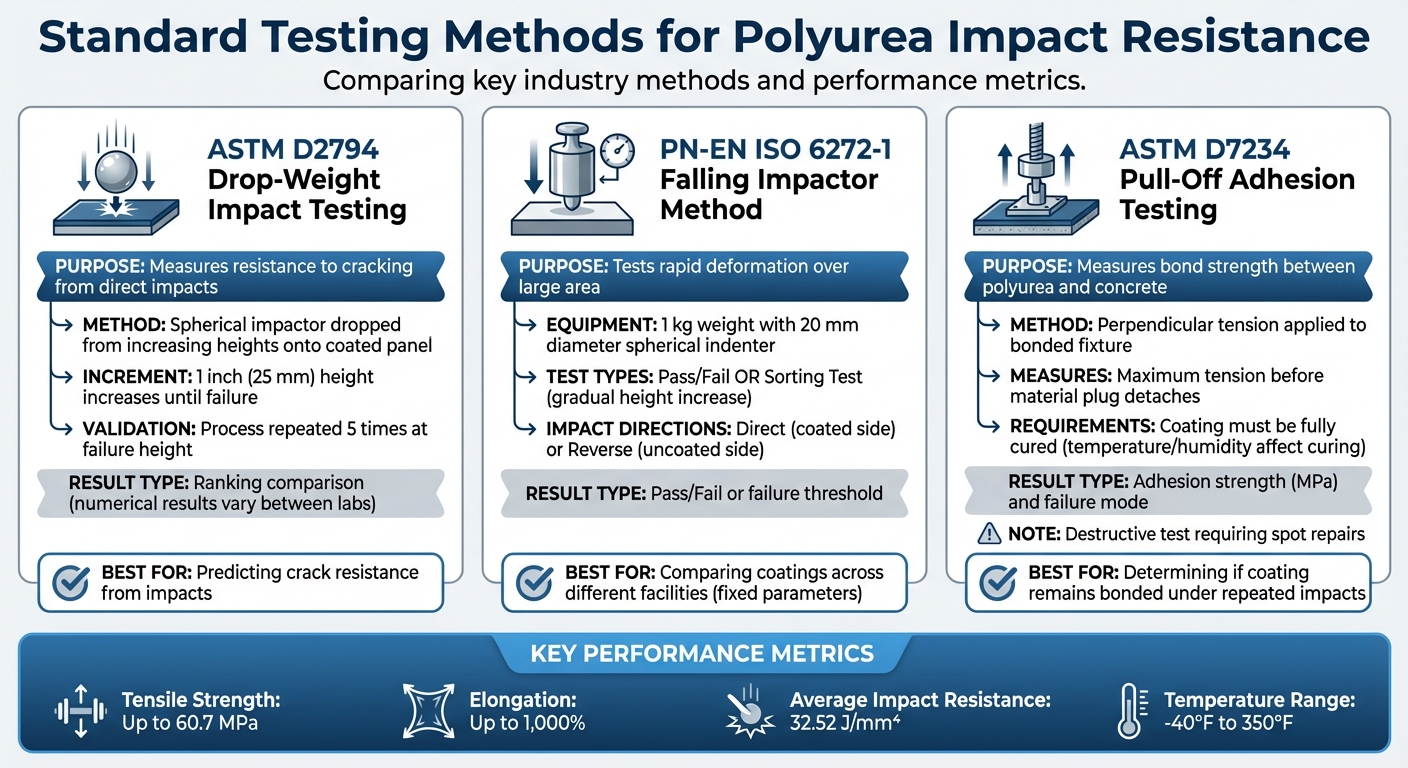
Standardized tests help evaluate how polyurea coatings handle impacts and stresses, ensuring they perform reliably under demanding conditions. Three key protocols – ASTM D2794, ISO 6272-1, and ASTM D7234 – are commonly used to measure impact resistance. Here’s a closer look at these methods.
ASTM D2794 Drop-Weight Impact Testing
This test examines how well a polyurea coating resists cracking when subjected to direct impacts. A spherical impactor is dropped from various heights onto a coated panel, creating a crater upon impact. Technicians then inspect the area for cracks using magnification or chemical detection methods. The drop height is increased incrementally – by 1 inch (25 mm) – until the coating fails. To confirm reliability, the process is repeated five times at the failure height and at adjacent levels.
According to ASTM International, this method is useful for predicting how organic coatings resist cracking caused by impacts. However, numerical results often vary between labs, so ranking coatings instead of relying on exact values tends to provide more consistent comparisons.
PN-EN ISO 6272-1 Falling Impactor Method
ISO 6272-1 employs a standardized 1 kg weight with a 20 mm diameter spherical indenter to test how coatings handle rapid deformation over a large area. This method can be used as a Pass/Fail test, checking if a coating meets a specific height requirement, or as a Sorting Test, gradually increasing the height to pinpoint the failure threshold.
The test examines whether the coating cracks or delaminates when impacted, and results are categorized as "direct" (impact on the coated side) or "reverse" (impact on the uncoated side). While similar to ASTM D2794, ISO 6272-1 specifies fixed equipment parameters, making it ideal for comparing coatings across different facilities.
ASTM D7234 Pull-Off Adhesion Testing
Adhesion strength plays a critical role in a coating’s impact resistance, which is why pull-off testing is often used alongside drop-weight methods. ASTM D7234 measures the bond strength between polyurea and concrete by applying perpendicular tension to a fixture bonded to the surface. The test determines the maximum tension the surface can handle before a plug of material detaches, highlighting the system’s weakest point.
ASTM International emphasizes the importance of pull-off strength and failure mode as key performance properties for coatings on concrete substrates. Coatings must be fully cured before testing, as low temperatures or high humidity can extend curing times. Though this is a destructive test requiring spot repairs afterward, it delivers crucial insights into whether the coating will remain bonded under repeated impacts.
Research Findings on Polyurea Impact Performance
Blast and Impact Protection on Steel and Concrete
Polyurea coatings exhibit a fascinating ability to shift from a rubber-like state to a glass-like state under high-speed impacts. This unique property allows them to absorb and dissipate kinetic energy efficiently, making them highly effective in reducing fragmentation and debris splash in concrete structures – even when the base material fails.
In April 2022, researchers Ping Lyu and Weibo Huang from Qingdao University of Technology tested Qtech T26 polyurea on reinforced concrete slabs measuring approximately 39 inches by 39 inches by 12 inches. During a contact explosion using about 3 pounds of TNT, the uncoated slab suffered a large front crater and complete back collapse. In contrast, a slab coated with about 0.4 inches of T26 polyurea only developed a small pit on the front surface, with no damage on the back. The kinetic energy conversion rate for the coated slab was 95.36%, compared to 87.27% for the uncoated one.
Additional studies, like those conducted by James T. Baylot at the U.S. Army Engineering University, compared polyurea-coated walls with fiber-reinforced polymers and steel plates. His findings highlighted polyurea’s exceptional ability to "catch" fragments and debris from walls, significantly lowering the risk of secondary injuries caused by flying concrete shards. Similarly, the U.S. Air Force Laboratory noted:
Compared with many other polymer materials, such as carbon fiber and aramid fiber, polyurea showed a better blast mitigation effect in the explosion protection of wall structures
.
These findings underscore polyurea’s potential in mitigating explosive impacts and pave the way for evaluating its performance in composite materials.
Impact Resistance on Polymer Laminates
When applied to carbon fiber-reinforced polymer (CFRP) laminates, polyurea coatings alter the failure mechanism from punching perforation to a tension-shear mode that dissipates energy. A 2021 study tested projectiles traveling at speeds between 1,969 and 4,613 feet per second. Results showed that rear-side coatings were particularly effective at minimizing damage while maximizing energy absorption. Drop-weight tests further confirmed that the placement of the coating plays a crucial role in optimizing energy absorption.
Drop-Weight Tests on Polyurea-Coated Concrete
Drop-weight tests on steel-polyurea composites reveal that the location of the coating has a significant impact on energy absorption. In November 2019, researchers evaluated low-carbon steel plates (approximately 28 inches by 28 inches by 0.15 inches) coated with polyurea using a blunt cylinder hammer. A 0.16-inch upper-layer coating delivered the highest energy absorption. For concrete substrates, rear-side coatings proved essential for maintaining structural integrity and capturing fragments during blasts or high-impact events.
In October 2018, Jun Chen from Auburn University conducted drop tower experiments on cementitious composite tiles. The study compared front-face, back-side, and sandwich configurations. The results demonstrated that polyurea coatings significantly improved the tiles’ impact resistance and energy absorption thresholds. Rear-side and sandwich applications performed particularly well, showing the most promise for enhancing the durability of concrete floors.
These findings highlight the versatility of polyurea coatings in improving impact resistance and structural durability across various applications.
Factors That Affect Impact Durability
Coating Thickness and Adhesion
The thickness of a polyurea coating is a key factor in its ability to withstand impacts. Coatings between 10–15 mils are suitable for lighter use, while heavy-duty applications often require thicknesses of 30 mils or more. For damaged or uneven concrete, multi-layer systems with thicknesses ranging from 25–40 mils can help fill surface imperfections and distribute impact forces more effectively.
Adhesion strength is just as important as thickness. Polyurea penetrates the tiny pores and capillaries in concrete at a molecular level, forming a strong bond that resists delamination under stress or direct impacts. With elongation properties often exceeding 300%, polyurea maintains its protective qualities even when the underlying concrete shifts. Together, these characteristics highlight how material properties work in tandem to enhance durability.
Impedance Mismatch and Strain Rate Effects
The combination of polyurea’s flexibility and concrete’s rigidity creates an "impedance mismatch", a phenomenon that helps absorb and dissipate shock waves during impacts. When subjected to high-speed impacts, polyurea undergoes a transformation from a rubbery state to a glassy state.
Research on polyurea suspension pads has shown that a 0.16-inch (4 mm) coating can reduce peak impact pressure by 74% and impulse by 49%. The National Center for Biotechnology Information elaborates:
Polyurea’s mechanical properties, such as its stiffness and strength, increase as the speed of the impact or loading increases.
This strain-rate sensitivity means polyurea becomes more effective during sudden, high-velocity impacts. Its soft phase absorbs strain energy, while the hard phase dissipates it through structural changes and hydrogen bond dissociation.
Substrate Material and Reinforcement
The choice of substrate and its preparation significantly influence polyurea’s impact performance. On rigid materials like steel, polyurea acts as a shock-absorbing layer, while on brittle materials like concrete, it helps contain structural damage and prevents debris from scattering. Research by Acharya, Ebrahimian, and Moustafa found that applying a 0.24-inch (6 mm) polyurea coating to reinforced concrete beams increased flexural capacity by 11.2% to 19.4% and shear capacity by 28.2% to 42.5%.
The position of the coating also plays a role. On steel, applying polyurea to the back face provides better impact resistance than applying it to the front. Li and colleagues observed:
Polyurea can reduce the damage level of steel plates when sprayed on the back face of the steel plate, whereas the performance of steel plates deteriorates when polyurea is cast onto the front face.
For concrete substrates, surface preparation is critical. Sandblasting to a roughness level of approximately Sa 2.5 ensures strong adhesion, which is essential for impact durability. This bond allows polyurea to confine spalled concrete fragments during impacts or blasts, reducing the risk of secondary injuries caused by scattered debris.
What This Means for Concrete Floor Coatings
Benefits of Polyurea Coatings for Concrete Floors
Polyurea coatings have been shown to significantly improve the performance of concrete floors. Studies reveal that these coatings can boost a concrete beam’s maximum load capacity by 16% and increase deflection before failure by an impressive 81%. Additionally, polyurea-coated surfaces recover 71–77% of deformation energy, compared to just 41–61% in untreated concrete.
This enhanced energy absorption is particularly valuable in settings like warehouses, garages, and industrial facilities, where heavy impacts from tools or equipment are common. Research led by Luis Mercedes at the Polytechnic University of Catalonia highlights how polyurea acts as a cushion, reducing crack propagation and minimizing fragmentation:
functioned as a cushion, reducing crack propagation speed and minimizing fragmentation
. Beyond surface protection, polyurea coatings also hold cracked concrete together, preventing pieces from breaking off even if the underlying material fails.
Another standout feature of polyurea is its ability to remain flexible in extreme temperatures, ranging from -40°F to 350°F. Hayley Shahbazi, Manager at Galaxy Concrete Coatings, describes this flexibility:
These advanced systems combine best strength with flexibility, creating a seamless, waterproof barrier that actually moves with your concrete instead of fighting against it
. This adaptability prevents the cracking and peeling often seen with rigid coatings when concrete expands or contracts.
Polyurea also creates a durable barrier against moisture and corrosive chemicals, significantly extending the lifespan of both the coating and the concrete it protects. Many polyurea installations last over 20 years, with some rated for more than 30 years [26, 30]. Its rapid curing time – around 5 seconds – enables same-day installations, minimizing downtime for homes and businesses.
These features make polyurea coatings a practical solution for a variety of real-world applications.
Atlas Concrete Coatings Services
Atlas Concrete Coatings leverages the benefits of polyurea to provide top-tier flooring solutions across Pennsylvania and New Jersey. Their chip floor systems combine a polyurea basecoat and topcoat with customizable color options, creating surfaces that resist impacts, chemicals, and UV damage. Atlas offers tailored solutions for various environments, such as garage floors designed to handle heavy equipment and hot tires, slip-resistant pool deck resurfacing, and industrial flooring for high-traffic warehouses and commercial kitchens.
To ensure long-lasting results, Atlas follows rigorous surface preparation techniques to create a strong molecular bond, preventing delamination under stress [29, 30]. For outdoor areas like patios and pool decks, they use aliphatic polyaspartic formulations, which maintain color stability even under direct sunlight. By applying these research-backed methods, Atlas delivers durable, impact-resistant surfaces that perform well in diverse conditions.
Atlas also provides complimentary site assessments to recommend the optimal coating thickness and application method for each project. Their chip systems come with a lifetime warranty, supported by the proven durability of the materials in standardized impact tests.
Conclusion
Testing Methods and Performance Results
Testing methods like ASTM D2794 and PN-EN ISO 6272-1 effectively demonstrate how polyurea performs under impact. Research from the Polytechnic University of Catalonia revealed that applying a 5 mm (≈0.20 in) polyurea coating to 1.2 m (≈3.9 ft) prestressed concrete beams allowed them to absorb impacts from a 30 kg (≈66 lbs) mass dropped from 65 cm (≈25.6 in), equivalent to 191 N·m (≈141 ft·lb) of energy. Unlike uncoated beams, which suffered shear failure and fragmentation, the coated beams maintained their structural integrity. Similarly, tests conducted at Qingdao University of Technology in August 2022 showed that "Qtech T26" polyurea protected reinforced concrete slabs from a 10 kg (≈22 lbs) TNT contact explosion. The results? Zero back-face fragmentation in the coated slabs, compared to a 73 cm (≈28.7 in) perforation in the uncoated ones.
Data also highlight how increasing the coating thickness significantly boosts impact resistance, with an average of 32.52 J/mm. Polyurea’s unique molecular structure dissipates energy effectively, using a confinement mechanism to prevent spalling and hold damaged concrete together, even when the substrate itself fails.
These findings clearly demonstrate polyurea’s effectiveness in protecting concrete under extreme impact conditions.
Choosing Polyurea Coatings for Your Floors
Building on these impressive test results, polyurea coatings are an excellent choice for concrete floors, especially in high-traffic or high-impact environments. For property owners and managers, these coatings deliver proven durability and performance. Lab tests confirm their ability to handle demanding conditions: in one study, polyurea increased concrete deflection by 81% and recovered 71–77% of deformation energy. This makes it a top choice for spaces like warehouses, garages, and industrial facilities where floors endure heavy impacts and constant use.
Atlas Concrete Coatings brings this research into practice, offering durable, impact-resistant polyurea flooring solutions in Pennsylvania and New Jersey. Their chip floor systems, built on rigorous surface preparation and optimal coating thickness, ensure strong adhesion and long-lasting performance. Whether you need garage floors that can handle dropped tools, industrial flooring for heavy machinery, or pool decks with added slip resistance, Atlas provides free site assessments to recommend the best solution for your needs. Plus, their chip systems come with a lifetime warranty for added peace of mind.
FAQs
What is the most reliable impact test standard for coatings?
The ASTM D2794 standard is a well-known method for assessing the impact resistance of coatings. This test measures durability by dropping a weight onto coated surfaces, making it a reliable choice in both construction and industrial settings.
How thick should polyurea be for my floor?
Polyurea flooring is generally applied at a thickness ranging from 40 to 100 mils (0.04 to 0.1 inches). The exact thickness you need depends on the intended use and the level of durability required. Thicker coatings tend to offer greater resistance to impacts, making them ideal for heavy-duty applications. It’s a good idea to consult with a professional to figure out the best thickness for your specific situation.
What surface prep is needed for strong adhesion?
Getting the surface ready is one of the most important steps to ensure polyurea coatings stick properly. Here’s what needs to be done:
- Inspect the surface: Look for cracks, stains, and any signs of moisture.
- Thorough cleaning: Use grinders or pressure washers to remove dirt, grease, and other debris.
- Fix any damage: Repair cracks or other imperfections to create a smooth base.
- Mechanical profiling: Achieve a surface profile of CSP 2–3 to ensure the coating bonds effectively.
- Final check: Make sure the surface is clean, completely dry, and free of contaminants before applying the coating.
Skipping these steps can lead to serious issues like poor adhesion, peeling, or delamination. Taking the time to prepare properly makes all the difference.