

Polyurea coatings are spray-applied membranes known for their high tensile strength (23–25 MPa) and exceptional flexibility (up to 400% elongation). These properties make them effective for protecting concrete surfaces and improving load-bearing performance. When applied, they create a seamless, waterproof barrier that strengthens concrete by reducing cracks, resisting impacts, and preventing damage from chemicals and moisture.
Key findings from research include:
- 4.7% increase in ultimate load capacity for coated concrete beams.
- Ability to bridge cracks up to 5 mm and maintain stiffness under repeated loads.
- Enhanced energy absorption and toughness, especially in high-impact scenarios.
- Long-term durability against moisture, temperature changes, and chemical exposure.
Polyurea coatings are widely used in residential garages, commercial spaces, and industrial facilities. While they don’t replace core structural components, they preserve concrete integrity, reduce maintenance, and extend service life, particularly in high-traffic or harsh conditions.
Research Methods and Findings
Testing Methods and Variables
Researchers have employed various tests – like flexural, drop-weight, and cyclic loading – to evaluate how polyurea affects the load capacity of concrete. These tests measure factors such as bending strength, deflection, and how cracks develop under stress. For instance, drop-weight tests mimic sudden impacts, like a tool or piece of equipment falling, to examine how well the material resists damage and absorbs energy. Cyclic loading tests, on the other hand, involve repeated loading and unloading to assess fatigue resistance and long-term durability.
Several variables influence the outcomes of these tests. Coating thickness is a critical factor, as thicker layers on the tension side of concrete structures reduce damage in impact scenarios by enhancing crack bridging and protection. Test speed also plays a role due to strain-rate sensitivity. For example, tests conducted at 50 mm/min produced tensile strength of 24.08 MPa with 417% elongation, while at 100 mm/min, the tensile strength dropped slightly to 23.03 MPa with 391% elongation. This indicates that faster, dynamic tests often highlight greater performance improvements compared to slower, static ones. Additionally, substrate strength impacts results. Beams with minimal longitudinal reinforcement demonstrate polyurea’s ability to improve ductility and serviceability, even if the ultimate load capacity only increases modestly. Other tests simulating moisture, temperature fluctuations, and chemical exposure confirm polyurea’s durability over time.
In one study, researchers observed a 4.7% (≈4.6 kN) increase in breaking force, with bending strength and stiffness holding steady even after cycling the load to 90% of failure capacity. Another set of tests focused on glass fiber reinforced polyurea (GFRPU) systems, examining seven beams with varying coating thicknesses, the number of coated surfaces, and internal reinforcement. These tests demonstrated that polyurea enhances ductility and energy absorption, while the addition of glass fibers further improved stiffness and flexural strength. These findings help distinguish between localized surface effects and broader structural benefits.
Local vs. Structural Performance Metrics
The testing methods also allow researchers to differentiate between local coating properties and overall structural performance. Local metrics evaluate surface-level characteristics like abrasion resistance, adhesion to concrete, hydrophobicity, and chemical resistance. For example, a modified hydrophobic polyurea coating achieved a contact angle of 131.2°, reducing the Manning roughness coefficient by 10.0–11.6%, while bond strength dropped slightly by only 0.1 MPa compared to standard polyurea.
On the other hand, structural metrics measure how polyurea improves load capacity, stiffness, and ductility. For example, the 4.7% increase in ultimate load observed in flexural tests is a structural metric, as is the ability of coated beams to seal and bridge cracks up to 5 mm wide, preventing water and corrosive substances from reaching internal reinforcement. Impact tests on high-performance cementitious composites revealed that applying polyurea to the tension side significantly increased flexural strength and toughness while minimizing damage – another structural advantage.
Both sets of metrics are important but serve different purposes. Local tests focus on how the coating performs in everyday conditions, while structural tests reveal its ability to enhance the concrete’s overall strength and resilience under stress. Together, they provide a comprehensive picture of polyurea’s benefits.
How Polyurea Affects Load-Bearing Capacity
Ultimate Load and Stiffness Improvements
Applying polyurea to reinforced concrete beams creates a continuous tensile layer that bridges cracks and delays spalling of the concrete cover. In bending tests on beams with minimal longitudinal reinforcement, researchers noted an average 4.7% increase in breaking force compared to beams without the coating. While this increase may seem modest, the polyurea layer plays a crucial role in stabilizing crack propagation and preventing premature degradation in both compression and tension zones.
Load-deflection curves reveal that beams coated with polyurea deflect less under the same load levels compared to uncoated beams. Once cracks appear, the polyurea layer limits crack openings, reducing curvature and resulting in smaller deflections at serviceability limits. In cyclic loading tests – where beams were loaded to about 90% of the uncoated beam’s ultimate load, then unloaded and reloaded – polyurea-coated beams retained their original bending strength and stiffness without additional residual deflection. This ability to maintain stiffness under repeated loading is especially important for structures that endure heavy traffic or machinery. These stiffness improvements also contribute to better energy absorption under impact loads.
Energy Absorption and Toughness
Polyurea’s ability to absorb energy stems from its high tensile strain capacity. Tests show a tensile strength of ≈23 MPa and 400% elongation. This ductility allows the coating to stretch significantly while still bearing loads, making it effective at dissipating energy during impacts or dynamic loads. Drop-weight impact tests demonstrate that polyurea-coated composites show higher resistance to impacts, with smaller damaged areas and fewer cracks compared to uncoated specimens. Coating the tension side of the beam proved to be particularly effective.
The material’s strain-rate sensitivity further enhances its performance under sudden loads. As the speed of impact or loading increases, polyurea becomes stiffer and stronger. Tests on prestressed concrete beams confirm that polyurea-coated members handle impact forces better, reducing spalling, minimizing crack widths, and improving ductility compared to uncoated beams. This makes polyurea a valuable addition in industrial environments where heavy, rapid loads are frequent.
Composite Layer Interaction
Beyond improving load and energy performance, the interaction between the polyurea layer and the concrete enhances overall structural behavior. Once cured, the sprayed polyurea forms a bonded shell around the concrete, acting as an external tension layer that transfers stresses through shear at the interface. When the concrete cracks under load, the polyurea membrane redistributes stresses, reducing peak crack openings and smoothing stress gradients along the length of the beam. The coating can bridge cracks up to 5 mm wide, limiting the entry of water, air, and harmful chemicals that could accelerate corrosion of the reinforcement.
In cases where glass fibers are embedded in the polyurea – creating glass fiber-reinforced polyurea (GFRPU) – the composite layer performs similarly to a thin, fiber-reinforced tension plate. Tests on seven concrete beams with different GFRPU configurations showed that while polyurea’s ductility aids energy absorption, the added glass fibers increase stiffness and strength, allowing the composite layer to carry part of the bending tension. These GFRPU systems consistently outperformed plain concrete in terms of maximum load capacity and displacement at failure. By preserving the concrete cover and delaying spalling, the coating helps maintain the effective depth and stiffness of the section, ensuring sustained load-bearing capacity over time. This synergy between polyurea and the concrete element highlights its role in enhancing the long-term performance of reinforced concrete structures.
Environmental and Service Conditions
Temperature and Moisture Effects
Polyurea’s behavior changes with temperature. When temperatures drop below its glass transition range (–40°F to –4°F), it becomes noticeably stiffer. At room temperature, however, it demonstrates impressive flexibility and strength, achieving tensile strength between 23–24 MPa (approximately 3,350–3,480 psi) and elongation of 390–420%. This flexibility allows it to adapt to thermal expansion and contraction in concrete, helping to reduce cracking.
Once cured, polyurea creates a dense, low-permeability barrier that effectively blocks water, chlorides, and many chemicals from penetrating the concrete. This barrier plays a critical role in preserving the structural integrity of reinforced concrete by reducing the risk of steel reinforcement corrosion. By preventing moisture and corrosive substances from seeping in, the coating ensures protection against long-term damage. Durability tests have demonstrated that polyurea shows strong resistance to water erosion, even in severe conditions.
These temperature and moisture-resistant properties make polyurea a reliable choice for maintaining long-term performance, even under challenging conditions.
Fatigue and Long-Term Durability
Polyurea’s stability under environmental stress translates into consistent performance, even when exposed to cyclic loading. Beams coated with polyurea retain their bending strength after repeated load cycles. Its resistance to acids, alkalis, fuels, and solvents extends the lifespan of concrete structures by shielding them from aggressive chemicals. This feature is particularly valuable in demanding environments, such as wastewater treatment facilities and chemical-processing plants, where exposure to harsh substances could otherwise accelerate material degradation.
Tests on prestressed concrete beams have shown that polyurea coatings enhance impact resistance over time. By keeping harmful agents at bay and preserving the concrete’s protective cover, polyurea ensures the structural integrity and load-bearing capacity of concrete systems. Its durability and protective qualities make it a dependable solution for creating sustainable, heavy-duty flooring systems that can withstand rigorous use over their service life.
sbb-itb-4b4bb37
Practical Applications for Floor Design
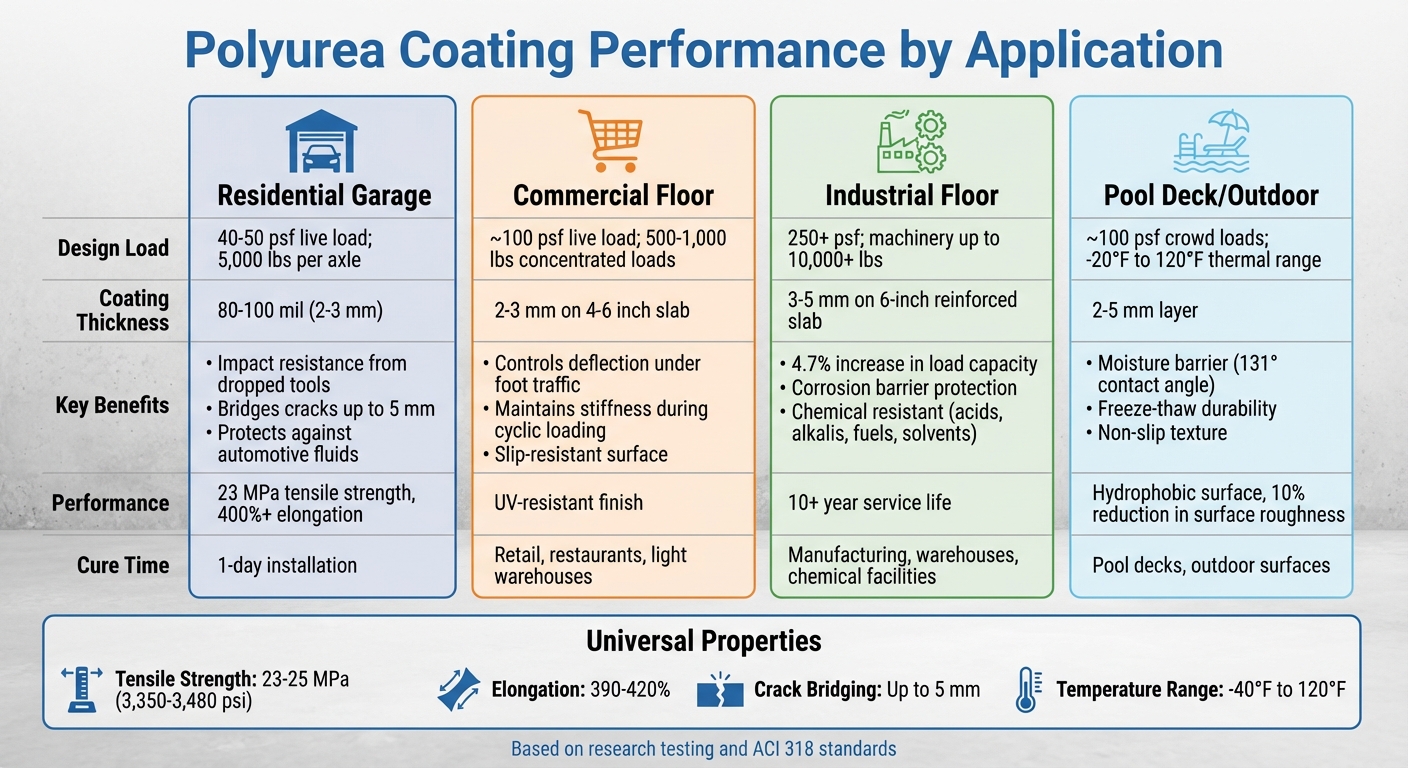
Polyurea Coating Applications and Performance Specifications by Floor Type
Design Considerations for Load-Bearing Floors
Polyurea coatings can increase bending strength by 4.7%, but they’re not a substitute for the core structural elements of a floor. Structural designs still need to adhere to ACI 318 standards, such as using 4–6-inch slabs made from 3,000–4,000 psi concrete. For commercial spaces, floors should support live loads of about 100 psf, while light industrial areas often require a capacity closer to 250 psf. A 2–3 mm layer of polyurea can bridge cracks up to 5 mm wide, minimize deflections, and protect against corrosion caused by moisture or chemicals.
Even small improvements in strength can make a big difference in serviceability. Coated floors can handle repeated load cycles at 90% of their failure load without additional deflection. This ensures the floors stay level and crack-free during regular use, even with heavy vehicle traffic or accidental impacts from tools. With a tensile strength of 23–24 MPa (3,350–3,480 psi) and an elongation range of 390–420%, polyurea coatings are designed to flex with the concrete substrate rather than cracking under stress. These principles are central to the solutions provided by Atlas Concrete Coatings.
Atlas Concrete Coatings Applications
Atlas Concrete Coatings specializes in polyurea-based chip floor coatings, offering excellent impact resistance and crack-bridging capabilities. These features make their coatings a great choice for residential garages, which often endure vehicle loads of up to 5,000 lbs per axle. Their one-day installation process uses rapidly curing polyurea, which offers over 400% elongation and strong impact resistance.
"Our floor coatings maintain surface integrity under heavy, high-friction loads. Polyurea adapts to variable loads without cracking or peeling, even under extreme forces." – Atlas Concrete Coatings
For commercial and industrial spaces, Atlas Concrete Coatings’ systems take advantage of polyurea’s ability to resist sulfuric acid, alkalis, diesel, gasoline, and solvents. Industrial floors typically feature a 3–5 mm coating applied over 6-inch reinforced slabs, creating a seamless, durable barrier that supports loads of 250+ psf while protecting against chemical exposure. Their pool deck resurfacing services use the same technology to create non-slip surfaces that resist moisture and handle temperature swings from –20°F to 120°F. This approach addresses durability concerns like freeze-thaw damage, as confirmed through testing.
The table below highlights key applications and specifications for various types of floors.
Use Case Summary Table
| Floor Type | Design Load | Polyurea Benefits | Key Specifications |
|---|---|---|---|
| Residential Garage | Approximately 40–50 psf live load; vehicle loads up to 5,000 lbs per axle | Impact resistance from dropped tools; bridges cracks up to 5 mm; protects against automotive fluids | 80–100 mil thickness; 23 MPa tensile strength; 400%+ elongation; 1-day cure time |
| Commercial Floor | Around 100 psf live load; concentrated loads of 500–1,000 lbs | Controls deflection under foot traffic; maintains stiffness during cyclic loading; provides slip resistance | 2–3 mm coating on a 4–6-inch slab; UV-resistant finish |
| Industrial Floor | Designed for loads of 250+ psf; supports machinery up to 10,000+ lbs | Tolerates cyclic loading; acts as a corrosion barrier; adds about 4.7% load capacity over uncoated concrete | 3–5 mm thick coating over a 6-inch reinforced slab; resists acids, alkalis, fuels, solvents; 10+ year service life |
| Pool Deck/Outdoor | Approximately 100 psf for crowd loads; withstands thermal cycling from –20°F to 120°F | Provides a moisture barrier with a contact angle of 131°; ensures freeze-thaw durability; delivers a non-slip texture | 2–5 mm layer; hydrophobic surface; roughly 10% reduction in surface roughness |
Conclusion
Polyurea coatings provide a reliable solution for protecting concrete surfaces and minimizing crack growth, making them an excellent choice for durable floor systems. Research highlights their effectiveness in enhancing concrete floor performance under stress, particularly in areas like crack control, impact resistance, and long-term durability. While the ultimate load improvement is modest at 4–5%, the real value lies in how polyurea preserves the concrete over time. Coated slabs can endure repeated loads without losing stiffness, bridge cracks up to 5 mm wide, and resist damage from impacts and chemical exposure. For U.S. homeowners, this translates to garage floors or pool decks that stay level, crack-free, and visually appealing for years, all while reducing maintenance needs and extending the floor’s lifespan.
These benefits go beyond just numbers on a lab report – they have practical advantages for property owners. In commercial spaces like retail stores, restaurants, and light warehouses, polyurea coatings reduce maintenance and repair demands, even in high-traffic areas. Their ability to maintain load-bearing performance under repeated impacts and cyclic loading means less downtime and safer surfaces for employees and customers alike. For industrial applications, polyurea acts as a critical protective layer, helping concrete retain its strength while resisting wear from abrasion, chemicals, and moisture over time.
Research also underscores polyurea’s durability in challenging conditions, such as freeze–thaw cycles and moisture exposure. Tests demonstrate strong adhesion and minimal degradation after repeated freezing and thawing or prolonged immersion. Its low permeability creates a barrier against water and deicing salts, crucial for preventing corrosion and spalling in colder climates. When properly installed on a well-prepared substrate – with all necessary repairs completed – polyurea consistently delivers enhanced safety, durability, and extended service life across residential, commercial, and industrial settings.
While polyurea doesn’t significantly increase structural capacity, its real strength lies in protecting the slab, controlling crack growth, and maintaining performance under heavy use and environmental stress. Companies like Atlas Concrete Coatings utilize polyurea systems alongside proper concrete repair and preparation to create durable, high-performance flooring solutions that stand the test of time.
FAQs
How does polyurea coating improve the load-bearing strength of concrete surfaces?
Polyurea coatings enhance the strength and resilience of concrete by introducing flexibility and durability. This added flexibility allows the material to absorb stress effectively, minimizing the risk of cracks even under heavy loads or constant abrasion.
Beyond strength, polyurea creates a seamless, robust layer that shields surfaces from wear and exposure to harsh elements. Its long-lasting protection makes it an excellent choice for residential, commercial, and industrial settings where durability is a top priority.
What advantages do polyurea coatings provide in challenging environments?
Polyurea coatings stand out in tough conditions thanks to their impressive durability and adaptability. They can withstand UV rays, harsh chemicals, extreme temperatures, and moisture, all while preserving the surface beneath them.
Built to endure challenging environments, these coatings offer dependable, long-term protection, cutting down on frequent repairs or upkeep. Whether for residential projects or industrial use, their broad range of applications makes them a go-to solution.
What makes polyurea coatings a better choice than traditional concrete reinforcement methods?
Polyurea coatings stand out for their exceptional strength, flexibility, and long-lasting durability, outpacing traditional options like epoxy. These coatings resist chipping, peeling, and discoloration – even when exposed to tough conditions. With a lifespan that often stretches beyond a decade, they offer a dependable, long-term way to protect and improve concrete surfaces.
What’s more, polyurea coatings are versatile enough to suit a range of applications while delivering both practical and visual advantages. Their capacity to handle heavy loads and endure extreme environments makes them a top pick for residential, commercial, and industrial settings alike.