
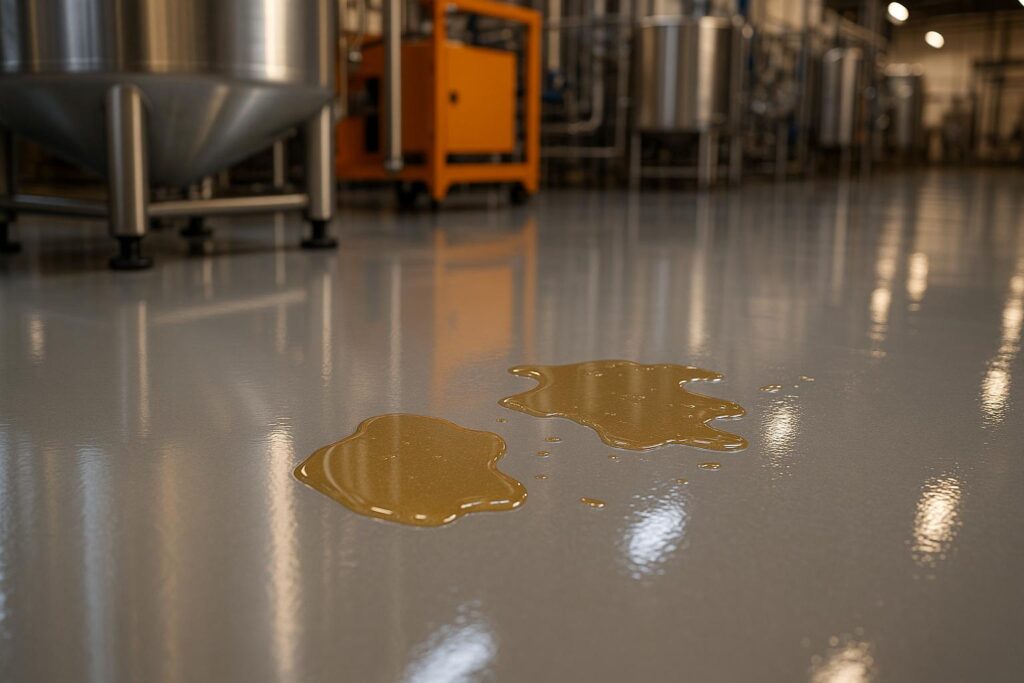
Polyurea coatings are the go-to solution for industrial floors facing harsh chemicals, heavy traffic, and extreme conditions. They outperform other coatings like epoxy and polyurethane by offering:
- Chemical Resistance: Withstand acids, alkalis, salts, and solvents without damage.
- Low Permeability: Block water, oxygen, and chloride ions to protect concrete and steel.
- Strength and Flexibility: Absorb impacts, bridge cracks up to 5 mm, and handle heavy loads.
- Thermal Stability: Perform well in extreme temperatures and resist UV degradation.
- Fast Curing: Harden in 5–120 seconds, minimizing downtime.
These coatings are ideal for industries like wastewater treatment, chemical processing, and manufacturing, providing long-lasting protection while reducing maintenance and compliance costs. With quick installation and proven durability, polyurea is a practical choice for demanding environments.
Properties of Polyurea Coatings for Corrosive Environments
Chemical Resistance
Polyurea coatings are built to withstand harsh chemical environments. Thanks to their densely crosslinked network formed by the reaction between isocyanates and amine-terminated resins, they resist hydrolysis and stand up to acids, alkalis, and salts effectively.
In industries like wastewater treatment plants and chemical facilities, where exposure to corrosive substances is routine, polyurea maintains its integrity. Unlike epoxy and polyurethane systems, which can soften or blister under such conditions, polyurea coatings remain durable. Both field applications and lab tests confirm their resilience against cleaning chemicals, disinfectants, brines, and even fuel or oil spills, ensuring long-term performance in demanding environments.
Low Permeability for Substrate Protection
When applied correctly, polyurea forms a seamless, joint-free membrane that acts as a barrier against water, oxygen, and chloride ions – key contributors to corrosion in concrete and steel. Laboratory studies using electron probe microanalysis (EPMA) on polyurea coatings for underground drilling pipes revealed no sulfate penetration through the coating layer. This performance meets the Type D corrosion‑resistant classification outlined in JIS A7502‑2:2015, showcasing its exceptional ability to block corrosive agents.
This impermeability is particularly valuable in preventing deicing salts, seawater, and industrial chemicals from reaching vulnerable materials like concrete slabs and embedded rebar. By halting these agents at the surface, polyurea coatings significantly slow down processes like carbonation, corrosion, and freeze-thaw damage. This makes them an ideal choice for protecting containment areas, loading docks, and washdown zones.
Mechanical Strength and Flexibility
Polyurea coatings combine impressive strength with flexibility. Tests show they can elongate over 350% while offering tensile strength close to 10% of structural steel. This unique combination allows the coating to absorb impacts and bridge cracks in the substrate, even spanning gaps up to 5 mm without compromising its continuity.
On industrial floors exposed to heavy forklift traffic, vibrations, temperature changes, and minor shifts in the slab, polyurea coatings excel. They prevent reflective cracking, delamination, and localized failures by absorbing stress rather than transferring it to the underlying concrete. This keeps the protective barrier intact, even under significant mechanical loads.
Thermal and Environmental Stability
Polyurea coatings are designed to perform under extreme temperature conditions. They maintain their flexibility and adhesion across a broad temperature range, even during rapid temperature changes. Unlike rigid coatings that can crack or become brittle, polyurea’s chemical structure ensures it remains tough and stable.
This makes it suitable for environments like freezer rooms operating below 32°F, areas exposed to hot washdowns, and exterior spaces subjected to intense sunlight. Furthermore, polyurea resists thermal shock and UV degradation better than many traditional coatings, ensuring long-lasting protection in both controlled and outdoor industrial settings.
Fast Curing and Reduced Downtime
One of the standout features of polyurea is its rapid curing time. Spray-applied polyurea gels within 5 to 120 seconds and can be water-ready in just 60 seconds. This quick turnaround means floors can return to light service within hours, compared to the 24 to 72 hours required by traditional epoxy or polyurethane systems.
This speed allows projects to be completed overnight or over a weekend, minimizing disruptions. For instance, specialized installers like Atlas Concrete Coatings can apply polyurea-based chip flooring systems in a single day, keeping downtime to an absolute minimum.
Performance of Polyurea Coatings in Industrial Settings
Field Studies and Case Reports
Polyurea coatings have consistently shown their worth in some of the most demanding industrial environments. For instance, a wastewater pipeline spanning 1.5 km (about 0.93 miles) and exposed to high-chloride brackish water was treated with a 2 mm (approximately 0.08 inches) polyurea anti-corrosion coating. This application not only restored the pipeline’s structural integrity but has also continued to protect it from corrosion during ongoing use.
In another example, concrete structures at a water treatment facility faced constant exposure to chlorine-based disinfectants. A 3 mm (roughly 0.12 inches) polyurea coating was applied, providing both waterproofing and corrosion resistance despite the aggressive chemical environment. These examples highlight polyurea’s reliability in protecting infrastructure in places like wastewater treatment plants, chemical processing facilities, and manufacturing floors.
Mining operations have also benefited from polyurea’s toughness. In one case, a conveyor belt received a 4–5 mm (approximately 0.16–0.20 inches) high-abrasion-resistant polyurea coating on both sides. The belt was operational again within 12 hours, and the coating extended its service life well beyond 12 months. This type of performance has made polyurea a go-to solution for areas like containment zones, loading docks, processing areas, and sumps, where heavy traffic, chemical spills, and frequent cleaning are common.
Service Life and Long-Term Durability
Polyurea’s reputation for durability is backed by both field performance and laboratory research, making it a reliable choice for long-term use in tough environments. Studies show that polyurea coatings provide superior corrosion protection compared to traditional options, even when exposed to harsh chemicals. These coatings are highly impermeable to water, oxygen, and chloride vapor and demonstrate strong resistance to electrochemical degradation. In one lab study, polyurea coatings showed no detectable penetration of sulfate ions, meeting the stringent Type D corrosion-resistant standard (JIS A7502-2:2015) for underground drilling pipes.
Real-world applications in U.S. manufacturing plants, warehouses, and automotive facilities reinforce these findings. Properly applied polyurea coatings on floors show minimal blistering or delamination, even under heavy use. Experts in corrosion prevention note that polyurea outlasts many conventional coatings, resisting underfilm corrosion and mechanical damage in environments where other systems often require frequent repairs or recoating. Facility owners often choose polyurea for its ability to deliver multi-year or even multi-decade performance, especially in high-traffic and chemically exposed areas, while reducing the need for frequent maintenance. This durability also helps facilities meet stringent U.S. spill containment standards.
Regulatory Compliance for Spill Containment
Polyurea membranes play a key role in helping facilities comply with U.S. spill containment and secondary containment regulations. Their spray-applied nature creates seamless, impermeable liners that meet EPA and state-level requirements for containing hazardous liquid spills within dikes, sumps, and containment basins.
The chemical resistance of polyurea aligns with regulations requiring containment materials to be compatible with stored chemicals and to prevent leaks into soil or groundwater. The seamless barrier it forms ensures compliance with guidelines that demand containment systems remain free of cracks or gaps that could allow leaks. Additionally, polyurea’s fast-curing properties make it ideal for retrofitting facilities with minimal downtime, enabling facilities to meet compliance deadlines without disrupting operations. U.S.-based contractors, such as Atlas Concrete Coatings, can provide installation records, product data sheets, and test results to support compliance during inspections and audits.
Akfix Polyurea Coating Technology
sbb-itb-4b4bb37
Polyurea vs. Other Industrial Floor Coatings
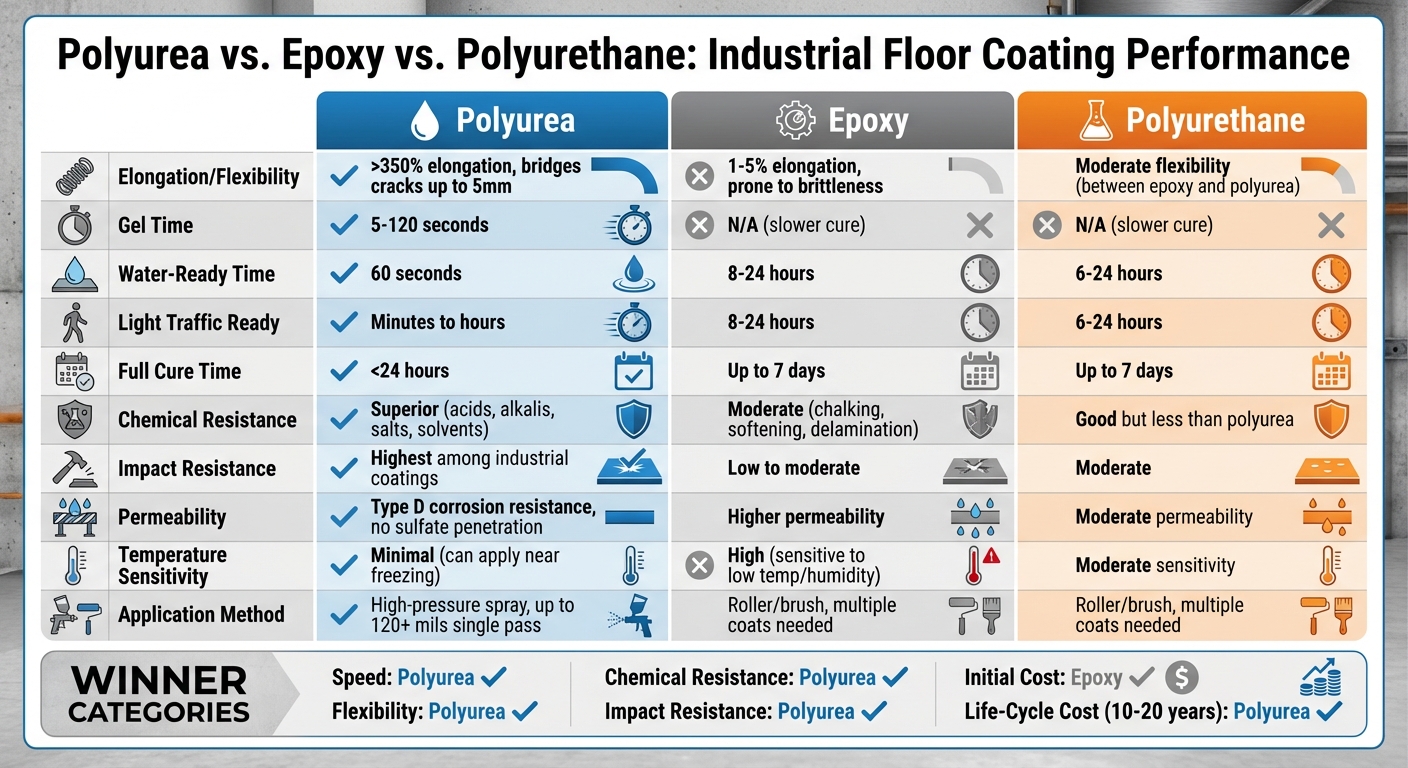
Polyurea vs Epoxy vs Polyurethane Industrial Coating Comparison
Performance Metrics Comparison
When comparing polyurea to epoxy and polyurethane, the differences in performance are striking. Research highlights that polyurea offers superior chemical resistance, lower permeability, and better impact and abrasion resistance in tough industrial settings.
One standout feature of polyurea is its impressive flexibility. With elongation rates exceeding 350%, it can bridge cracks up to 5 mm. In contrast, epoxies have a much lower elongation range of 1–5%, making them prone to brittleness. Polyurethane coatings, while more flexible than epoxy, still fall short of polyurea’s capabilities. Permeability tests further emphasize polyurea’s edge, showing its Type D corrosion resistance. This creates a seamless, low-permeability barrier that outperforms many epoxy and polyurethane systems in protecting substrates like concrete and steel from moisture and chlorides.
Impact resistance is another area where polyurea shines. It leads the pack among industrial coatings, making it an excellent choice for floors exposed to forklift traffic, dropped tools, and heavy rolling loads. Additionally, polyurea systems maintain their structural integrity even in environments with harsh chemicals like chlorides, acids, and alkalis – situations where epoxies often fail by chalking, softening, or delaminating over time.
These performance advantages also translate into practical benefits during installation.
Application and Installation Advantages
Polyurea’s quick application and curing process set it apart. It gels in just 5–120 seconds and can be water-ready in about 60 seconds. Light foot traffic is possible within minutes, and full service can resume in less than 24 hours. Compare this to standard 100% solids epoxies, which require 8–24 hours before light traffic and up to 7 days for a full chemical cure, especially in cooler temperatures. Polyurethane systems have similar limitations, needing 6–24 hours for recoating and up to 7 days for a complete cure.
This speed makes polyurea a game-changer for U.S. facilities like manufacturing plants and warehouses that can’t afford extended downtime. Entire installations can be completed during overnight or weekend maintenance windows, while epoxy or polyurethane systems often require phased work zones and longer shutdowns. Polyurea also performs well across a wider range of temperatures and humidity levels, unlike epoxies, which are more sensitive to conditions like low temperatures or high humidity. Polyurea systems can be applied even near freezing, with minimal sensitivity to moisture, thanks to their rapid reaction times.
The application process itself is highly efficient. Polyurea is applied using plural-component high-pressure, high-temperature spray equipment, which mixes the material at the spray gun to create an instant-set, seamless membrane. This allows for thick film builds – up to 120+ mils in a single pass – without sagging. This feature is particularly useful for sloped surfaces, trenches, and coved bases. In contrast, epoxy and polyurethane coatings often require multiple coats to achieve similar thickness, increasing labor costs and the risk of intercoat contamination.
Life-Cycle Cost Efficiency
Polyurea’s performance and installation benefits also lead to long-term cost savings. While the upfront material and equipment costs may be higher than those of epoxy or polyurethane, life-cycle cost analyses reveal that polyurea often provides a lower total cost of ownership. The rapid cure time minimizes downtime, which can be a major cost factor for U.S. plants where idle production lines can result in thousands of dollars in lost revenue per hour.
Polyurea’s durability further reduces long-term expenses. Its extended maintenance intervals and reduced need for resurfacing lower cumulative labor, disposal, and permit costs. Case studies on pipelines, tanks, and other infrastructure show that polyurea maintains corrosion-free surfaces for years, even in aggressive environments. For industrial flooring, its chemical resistance, crack-bridging ability, and impact toughness mean fewer repairs caused by forklift damage, thermal expansion, or chemical spills. In comparison, rigid epoxies are more likely to crack or delaminate when the substrate shifts.
Polyurea’s exceptional corrosion protection also helps prevent damage to underlying concrete or reinforcement, avoiding costly structural repairs. When factoring in operational and indirect costs – like downtime, maintenance cycles, and avoided substrate damage – polyurea often proves more economical over a 10- to 15-year period, despite its higher initial cost. Contractors in the U.S., such as Atlas Concrete Coatings, frequently use polyurea systems for garages, workshops, and industrial floors due to their fast installation, chemical resistance, and long-lasting durability. This positions polyurea as a clear upgrade for demanding environments, outperforming conventional epoxy systems.
Installation Guidelines for Industrial Polyurea Flooring
Design and Thickness Recommendations
For industrial floors exposed to corrosive chemicals, a polyurea system thickness of 60–125 mils (1.5–3.0 mm) is generally recommended. In lighter-use areas, such as storage or light-duty processing zones, 40–60 mils may suffice. However, for tougher environments like chemical loading zones, secondary containment areas, or wastewater treatment facilities, 80–125 mils is often necessary. Adjusting the thickness at critical points – like joints, drains, and terminations – can improve durability. Extending the polyurea coating 4–6 inches up walls and around equipment pads also enhances containment and simplifies cleaning.
Slip resistance is another key consideration, determined by factors like wet conditions, chemical exposure, and traffic type. To achieve the appropriate grip, installers typically broadcast silica sand, aluminum oxide, or quartz into the wet polyurea at a rate of 3–6 pounds per 100 square feet. This is then sealed with a clear or pigmented topcoat to meet OSHA and ASTM standards for wet work areas. Fine or medium quartz is often used in areas where cleanliness is critical, while coarser aggregates are preferred in high-traffic zones, ramps, or areas prone to oils and grease.
Control and expansion joints are typically preserved and sealed with elastomeric joint materials that work with the polyurea system. At doorways, drains, and sumps, installers should use saw-cut keyways or chases to secure the polyurea to the concrete, preventing peeling under heavy traffic.
Concrete Surface Preparation
Proper surface preparation is crucial for ensuring the polyurea system adheres effectively. Most specifications follow ICRI Guideline 310.2R, aiming for a concrete surface profile (CSP) of 3–5, depending on the polyurea’s thickness. Techniques like shot blasting or diamond grinding are used to remove laitance, coatings, oils, and other contaminants. Afterward, vacuuming ensures a clean, dry substrate. Many manufacturers also require concrete compressive strength of at least 3,500 psi and pull-off adhesion tests (ASTM D4541) to confirm a bond strength of 200–300 psi before installation.
Moisture testing is typically conducted using ASTM F2170 in-situ relative humidity tests or ASTM F1869 calcium chloride tests to measure vapor emission rates and internal humidity levels. If results exceed the coating’s limits, moisture mitigation strategies – like epoxy or polyurethane vapor barriers – may be necessary, or the system may need adjustment to handle higher vapor levels. Structural repairs should come first, addressing unsound concrete, filling cracks, and rebuilding spalls with compatible materials. In areas with oil or chemical contamination, aggressive cleaning, scarification, or even replacing the top concrete layer may be required to prevent adhesion failures or osmotic blistering under the polyurea.
Cost and Installation Benefits
Polyurea offers a rapid cure time, making it possible to resume foot traffic within hours and full industrial operations within 24 hours. This quick turnaround minimizes downtime, which is a critical advantage in industrial settings. Facilities can avoid prolonged shutdowns, saving on rerouting, storage, and overtime costs.
Although the initial cost of polyurea is higher, its durability and low maintenance requirements often make it more economical over time. Studies show that its resistance to chemicals, impacts, and heavy traffic reduces the need for frequent repairs or recoating, cutting down on unexpected shutdowns and maintenance costs. Over a 10–20 year period, when factoring in labor, downtime, and disposal of failed coatings, polyurea systems often prove to be a more cost-effective solution.
Facility managers are advised to hire certified installers with experience in corrosive environments and references from similar projects. Companies like Atlas Concrete Coatings offer one-day or weekend installations, allowing facilities to resume operations quickly. This is especially beneficial for 24/7 operations, where even a single day of downtime can result in significant financial losses.
These guidelines highlight how polyurea’s performance characteristics can deliver both operational efficiency and long-term economic benefits in demanding industrial environments.
Conclusion
Research and practical applications demonstrate that polyurea coatings perform exceptionally well in harsh industrial environments. With their strong chemical resistance, low permeability, impressive mechanical strength, and quick curing times, these coatings provide reliable protection for concrete surfaces against acids, alkalis, chlorides, and solvents. This combination not only minimizes downtime but also helps cut maintenance expenses. Whether used in wastewater pipelines, chemical plants, or manufacturing facilities, polyurea coatings have shown they can extend service life and significantly reduce corrosion-related damage, making them a cost-efficient choice over 10–20 years.
For U.S. facilities grappling with aggressive chemicals, heavy equipment traffic, and tight operational schedules, polyurea coatings offer a practical solution. They form a durable, impermeable barrier that complies with spill containment and safety regulations. Plus, their rapid curing – often allowing operations to resume the same day – means less frequent recoating and fewer structural repairs, keeping businesses moving efficiently.
FAQs
What makes polyurea better than epoxy for chemical resistance and durability?
Polyurea offers a clear advantage over epoxy in terms of chemical resistance and durability. It’s tougher, more flexible, and built to withstand harsh conditions, making it a go-to choice for corrosive industrial environments. Unlike epoxy, polyurea is far better at resisting chipping, peeling, and discoloration, ensuring it holds up longer even in extreme settings.
What really sets polyurea apart is its flexibility. This quality allows it to adjust to surface movement without cracking, delivering a protective floor coating that stays intact and dependable in high-stress environments.
Why is polyurea’s fast curing time beneficial for industrial environments?
Polyurea’s quick curing time is a game-changer for industrial settings, helping to shorten project timelines and limit operational downtime. This allows businesses to get back to full productivity faster, which can make a big difference in high-demand environments.
Its rapid application and curing process make it especially well-suited for time-sensitive spaces like factories, warehouses, and other busy facilities. Beyond just saving time, this efficiency also cuts down on labor costs, offering a practical and budget-friendly option for industrial flooring projects.
Why is polyurea a smart investment despite its higher upfront cost?
While polyurea coatings might come with a higher upfront price, they’re a wise choice thanks to their impressive durability and extended lifespan, often exceeding a decade. These coatings are tough against chipping, peeling, and discoloration, which means you won’t have to worry about constant repairs or replacements.
In the long run, this resilience leads to reduced maintenance expenses and minimal interruptions to daily operations. Whether it’s for industrial, commercial, or residential use, polyurea coatings prove to be a cost-efficient option over time.