

Concrete dust isn’t just messy – it’s dangerous. Breathing in silica particles from grinding or cutting concrete can lead to life-threatening diseases like silicosis and lung cancer. OSHA mandates strict dust control measures, including high-efficiency vacuums with HEPA filters, to protect workers and avoid hefty fines. Here’s what you need to know to pick the right vacuum:
- HEPA Filtration: Required to trap 99.97% of particles as small as 0.3 microns. This ensures harmful silica dust doesn’t escape into the air.
- Airflow (CFM): Match your vacuum’s airflow to your tool size and project area. Example: A 7-inch grinder needs at least 175 CFM.
- Water Lift: Look for 80–120 inches for strong suction, especially with HEPA filters.
- Automatic Filter Cleaning: Keeps suction consistent by preventing clogs.
- Electrical Needs: Most vacuums require 115V/20-amp circuits; larger ones may need 220V or propane power.
- Durability and Mobility: Choose a vacuum with a sturdy frame, crush-resistant hoses, and easy-to-move wheels for job site conditions.
Proper dust control not only ensures safety but also improves surface preparation for coatings like polyurea or epoxy. Always prioritize compliance with OSHA standards to protect workers and avoid penalties.
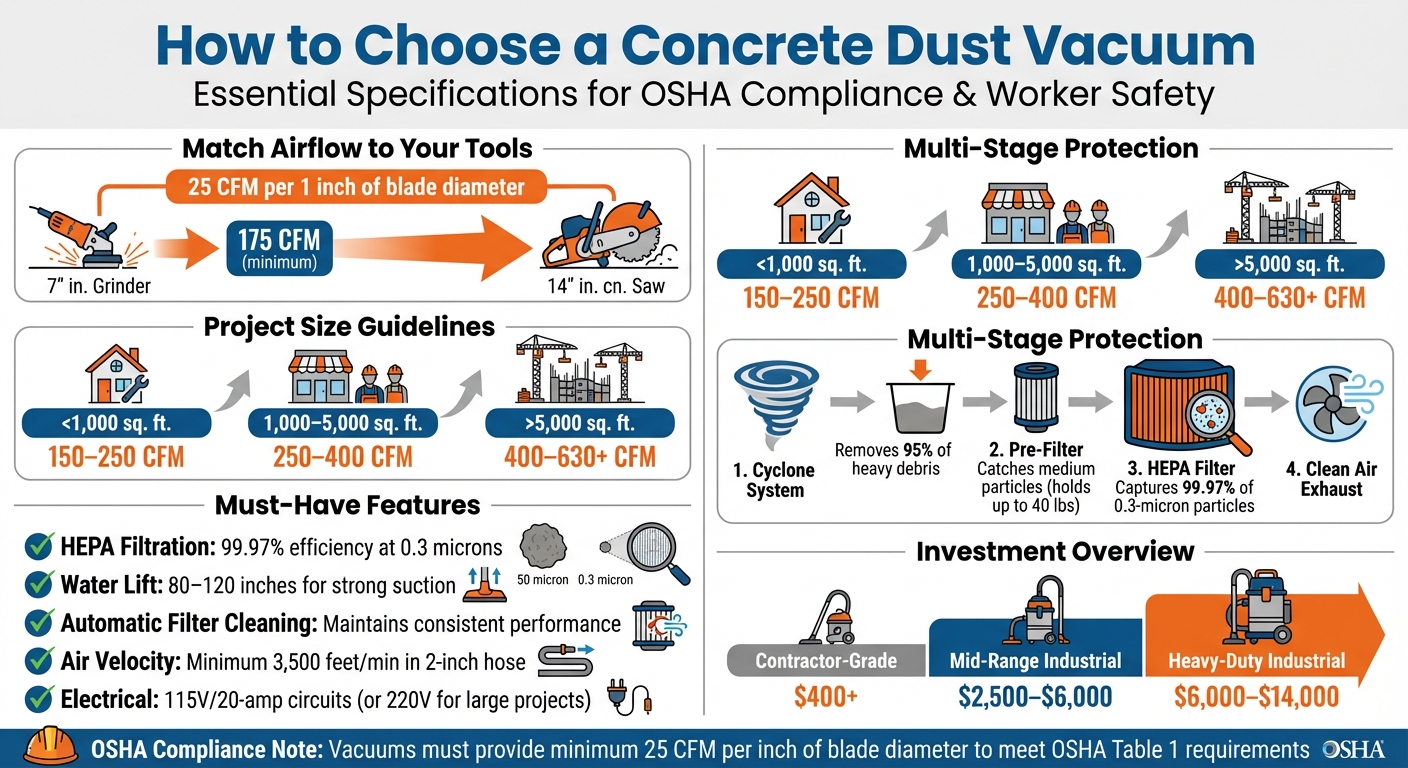
Concrete Dust Vacuum Selection Guide: CFM Requirements by Project Size and Tool Type
Wet/Dry Concrete Dust Vacuums | Automatic Cleaning & Power Take-Off
sbb-itb-4b4bb37
Power and Performance Specifications
When choosing a vacuum for silica dust, focus on two key technical specs: airflow (CFM) and water lift. These measurements are critical in ensuring worker safety and effective dust collection.
Airflow (CFM) and Suction Strength
Airflow, measured in cubic feet per minute (CFM), indicates how much air the vacuum moves. For handling concrete dust, higher CFM is essential to capture fine silica particles and maintain suction across large areas. A general rule of thumb: you need 25 CFM for every 1 inch of blade diameter. For example, a 7-inch grinder requires at least 175 CFM, while a 14-inch saw needs 350 CFM.
The size of your project also dictates the necessary CFM:
- Small jobs (<1,000 sq. ft.): 150–250 CFM
- Medium projects (1,000–5,000 sq. ft.): 250–400 CFM
- Large commercial sites (>5,000 sq. ft.): 400–630+ CFM
Insufficient airflow can cause dust to settle in hoses or escape the collection system. To avoid clogs, ensure a minimum air velocity of 3,500 feet per minute in a 2-inch hose.
After airflow, evaluate water lift and motor strength to maintain performance under heavy filter resistance.
Water Lift and Motor Specifications
Water lift measures suction power, showing how effectively the vacuum pulls debris through dense HEPA filters. Measured in inches of water column (inH2O), a range of 80–120 inches is ideal for surface preparation work. As Josh Locke from Bartell Global explains:
"Water lift gets it going, and CFM keeps it moving. There is a dependence between the two."
High water lift is especially important because HEPA filters can reduce airflow by up to 30%. Industrial vacuums often rely on powerful motors to handle this. Smaller units might use 17-amp motors, while heavy-duty models may feature multiple independent motors or propane engines delivering 17 horsepower.
Electrical Requirements
The vacuum’s electrical setup is just as important as its mechanical specs. Commercial dust extractors typically run on 115V single-phase power, drawing 20 amps. This can be an issue on job sites, as standard residential outlets are only rated for 15 amps. To avoid breaker trips or fire hazards, always use dedicated 20-amp circuits.
High-performance vacuums often include 20-amp plug configurations that prevent use with lower-rated outlets, ensuring safe operation. For larger projects over 5,000 square feet, consider 220V systems or propane-powered models to achieve the necessary CFM levels. On remote sites without reliable electricity, portable generators or pneumatic vacuums powered by compressed air may be required.
Filtration Systems and Standards
The filtration system in your vacuum determines whether it effectively protects workers or just redistributes hazardous dust. A solid filtration system is just as important as high airflow when it comes to controlling concrete dust safely. HEPA filters are a must – they capture 99.97% of particles as small as 0.3 microns. Standard shop vacuums, on the other hand, often allow microscopic silica particles to escape, which can compromise air quality.
Concrete and mortar can contain anywhere from 25% to 70% silica. These silica particles are usually 3 microns or larger, making them far too small to see with the naked eye (visual detection typically requires particles to be 40–50 microns). To ensure a safe work environment, components like HEPA filters, automatic cleaning systems, and pre-filters with cyclone systems work together to trap and contain these harmful particles.
HEPA Filter Requirements
When choosing a HEPA filter, ensure it’s individually tested and serialized to meet the 99.97% efficiency standard at 0.3 microns. Why 0.3 microns? It’s the size of the most penetrating particles, which are the hardest to capture. The HEPA filter should be the final stage in your system, ensuring that no fine dust escapes before the air is released back into the workspace.
Vacuums equipped with HEPA filtration can reduce respirable silica concentrations by up to 99% compared to grinding without dust control measures. However, the system must be airtight, meaning all exhaust air must pass through the filter without leaking through seals or gaskets.
Automatic Filter Cleaning
Silica dust can quickly clog filters, reducing suction power and efficiency. That’s where automatic cleaning systems come in. Technologies like reverse pulse or jet pulse cleaning use air to flush filters clean during operation. This keeps airflow consistent and ensures the vacuum performs effectively without requiring frequent manual cleaning.
OSHA recommends vacuums with back-pulse filter cleaning cycles to improve dust collection. These systems can also extend the life of HEPA filters by preventing dust from embedding deeply into the pleats. For heavy grinding tasks, automatic cleaning reduces both labor costs and downtime. One important tip: never use compressed air to blow out a HEPA filter, as it damages the fibers and reduces its efficiency.
Pre-Filters and Cyclone Systems
A multi-stage filtration system helps protect your HEPA filter and keeps suction strong throughout the day. Cyclone systems use centrifugal force to spin dust-filled air, separating heavier particles and directing them into a collection chamber. This process can remove up to 95% of debris before it even reaches the main filters.
Pre-filters add another layer of protection by catching medium-to-heavy particles that slip through the cyclone stage. Some micro pre-filter bags can hold up to 40 pounds of concrete dust, significantly reducing the strain on your HEPA filter. As Marcus Turek, North American Sales Manager at Sase Co., aptly states:
"Any vacuum is only as good as its filter system."
Construction and Mobility
Once power and filtration needs are sorted, the vacuum’s construction and mobility become key factors in determining how well it performs on busy job sites. A vacuum designed for concrete work must be tough enough to handle abrasive dust and the physical challenges of the environment. Beyond achieving the right CFM and water lift, a rugged build ensures the vacuum can endure heavy use. Models with all-metal construction, galvanized or powder-coated components, and durable steel frames – or reinforced housings – fare much better under such demanding conditions. As Bryon Bruington, Technical Sales Director at Kut-Rite Manufacturing Co., wisely points out:
"Contractors should put as much thought into choosing and maintaining their vacuum as they do into their grinders or diamond-blade saws."
Frame and Wheel Construction
A vacuum’s frame and wheels play a big role in its stability and ease of movement. High-strength swiveling and locking casters provide balance on uneven surfaces, while sturdy wheels make it easier to roll over cords and debris. For industrial dust extractors weighing around 200 lbs, a wide-stance dolly or an ergonomic cart with oversized handles simplifies transportation. Many frames also come with built-in storage trays and cable holders to keep attachments secure during transit. Extended warranties on the housing can also signal a design built to last.
Hose Length and Dust Collection Systems
Durable, crush-resistant hoses are a must for reaching work areas without losing suction power. A high water lift – preferably over 90 inches – prevents abrasive concrete dust from settling in the hose before it reaches the collection tank. Continuous bagging systems, like Longopac solutions, make dust disposal more efficient by sealing bags and containing harmful cement fines and respirable silica, all while minimizing downtime. Beyond hose specs, the unit’s weight and maneuverability also influence how well it integrates into daily operations.
Weight and Maneuverability
A vacuum’s weight directly affects how easily it can be moved around the job site. Portable HEPA vacuums, weighing as little as 32 lbs, are perfect for patch repairs or projects involving multiple levels. On the other hand, heavier units – exceeding 200 lbs – offer greater capacity for continuous grinding but require heavy-duty carts with large wheels to prevent tipping or getting stuck. Smaller vacuums are better suited for tight spaces, while larger ones excel in open areas. This balance ties back to performance and filtration needs, ensuring the vacuum can meet all demands on-site. As Marcus Turek, North American Sales Manager at Sase Co., aptly states:
"You can never have a vacuum that is too big and powerful, but you can definitely have one that is too small."
Matching Vacuums to Your Work
Tool and Project Compatibility
Once you’ve considered power and filtration, the next step is ensuring your vacuum matches your specific tools and project needs. A quick calculation to determine the minimum airflow requirement is to multiply the largest blade diameter of your tool by 25. For example, grinders typically require airflow ranging from 175 to 250 CFM, depending on their blade size. To maximize dust collection, make sure your vacuum connects directly to your tool’s dust extraction port – this captures the dust right at the source.
The size of your project also plays a big role in choosing the right vacuum. For smaller projects under 1,000 square feet, a vacuum with 150–250 CFM is usually enough. Medium-sized projects (1,000–5,000 square feet) often need 250–400 CFM, while large commercial spaces over 5,000 square feet may demand 400–630+ CFM. If you’re working outdoors or at sites with limited power access, propane-powered vacuums can provide the mobility and higher CFM needed for such environments. Picking the right vacuum not only improves your tool’s performance but also ensures compliance with OSHA’s airflow standards.
OSHA Airflow Compliance
OSHA has clear guidelines when it comes to airflow: at least 25 CFM per inch of blade diameter for grinders and saws. This airflow is critical for controlling dust safely. For context, a single pass with a grinder can raise silica dust levels to 400 µg/m³ – eight times OSHA’s 8-hour limit of 50 µg/m³. To maintain proper airflow throughout the day, your vacuum should have a HEPA filter capable of capturing 99.97% of particles as small as 0.3 microns, along with an automatic filter-cleaning system. Without this cleaning feature, dust buildup can reduce suction, making it harder to meet OSHA’s airflow requirements.
A study by the University of Iowa’s College of Public Health highlighted this issue. Vacuums that relied solely on bags saw their airflow drop from 80 CFM to as low as 30 CFM as debris collected. In contrast, cyclonic systems maintained airflow above 70 CFM, even as the workload increased. This underscores the importance of using the right vacuum system for consistent performance and safety.
Surface Preparation for Floor Coatings
When it comes to applying floor coatings like polyurea or epoxy, proper dust control during surface preparation is critical. Any leftover dust can act as a barrier, preventing the coating from bonding effectively to the concrete surface. According to Atlas Concrete Coatings, thorough surface preparation – supported by cyclonic pre-separation – ensures the best adhesion and long-lasting results. If you notice visible dust trails behind your grinder, it’s a sign your vacuum isn’t keeping up, which could lead to coating failure.
Atlas Concrete Coatings, known for its polyurea-based chip floor coatings, emphasizes the importance of clean surfaces for residential, commercial, and industrial projects. Their quick-install systems rely on vacuums with cyclonic pre-separation, which can remove up to 90% of heavy debris before it reaches the filter. This helps maintain strong suction and ensures the concrete surface is clean enough for coating application. Additionally, systems like Longopac make bag changes dust-free, reducing the risk of reintroducing fine silica particles into the workspace before the coating is applied. Proper dust control not only sets the stage for a successful coating application but also ensures the durability of the finished surface for years to come.
Conclusion
Vacuum Selection Checklist
When choosing a vacuum, keep these essential factors in mind: HEPA filters should capture 99.97% of particles as small as 0.3 microns. Match the airflow (CFM) to your project size for optimal performance: 150–250 CFM is ideal for spaces under 1,000 square feet, 250–400 CFM works for medium-sized projects, and 400–630+ CFM is necessary for larger commercial areas exceeding 5,000 square feet.
Look for vacuums with automatic filter-cleaning mechanisms like pulse-back or reverse-blast systems to maintain consistent suction throughout the day. As Ben Kruse, Marketing Director at Pulse-Bac Vacuums, explains:
"I’d make sure I have an automatic filter-cleaning mechanism because I wouldn’t want to fail a PEL (permissible exposure limit) test because one of my employees forgot to clean the filters like he should".
Ensure the vacuum complies with OSHA Table 1 requirements, which mandate at least 25 CFM per inch of blade diameter. Additionally, check that your job site provides the necessary electrical voltage (230V/480V) to power the equipment.
Cost considerations vary: contractor-grade HEPA vacuums start around $400, while industrial systems can range from $2,500 to $14,000. By adhering to these guidelines, you’ll not only meet OSHA standards but also achieve effective dust control, protecting workers and improving surface preparation for longer-lasting coatings.
Professional Floor Coating Services
Selecting the right vacuum is a crucial step in achieving superior floor coatings. Effective dust control during surface preparation isn’t just about safety – it directly impacts coating adhesion. Any leftover dust can act as a barrier, weakening the bond between the concrete and the coating. Companies like Atlas Concrete Coatings follow these standards to deliver durable, high-quality installations. Their polyurea-based chip floor coatings rely on meticulously cleaned, dust-free surfaces to ensure both strength and aesthetic appeal in residential, commercial, and industrial applications.
Whether you’re preparing a garage floor, pool deck, or an industrial space, pairing the right vacuum system with professional installation ensures a long-lasting result. Atlas Concrete Coatings’ streamlined installation process and careful attention to surface preparation offer not only stunning floors but also durable, low-maintenance surfaces. Visit Atlas Concrete Coatings to learn more about their services and the role of proper preparation in creating exceptional concrete coatings.
FAQs
Do I need a HEPA vacuum for concrete dust?
Using a HEPA vacuum is a smart choice for managing concrete dust. These vacuums are designed to capture respirable crystalline silica, which can pose serious health risks if inhaled. By using a HEPA filter, you can trap even the finest particles, ensuring better dust control and helping you stay compliant with OSHA safety standards.
How do I size a dust vacuum to my grinder or saw?
To choose the right dust vacuum for your grinder or saw, focus on suction power, filtration capability, and the amount of dust produced. Opt for a vacuum equipped with a HEPA filter, which can trap particles as tiny as 0.3 microns. Make sure the vacuum provides sufficient airflow and motor strength to manage debris efficiently without frequent clogs. Always align the vacuum’s specs with the dust output of your tool for proper dust control.
Why does my vacuum lose suction during grinding?
When your vacuum loses suction while grinding, it’s often because the filters are clogged with debris. This blockage reduces airflow and makes it harder for the vacuum to work efficiently. To keep your vacuum performing well, especially when dealing with concrete dust, make it a habit to clean or replace the filters regularly. This simple step can go a long way in maintaining strong suction and overall effectiveness.