

Looking to make your industrial floors safer? Choosing the right slip-resistant coating is critical for preventing accidents, meeting safety regulations, and ensuring long-term durability. Here’s a quick breakdown of five popular coating options – epoxy, polyurethane, polyurea, rubberized, and quartz-based – along with their key features:
- Epoxy: Durable and cost-effective but requires additives for traction and can crack under surface movement. Best for heavy-duty areas.
- Polyurethane: UV-resistant and flexible, making it ideal for outdoor spaces. Needs additives to improve slip resistance.
- Polyurea: Fast curing, highly resistant to UV damage, and flexible. Great for minimizing downtime and handling surface shifts.
- Rubberized: Naturally slip-resistant and comfortable, though less durable in environments exposed to oils or fats.
- Quartz-Based: Offers excellent traction and durability with a textured surface, but comes with higher upfront costs.
Quick Comparison
| Coating Type | Slip Resistance | Durability (Years) | Cure Time | Cost per Sq. Ft. |
|---|---|---|---|---|
| Epoxy | High (with additives) | 5–10 | 24–72 hours | $3–$7 |
| Polyurethane | Moderate | 10–15+ | 2–3 days | $6–$10 |
| Polyurea | High | 15–20+ | Minutes | $6–$12 |
| Rubberized | Naturally high | Good (varies) | Moderate | Varies |
| Quartz-Based | High (textured) | 25+ | 24 hours (foot traffic) | Higher upfront |
Key takeaway: The best coating depends on your specific needs – whether it’s durability, safety, UV resistance, or speed of application. Each option has strengths and trade-offs, so consider factors like traffic levels, exposure to chemicals, and maintenance requirements when making your decision.
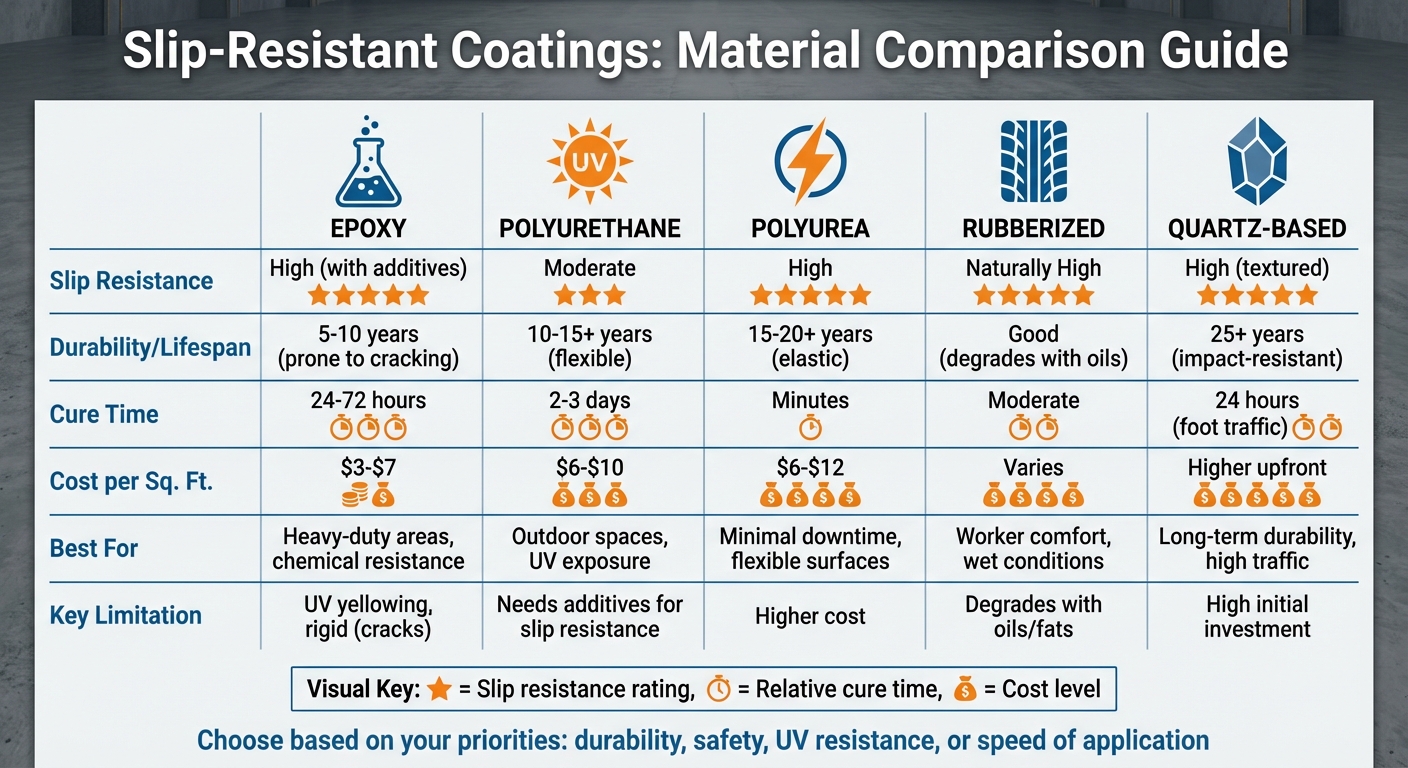
Slip-Resistant Coating Comparison: Epoxy vs Polyurethane vs Polyurea vs Rubberized vs Quartz
Epoxy, Polyurea or Polyaspartic : Which is the BEST garage floor coating?
sbb-itb-4b4bb37
1. Epoxy Coatings
Epoxy coatings are a reliable choice for industrial floors, offering strong protection against heavy machinery, chemical spills, and high traffic. Their slip resistance can be adjusted by adding textures or incorporating materials like flake, chip, or quartz to meet specific site needs.
Slip Resistance
By default, epoxy creates a smooth surface, which can become slippery when wet. Adding texture significantly boosts slip resistance. These finishes can range from light to highly coarse, making them ideal for areas prone to oils, spills, or other liquids with high viscosity. Sherwin-Williams highlights this versatility:
"Our slip resistant flooring and coatings come in a variety of finishes, from the very mild to coarser textures, and are installed according to your specific needs."
For cost-effective solutions, sand or aluminum oxide aggregates can be used, with sizes ranging from 220 to 46 mesh. This customization allows users to match the slip resistance to the level of traffic, enhancing safety without compromising the coating’s durability.
Durability
Epoxy coatings are built to handle demanding environments. The most durable versions are 100% solids systems, which cure to their full thickness without losing volume. In contrast, water-based epoxies, which contain 30%–40% solids, shrink as they dry. Slip Free Systems explains:
"100% solids will yield 100% dried material after the floor coating fully cures. For instance, 50% volume solids will yield 50% of the thickness after the floor coating fully dries."
These coatings can range in thickness from 3 mils to over 25 mils, making them suitable for foot traffic as well as rubber and steel wheel loads. However, they are not without limitations. Exposure to UV light can cause yellowing (ambering), and their rigidity may lead to cracking on substrates that move frequently, such as elevated ramps. This inflexibility can also result in brittleness under stress.
Application Time
Epoxy coatings require a continuous "wet edge" application to ensure a seamless finish. Proper surface preparation is critical to avoid issues like scratches, abrasion, or "hot tire pick up." On a speed scale of 1 (slow) to 5 (fast), epoxy installation typically falls between 2 and 4, depending on the system. While this moderate pace takes time, it ensures a high-quality, defect-free result.
Cost
Among resinous flooring systems, epoxy stands out as one of the most budget-friendly options. On a cost scale of 1 (low) to 5 (high), standard epoxy scores a 2 for both installed and life-cycle costs. This makes it much cheaper than alternatives like polyurea (rated 5) or urethane (rated 3) while still delivering excellent durability in areas exposed to chemicals. Though higher-end options like epoxy mortar or epoxy terrazzo are more expensive, standard broadcast epoxy remains an economical solution for most industrial settings.
2. Polyurethane Coatings
Polyurethane coatings act as a UV-resistant, flexible top layer that complements epoxy’s sturdy foundation, effectively preventing yellowing caused by sunlight exposure. This combination creates a strong, adaptable surface, setting the stage for customized traction solutions.
Slip Resistance
Much like epoxy, polyurethane forms a smooth, non-porous surface that can become slippery when wet. On its own, it lacks traction and requires additives to improve slip resistance. Thanks to its thinner application layer, polyurethane works well with fine stir-in polymer beads like Shark Grip or Gator Bite. These lightweight additives are perfect for low-maintenance spaces such as showrooms. For areas needing heavier traction, aluminum oxide can be broadcast onto the surface, though this comes with a trade-off in ease of cleaning. As John Barnett of Roe Painting explains:
The more anti-skid or aggregate you put in the actual finish, the more it’s going to change the look of the floor.
Durability
Polyurethane shines when it comes to UV stability and flexibility, making it a top choice for spaces exposed to sunlight. Unlike epoxy, it won’t yellow, chalk, or fade, which makes it particularly well-suited for outdoor industrial areas or spaces with abundant natural light. Its flexibility – 98–100% greater than standard epoxy – allows it to handle temperature swings from -40°F to 104°F without cracking. This adaptability also helps prevent delamination, a common issue with rigid epoxy on moving surfaces like ramps or loading docks. Beyond flexibility, polyurethane resists abrasion, impacts, and chemical spills, all while requiring less upkeep than epoxy systems.
Application Time
Polyurethane’s durability comes with the added benefit of a faster cure time, which helps minimize downtime. While an epoxy base is still necessary, polyurethane cures more quickly, cutting total installation time to 2–3 days. However, it has a shorter pot life – around 30 minutes – making experienced installers essential for larger projects. This quicker cure time is especially valuable in industrial settings, where every hour of closure can lead to significant costs.
Cost
A standard epoxy system with a polyurethane topcoat typically costs between $3 and $7 per square foot installed. While polyurethane adds a slight premium compared to epoxy-only systems, its lower maintenance needs and extended lifespan often make it a worthwhile investment. Product prices vary, ranging from approximately $46 per liter for basic formulations to about $450 for specialized two-pack systems. Its balance of cost and performance makes it an excellent choice for industrial applications.
3. Polyurea Coatings
Polyurea has made a name for itself in industrial floor coatings, standing out for its impressive UV stability, which outperforms traditional epoxy systems. It’s especially valued in environments where minimizing downtime is a top priority.
By combining the strengths of epoxy and polyurethane systems, polyurea coatings offer an added edge with their quick curing times.
Slip Resistance
Polyurea coatings are generally thinner than epoxy coatings. This difference in thickness impacts their ability to embed aggregates. Epoxy’s thicker layer allows for embedding heavier aggregates like quartz or flake, which enhances traction. To get the best of both worlds, polyurea is often applied as a topcoat over an epoxy base. This hybrid method takes advantage of the textured surface created by epoxy while benefiting from polyurea’s quicker curing process.
Durability
One major advantage of polyurea is its resistance to UV damage. Unlike epoxy, which can yellow or "amber" over time when exposed to sunlight, polyurea retains its original color. Its flexibility also makes it less prone to cracking on surfaces that experience movement, such as elevated ramps or loading docks. This combination results in a finish that’s both long-lasting and low-maintenance.
By pairing this durability with rapid curing, polyurea coatings help reduce facility downtime significantly.
Application Time
What truly sets polyurea apart is its fast curing time compared to traditional epoxy systems. For instance, Atlas Concrete Coatings utilizes polyurea-based chip floor coatings to provide durable solutions with quick installation across various industries. While project timelines can vary, this speed advantage often means installations are completed much faster than with epoxy-only systems.
4. Rubberized Coatings
Rubberized coatings stand out for their natural high-traction properties, delivering reliable slip resistance even in wet conditions without needing extra additives. Compared to epoxy, polyurethane, and polyurea coatings, rubberized options offer a unique blend of features, especially in terms of safety and comfort. These coatings are typically assessed based on slip resistance, durability, application time, and cost.
Slip Resistance
One of the biggest strengths of rubberized coatings is their ability to maintain consistent traction, even when wet. This is a natural characteristic of rubber, making it a go-to choice for environments where safety is critical. On a 5-point scale, rubberized flooring scores a solid 4 for slip resistance, outperforming standard sheet vinyl (2) and equaling or surpassing polished concrete (3 to 4).
Durability
Rubberized coatings are rated as "Good" in durability. While they don’t match the "Excellent" rating of epoxy, they are still well-suited for many industrial applications. They offer strong impact resistance and provide a softer, more comfortable surface underfoot – an advantage for workers who spend long hours on their feet. However, rubberized coatings are less suitable for environments exposed to oils or fats, as these substances can degrade the material over time. In ideal conditions, maintenance is straightforward.
Application Time
Installing rubberized coatings requires moderate expertise, with a difficulty rating of 2 to 3 on a 5-point scale. This makes them manageable for professionals while still demanding some level of skill.
Cost
Rubberized coatings come with a relatively high upfront cost, scoring 4 out of 5 in terms of initial expense. They are pricier than standard epoxy coatings (2/5) but less expensive than polyurea (5/5). Over the long term, their costs are rated as moderate (3/5). While the initial investment may seem steep, the benefits – such as easier maintenance, enhanced worker comfort, and noise reduction – can make them a worthwhile choice for certain industrial settings.
5. Quartz-Based Coatings
Quartz-based coatings provide a high-quality option for industrial floors, combining durability, slip resistance, and longevity. These coatings achieve their textured surface by embedding finely graded quartz particles into a resin base, such as polyurea or epoxy. This design helps disperse moisture, oils, and debris, reducing the risk of slippery surfaces. The level of traction can also be adjusted by varying the size and density of the quartz particles.
Slip Resistance
Quartz coatings strike a balance between grip and ease of cleaning. Their medium texture provides excellent traction without making maintenance overly complicated. As John Barnett, Concrete Coating Division Lead at Roe Painting, notes:
I don’t believe it [traction additives] would ever reduce the durability of the coating… If anything, the more we put in, the more wear and tear it’ll take.
This makes quartz coatings ideal for industrial environments where both safety and routine cleaning are priorities. Medium-grade quartz aggregate offers enough grip to prevent slips while still allowing for standard cleaning methods like mopping.
Durability
Quartz flooring is built to last. The quartz particles, embedded in a tough, non-porous matrix, can handle heavy loads, high foot traffic, and even impacts from dropped objects without cracking or denting. These coatings also resist chemicals, thermal shocks, and UV exposure, ensuring that colors won’t fade in areas exposed to sunlight. With a lifespan exceeding 25 years, quartz-based coatings outlive options like vinyl flooring, which typically lasts only 10 to 20 years, making them a smart long-term investment.
Application Time
One advantage of quartz systems is their relatively quick curing process. Installation involves preparing the substrate, applying a basecoat with quartz broadcasting, and finishing with a topcoat. While the floor can handle foot traffic within 24 hours, it reaches full chemical cure in 4 days. This faster curing time helps minimize downtime in busy commercial or industrial spaces.
Cost
Quartz-based coatings come with higher upfront costs, but they deliver strong value over time. Their long lifespan and minimal maintenance needs reduce the frequency of replacements and ongoing expenses, making the initial investment worthwhile. However, proper preparation of the substrate – such as cleaning, repairing cracks, and leveling – is crucial to ensure the coating’s durability and performance.
With their distinctive features, quartz-based coatings offer a premium solution for environments that demand durability, safety, and efficiency. The next section will help weigh these benefits against potential drawbacks.
Advantages and Disadvantages
Choosing the right coating material comes down to weighing the pros and cons. The best option depends on your priorities – whether it’s slip resistance, durability, quick application, or budget. Here’s a breakdown of how different materials perform across key factors.
Epoxy stands out for its excellent chemical resistance and hard, durable surface, costing between $3–$7 per square foot. However, its smooth finish requires additives to improve traction, and its rigidity makes it vulnerable to cracking on surfaces that flex or shift. There’s also a downside when it comes to UV exposure. As Slip Free Systems, Inc. explains:
Epoxy is not resistant to ultraviolet light so the products with epoxy often change color or amber over time.
Polyurea is known for its lightning-fast cure times and flexibility, which helps it bridge cracks in concrete. Although it’s more expensive – ranging from $6–$12 per square foot – its durability and quick application make it a go-to for facilities needing minimal downtime.
Rubberized coatings naturally provide high traction and improve worker comfort by reducing noise and fatigue. But they aren’t ideal for all environments – exposure to oils and fats can cause them to break down, limiting their use in many food processing settings.
Polyurethane is UV-resistant, preventing the yellowing that affects epoxy, but like epoxy, it also needs additives to enhance slip resistance.
To simplify the comparison, here’s a quick look at how these materials stack up:
| Coating Material | Slip Resistance | Durability / Lifespan | Cure Time | Cost per Sq. Ft. |
|---|---|---|---|---|
| Epoxy | High (with additives) | 5–10 years; prone to cracking | 24–72 hours | $3–$7 |
| Polyurethane | Moderate | High; flexible | Moderate | $6–$10 (as topcoat) |
| Polyurea | High | 15–20+ years; elastic | Minutes | $6–$12 |
| Rubberized | Naturally high | Good; degrades with oils | Moderate | Varies |
| Quartz-Based | High (textured) | High; impact-resistant | 24 hours (foot traffic) | Higher upfront |
Each material brings something different to the table. Whether you’re prioritizing speed, longevity, or safety, there’s an option that fits your needs.
Conclusion
Choosing the best slip-resistant coating comes down to understanding your facility’s specific needs and challenges. The right material should align with your environment and operational demands. For heavy-duty areas, 100% solids epoxy is a reliable choice, offering a tough, impact-resistant surface capable of handling static loads and heavy equipment. In wet environments, adding aluminum oxide aggregates with the appropriate size creates durable, slip-resistant surfaces.
For areas with surface movement, polyurea stands out for its flexibility and quick curing time. As Slip Free Systems explains:
Epoxy is not good to use on surfaces that inevitably need movement.
This makes polyurea-based solutions, like those from Atlas Concrete Coatings, an excellent option. Their fast curing reduces downtime while accommodating movement.
When dealing with UV exposure, urethane or polyurea topcoats are better suited for outdoor or sunlit areas. These coatings resist yellowing and improve both safety and aesthetics. As Sherwin-Williams highlights:
Urethane enamel topcoats are inherently less slippery than epoxy finishes.
Focus on key performance factors such as chemical resistance, abrasion, temperature changes, and downtime rather than just appearance. For facilities requiring quick turnaround and long-lasting durability, polyurea-based coatings from Atlas Concrete Coatings can last 15–20+ years with minimal upkeep. By tailoring your selection to your site’s specific demands, you can ensure safe and durable industrial flooring for years to come.
FAQs
How do I choose the right slip resistance level?
To determine the appropriate level of slip resistance for your space, start by assessing the specific safety requirements of the area. Factors like the type of surface material, how the space will be used, and potential hazards should guide your decision. Slip resistance is typically gauged using the dynamic coefficient of friction (DCOF), which is especially relevant for surfaces exposed to moisture.
For guidance, consult standards such as ANSI or NFSI. In areas where water or oil is common, look into coatings that include aggregates or those that comply with standards like ANSI A326.3 to improve safety and reduce risks.
Which coating works best on cracked or shifting concrete?
Polyurea coatings work exceptionally well for cracked or shifting concrete thanks to their flexibility and ability to withstand impact. Unlike rigid epoxy, which can crack under pressure, polyurea adjusts to movement, making it a long-lasting option for surfaces that experience frequent shifts.
What cure time can I expect before reopening the area?
Polyurea coatings usually set and cure within 24 hours, making it possible to reopen the area shortly after application. That said, curing times can differ based on factors like environmental conditions and the manufacturer’s instructions. To ensure the best outcome, always stick to the guidelines provided by the coating’s manufacturer.