
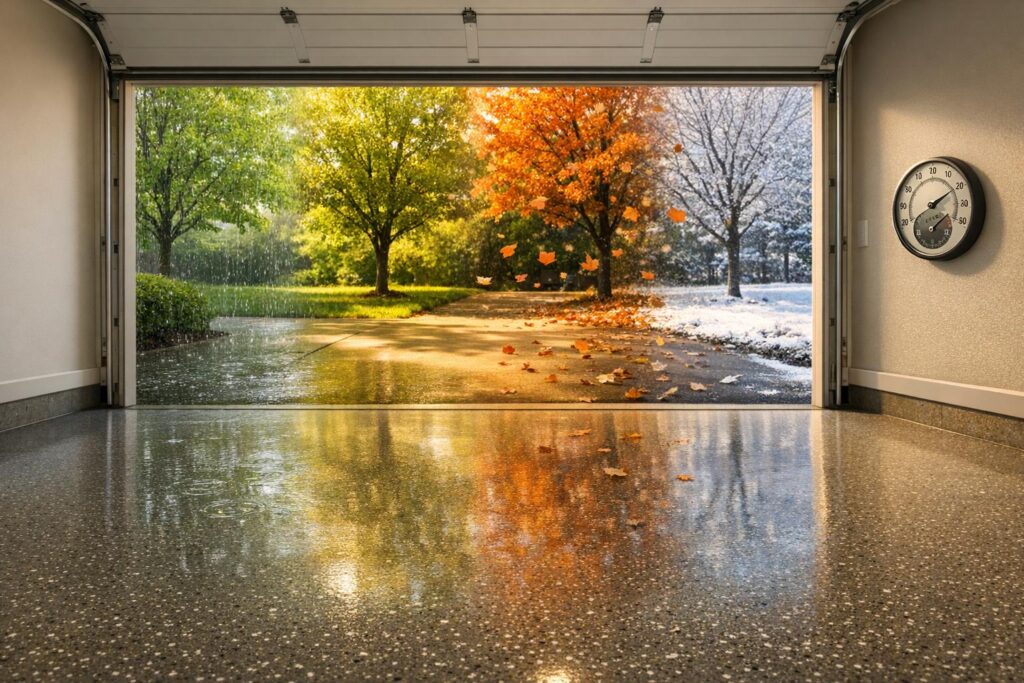
Polyurea floor coatings can be installed year-round, but the season you choose significantly impacts the results. Factors like temperature, humidity, and weather conditions affect how well the coating bonds and cures. Here’s a quick summary of what to expect in each season:
- Spring: Mild temperatures and moderate humidity make this season ideal. Quick curing minimizes delays from spring showers.
- Summer: Handles high heat up to 140°F, but high humidity requires careful moisture control.
- Fall: Stable temperatures and lower humidity work well, but fluctuating moisture from fall rains can be an issue.
- Winter: Performs even in freezing conditions (down to -30°F), but outdoor work faces challenges like snow and limited daylight.
Polyurea’s fast 24-hour cure time and wide temperature tolerance mean you can schedule installations at your convenience. However, spring and fall often offer the most favorable conditions for outdoor projects, while winter is great for indoor spaces like garages.
1. Spring Installation
Temperature Suitability
Spring’s mild temperatures provide an ideal setting for polyurea applications. The moderate climate helps maintain consistent performance, even with the day-to-night temperature swings common during this season. This stability ensures dependable bonding and curing throughout the process.
Curing Performance
One of polyurea’s standout qualities is its rapid curing time – floors are ready for use within just 24 hours. According to Atlas Concrete Coatings, this quick turnaround minimizes disruptions, making spring a convenient time to repair winter damage and prepare your garage floors for summer activities. The fast curing process is especially beneficial in spring, where weather can be unpredictable.
Season-Specific Challenges
Spring showers can occasionally pose a challenge, but polyurea’s quick curing time significantly reduces delays caused by moisture. While ensuring the concrete surface is dry before application is crucial for proper adhesion, the shorter curing period limits exposure to weather-related risks. Additionally, polyurea’s UV resistance protects your floors from yellowing and fading, ensuring they’re ready to withstand the stronger sunlight of the upcoming summer. These features make spring an excellent choice for polyurea installations compared to other seasons.
sbb-itb-4b4bb37
2. Summer Installation
Summer brings its own set of challenges for polyurea installations, with high temperatures and humidity requiring extra attention to detail.
Temperature Suitability
Polyurea handles extreme heat like a pro, performing well even in temperatures as high as 140°F. This means summer projects – whether for a garage floor, patio, or other concrete surfaces – are entirely feasible without compromising the coating’s durability or effectiveness.
Humidity Levels
Humidity, on the other hand, can complicate things. High moisture in the air might lead to water vapor mixing into the coating, which can cause bubbling or blistering. To avoid this, the substrate must be completely dry before application. Using dehumidifiers can also help manage moisture levels. Because of these complexities, hiring professionals for summer installations is often the smartest choice.
Curing Performance
One of polyurea’s standout features is its fast curing time – most floors are ready for use within 24 hours. But this quick curing also requires precision. As Floor Shield Coatings points out:
"The quick cure time of polyurea can be a blessing and a curse… it demands precision and speed during application, leaving no room for errors".
This means installers need to work quickly and accurately to ensure an even application. Combined with summer’s intense sunlight, this fast curing process highlights the importance of skilled application methods.
Season-Specific Challenges
Summer’s harsh sunlight can impact the finish, particularly for outdoor projects. To combat issues like yellowing or fading, adding UV protection to the coating or applying a 100% polyaspartic topcoat is essential. This step is especially critical for patios and driveways that endure prolonged sun exposure. For indoor projects, polyurea’s low VOC content ensures better air quality – an added benefit when air conditioning limits ventilation during the summer months.
3. Fall Installation
Fall brings a mix of lingering summer warmth and the first hints of winter’s chill. This transitional season requires thoughtful planning to make the most of polyurea’s quick curing and strong bonding capabilities.
Temperature Suitability
In much of the United States, fall temperatures typically hover between the mid-50s and low 70s°F. These moderate conditions are ideal for polyurea installations. At this range, concrete tends to stay stable, minimizing risks like cracking or peeling. This stability, paired with polyurea’s flexibility, creates a solid and long-lasting bond.
Humidity Levels
While fall often has lower humidity compared to summer, moisture levels can still fluctuate, creating potential hurdles. As Floor Shield Coatings explains:
"Polyurea’s sensitivity to moisture can be a real spoiler, especially in humid climates or on substrates that haven’t been properly dried".
When polyurea interacts with concrete, it bonds as it seeks out moisture. However, if excessive moisture is present, the bonding process halts, leaving the coating sitting on the surface rather than integrating with it. Fall rains can elevate the moisture content in concrete, so using tools like dehumidifiers or applying moisture barriers can help maintain proper conditions. Controlling moisture is essential for the curing process to work effectively.
Curing Performance
One of polyurea’s standout features is its fast curing time, often allowing full readiness for vehicles within 24 hours under stable conditions. However, this rapid curing can be disrupted by unexpected spikes in humidity, which may prevent proper bonding. A simple way to check curing progress is by gently pressing the surface – if it feels sticky or shifts, the curing process is incomplete.
Season-Specific Challenges
Fall’s unpredictable weather can complicate outdoor installations. A sunny morning can quickly turn damp, potentially interfering with the coating’s bond. Keeping a close eye on weather forecasts and adjusting schedules accordingly is crucial. For outdoor projects, like patios or driveways, using a UV-stable topcoat is recommended to guard against fading as sunlight intensity changes.
4. Winter Installation
Winter might seem like an unlikely time for polyurea application, but this season brings its own set of advantages. Polyurea defies the notion that cold weather is a dealbreaker, proving itself as a reliable option for floor coating installations even in freezing conditions.
Temperature Suitability
One of polyurea’s biggest strengths is its ability to perform in temperatures well below 32°F. For example, in North Dakota’s brutal winters, installations have been completed on concrete surfaces with curing times as fast as 1–2 days – no peeling, no cracking. Some polyurea formulations can even handle temperatures below 0°F. This makes it a year-round solution, especially for indoor spaces like garages, where outdoor conditions are irrelevant.
Humidity Levels
Winter’s lower humidity levels – typically ranging from 20% to 40% – create ideal conditions for polyurea application. These dry conditions reduce the chances of bubble formation during curing. And with polyurea’s rapid 24-hour cure time, the risk of moisture-related issues is kept to a minimum.
Curing Performance
Even when temperatures plummet, polyurea maintains its ability to bond strongly and fully cure within 24 hours. That said, winter installations still require careful planning to account for the unique challenges the season brings.
Season-Specific Challenges
Winter isn’t without its hurdles. Outdoor projects face limited daylight hours and the constant threat of snow, salt, and slush. For instance, road salt can corrode freshly coated surfaces if not cleaned up quickly. While these issues can complicate outdoor work, indoor installations – like garage floors – avoid most of these challenges by taking place in controlled environments.
To ensure success, professional application techniques and thorough surface preparation are critical. This helps address potential problems like limited daylight and the impact of salt exposure. With the right approach, winter installations can be just as effective as those in any other season.
Pros and Cons by Season
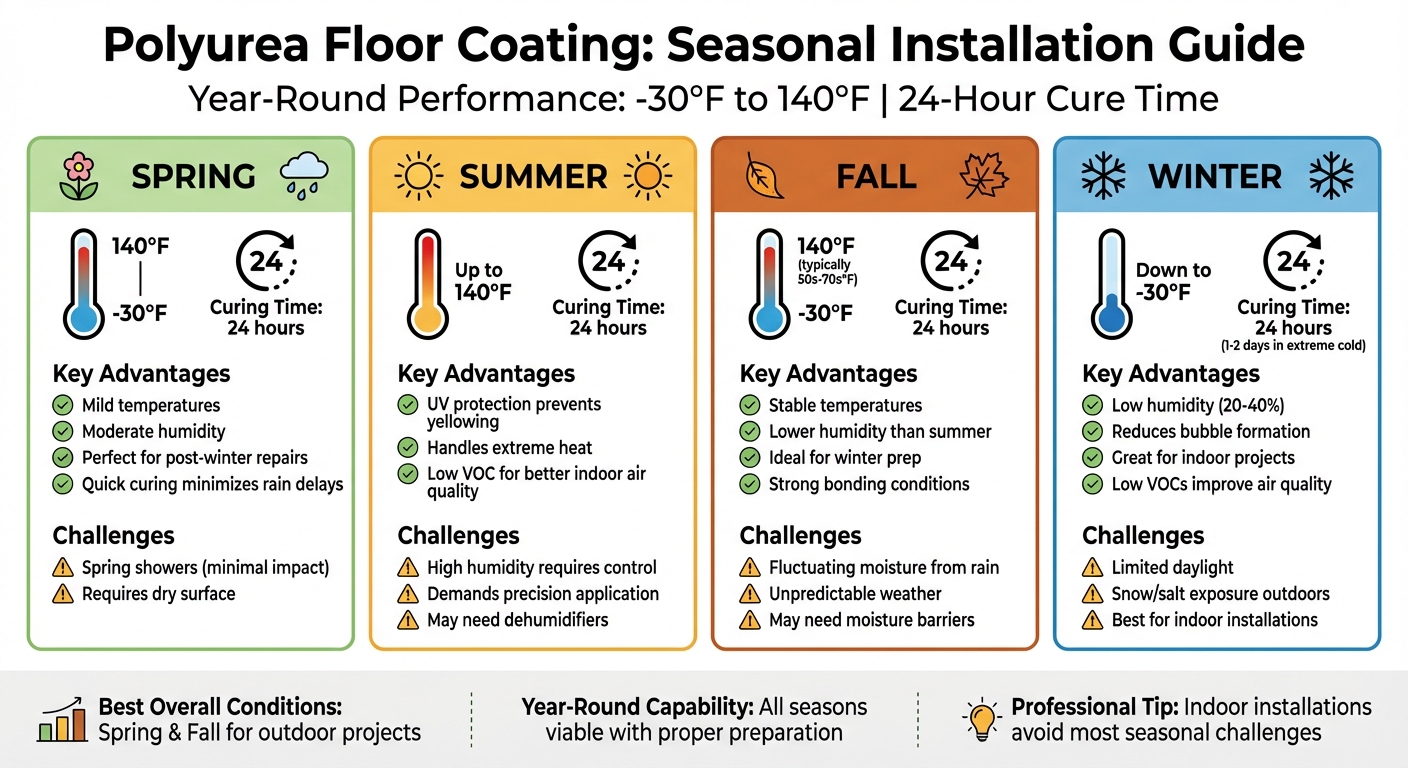
Seasonal Comparison Guide for Polyurea Floor Coating Installation
Polyurea flooring stands out for its ability to be installed year-round, thanks to its impressive temperature tolerance – from –30°F to 140°F. This means you don’t have to wait for “perfect” weather to get started.
Each season brings specific benefits to the table. For instance, spring’s mild weather makes it great for tackling post-winter repairs, while summer’s heat is no challenge due to the built-in UV protection that prevents fading. Fall offers stable conditions, ideal for getting surfaces winter-ready, and winter’s low humidity helps minimize bubble formation during curing. Here’s a quick breakdown of the seasonal advantages:
| Season | Temperature Suitability | Curing Performance | Key Advantages |
|---|---|---|---|
| Spring | –30°F to 140°F | 24-hour full cure | Perfect for refreshing floors after winter |
| Summer | Up to 140°F | 24-hour full cure | UV protection stops yellowing from intense sunlight |
| Fall | –30°F to 140°F | 24-hour full cure | Ideal for prepping surfaces ahead of winter |
| Winter | Down to –30°F | 24-hour full cure | Low VOCs promote safer indoor air quality |
One of polyurea’s most convenient features is its consistent 24-hour curing time, no matter the season. Most installations wrap up in just one day, so your floor is ready for use almost immediately. This reliability takes the unpredictability out of planning, unlike many other flooring options.
Whether you’re sprucing up a garage floor in January or giving your pool deck a facelift in July, polyurea’s dependable performance ensures you can schedule your project whenever it works best for you.
Conclusion
Polyurea floor coatings perform reliably throughout the year, handling temperatures between –30°F and 140°F. While installations can be done in any season, spring and fall often offer the most favorable outdoor conditions, steering clear of summer’s intense heat and winter’s freezing temperatures. Thanks to its fast 24-hour cure time and ability to adapt to various temperatures, polyurea allows you to plan installations around your schedule instead of waiting for perfect weather.
This adaptability means you can tackle projects when it suits you best. Atlas Concrete Coatings has extensive experience with polyurea installations across Pennsylvania and New Jersey, providing custom solutions for residential garages, commercial spaces, pool decks, and industrial floors. Their efficient one-day installation process keeps disruptions to a minimum, whether at home or work. For outdoor projects, they use UV-resistant formulas to prevent yellowing and fading caused by sunlight, while their low VOC products ensure safe indoor air quality during winter when ventilation might be limited. With a lifetime warranty on chip systems and free consultations, you can confidently plan your project no matter the season. By considering seasonal factors, you can decide the best time to upgrade your space with polyurea coatings.
FAQs
How do I know my concrete is dry enough for polyurea?
To determine if your concrete is ready for a polyurea coating, rely on ASTM-standard tests to measure moisture levels and detect potential vapor issues. These tests help ensure the surface is adequately prepared, setting the stage for a strong and durable finish. Skipping this step could compromise the coating’s longevity and performance.
Do I need a UV-stable topcoat for outdoor areas?
Using a UV-stable topcoat is crucial for outdoor spaces. This type of topcoat shields the surface from sun-induced fading and yellowing, helping maintain its durability and appearance over time.
Can I install polyurea in an unheated garage in winter?
Polyurea coatings can indeed be installed in an unheated garage during winter. This material is specifically engineered to handle extreme cold and can be applied in temperatures as low as -30°F. Its durability and adaptability make it a dependable choice, even in freezing conditions.