

Concrete floors face significant risks from moisture, leading to issues like delamination, efflorescence, and cracking. Polyurea coatings offer a durable solution by creating a watertight, flexible barrier that resists water, chemicals, and temperature changes. Unlike epoxy or polyurethane, polyurea performs well on damp surfaces, cures quickly, and lasts longer, making it ideal for residential, commercial, and industrial applications.
Key Takeaways:
- Moisture causes damage like peeling, blistering, and mold growth in concrete.
- Polyurea resists moisture better than epoxy or polyurethane and remains effective in high humidity.
- It cures in hours, forms a seamless barrier, and lasts 10–25 years with minimal maintenance.
- Ideal for garages, basements, pool decks, warehouses, and industrial floors.
Polyurea’s strength, flexibility, and fast curing make it a reliable choice for protecting concrete from moisture damage.
Akfix Polyurea Coating Technology

How Polyurea Stops Moisture Damage
Polyurea stands out as a moisture-blocking champion thanks to three key mechanisms. These features explain why it performs so well in wet environments compared to traditional coatings.
Forms a Watertight Barrier
When applied to concrete, polyurea creates an instant, seamless membrane. This is thanks to a chemical reaction between isocyanates and amine-terminated resins, which forms durable urea linkages. The result? A dense molecular structure that water simply can’t get through.
Polyurea also has the ability to bridge cracks. Its impressive 1,000% elongation means it stretches to seal hairline cracks as the substrate moves. Even after 10 days submerged in saltwater, polyurea coatings absorb less than 0.5% water – proving their resistance to moisture. The material’s tensile strength further ensures it resists stress while maintaining its watertight seal.
As ArmorThane puts it:
"Polyurea coatings quickly cure to form a watertight barrier between the coated structure and the external environment".
This continuous, seamless layer not only blocks liquid water but also allows vapor to escape, preventing moisture from becoming trapped. It also remains flexible, adapting to temperature changes without losing its integrity.
Stays Flexible Through Temperature Changes
Polyurea’s elastomeric properties let it move with the surface it’s protecting, rather than opposing it. It remains effective across a wide temperature range – from –40°F to 250°F, and even withstands brief spikes up to 430°F. In colder climates, where freeze-thaw cycles can wreak havoc on other coatings, polyurea stays intact without cracking or peeling. However, sudden temperature swings over 40°F can stress the coating if the surface isn’t prepped correctly, making thorough cleaning and drying a must.
Cures Quickly for Immediate Protection
Polyurea isn’t just strong and flexible – it’s also fast. Its chemical reaction kicks in almost instantly, with gel time measured in seconds. This speed allows it to outpace the isocyanate-water reaction, avoiding the blistering that can occur with other coatings.
Marc Broekaert of Huntsman International highlights this advantage:
"Polyurea is not water- or temperature-sensitive… the fact that the isocyanate/water reaction is not affecting the physical properties of the applied film, expands the use of polyurea to high relative humidity conditions".
Polyurea typically cures within 2 to 5 minutes, with surfaces ready for foot traffic in just 4 to 6 hours and vehicle traffic within 24 hours. This rapid curing process forms a watertight seal and allows for application in extreme conditions – up to 100% relative humidity and temperatures as low as –20°F to –25°F. These are conditions where traditional coatings like epoxy and polyurethane often fall short.
Where to Use Polyurea Coatings for Moisture Protection
Residential Spaces: Garages, Basements, and Pool Decks
Polyurea coatings shine in both residential and commercial settings when it comes to moisture protection.
Garages are constantly exposed to moisture risks, whether from vapor rising through concrete slabs or road salts brought in during winter. Polyurea forms a tough, durable barrier that resists moisture, oil stains, and even hot tire pickup. It’s five times harder than standard epoxy, making it a great choice for areas that deal with vehicles and heavy storage.
Basements often face hydrostatic pressure from groundwater, which can lead to leaks. Polyurea offers a seamless, waterproof layer for walls and floors, applied at thicknesses ranging from 50 to 100 mils. It works for both interior and exterior applications, but for the best results, it should be paired with drainage solutions like sump pumps or French drains to manage pressure.
Pool decks and patios demand UV-stable protection, and aliphatic polyurea is up to the task. It resists yellowing, stays clear, and can be finished with slip-resistant textures. Other areas in the home, like laundry rooms, mudrooms, home gyms, and crawl spaces, also benefit from polyurea’s ability to withstand high humidity, temperature swings, and moisture intrusion .
These residential uses highlight polyurea’s reliability, which is equally crucial in commercial and industrial applications.
Commercial and Industrial Floors
In commercial spaces with heavy foot traffic, polyurea’s quick curing time is a major advantage – it’s walkable within 2–4 hours and ready for vehicles in just 24 hours. For warehouses with frequent forklift use, polyurea coatings can last 20–25 years or more with proper upkeep.
Auto shops rely on polyurea for its resistance to oils and fluids, while hospitals appreciate its antibacterial surface that’s easy to clean. In food processing plants, where high humidity and constant wash-downs are the norm, polyurea performs exceptionally well – it can even be applied in environments with 100% relative humidity. The coating is built to handle extreme temperature ranges, from –40°F to 350°F, without cracking, making it a solid choice for demanding conditions. Before applying polyurea in commercial settings, moisture levels should be tested using calibrated meters, and if necessary, a moisture-mitigating hydro-epoxy primer should be applied .
sbb-itb-4b4bb37
Polyurea vs. Other Coatings for Moisture Protection
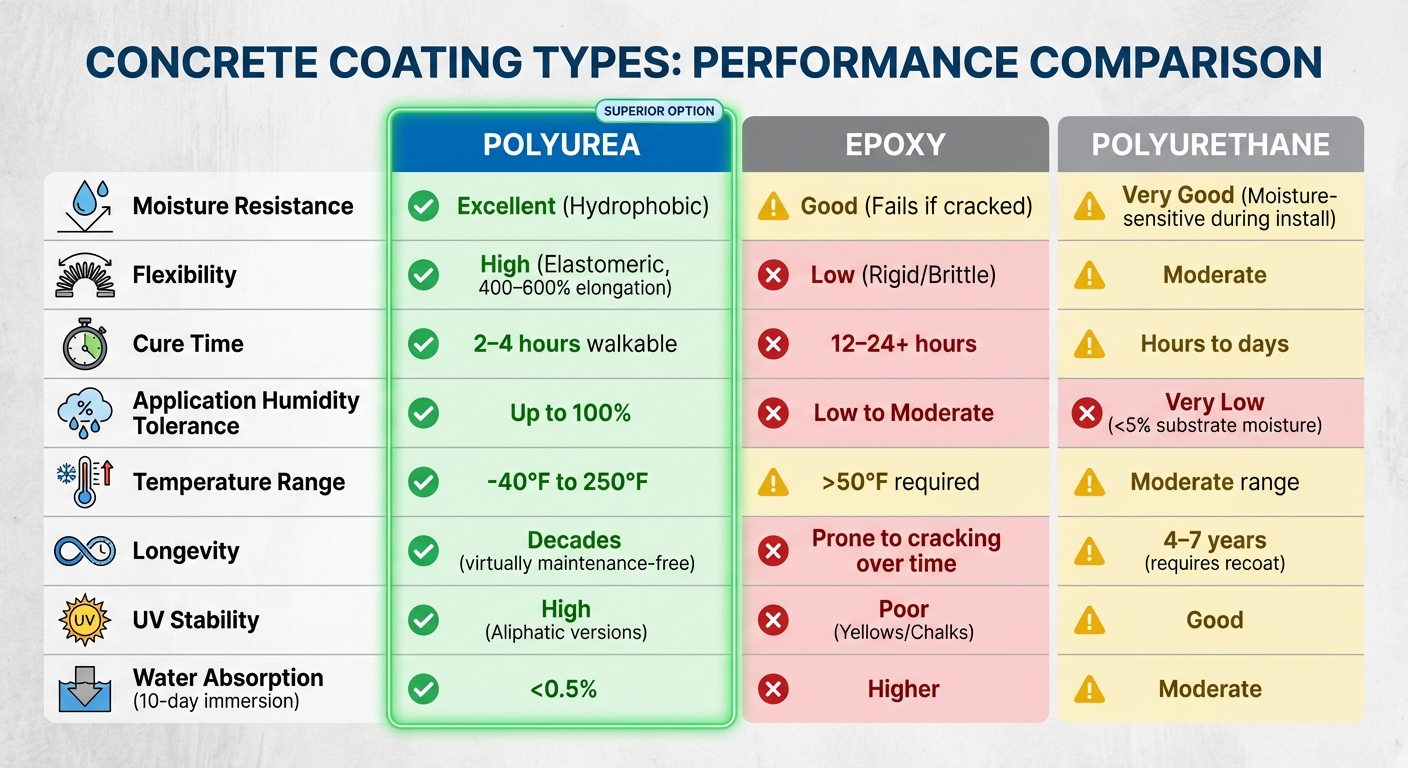
Polyurea vs Epoxy vs Polyurethane: Moisture Resistance Comparison Chart
When it comes to protecting concrete from moisture damage, polyurea often outshines alternatives like epoxy and polyurethane. While each coating has its merits, their performance under moisture-heavy conditions differs significantly, making the choice of material crucial for long-term durability.
Epoxy is known for being rigid and brittle. It struggles with substrate movement and doesn’t perform well in humid environments. Additionally, it requires temperatures above 50°F for curing. Though it may seem cost-effective initially, its tendency to crack and fail can lead to expensive repairs down the line.
Polyurethane offers better flexibility than epoxy and provides decent resistance to UV light. However, it’s highly sensitive to moisture during application. Substrate humidity above 5% can cause blistering and off-gassing. Moreover, polyurethane coatings need to be reapplied every 4–7 years, adding to maintenance costs.
Polyurea, on the other hand, stands out with its hydrophobic properties, actively repelling water. Thanks to its unique chemical structure, it accommodates substrate movement effortlessly and maintains its adhesion even in extreme humidity or on nearly saturated surfaces. It performs reliably across a wide temperature range, from -40°F to 250°F. In fact, its bond to concrete is so strong that the concrete itself often fails before the coating detaches.
"Polyurea can be used in extreme conditions. When it is used on substrates almost saturated with water, polyurea will not provoke blistering nor will blistering occur when the air contains high amounts of humidity."
– Marc Broekaert, Huntsman International LLC
The table below highlights how these coatings compare across key attributes.
Comparison Table: Moisture Resistance and Durability
| Feature | Polyurea | Epoxy | Polyurethane |
|---|---|---|---|
| Moisture Resistance | Excellent (Hydrophobic) | Good (Fails if cracked) | Very Good (Moisture-sensitive during install) |
| Flexibility | High (Elastomeric, 400–600% elongation) | Low (Rigid/Brittle) | Moderate |
| Cure Time | 2–4 hours walkable | 12–24+ hours | Hours to days |
| Application Humidity Tolerance | Up to 100% | Low to Moderate | Very Low (<5% substrate moisture) |
| Temperature Range | –40°F to 250°F | >50°F required | Moderate range |
| Longevity | Decades (virtually maintenance-free) | Prone to cracking over time | 4–7 years (requires recoat) |
| UV Stability | High (Aliphatic versions) | Poor (Yellows/Chalks) | Good |
| Water Absorption (10-day immersion) | <0.5% | Higher | Moderate |
This comparison makes it clear why polyurea is often the go-to solution for moisture protection in areas like pool decks, basements, or washdown bays. While the initial investment may be higher due to its specialized application, polyurea’s durability and low maintenance requirements can lead to significant long-term savings. Its ability to resist moisture and prevent mold growth makes it a reliable choice for demanding environments.
Conclusion
What Homeowners and Property Managers Should Know
Polyurea is a game-changer when it comes to protecting concrete surfaces in residential, commercial, and industrial settings. Its hydrophobic properties create a water-repellent barrier that stays flexible, even in extreme temperatures, making it a reliable choice for various environments. Plus, with a quick cure time – just 2 to 4 hours for walkability – it offers fast protection and adheres well, even on damp surfaces.
When it comes to longevity, polyurea coatings deliver impressive results. In residential applications, they typically last 10 to 15 years, while industrial settings can see durability stretching to 20–25 years with minimal upkeep. The seamless finish also adds an extra layer of defense, preventing water from seeping into vulnerable areas like joints and wall-floor connections. This combination of durability and performance makes polyurea a solid investment for protecting your property.
Why Choose Atlas Concrete Coatings for Polyurea Applications
For professional installation and reliable results, Atlas Concrete Coatings stands out as a top choice. Their team, trained by Penntek, ensures every surface is expertly prepared and coated. The polyurea they apply bonds deeply with the concrete, creating a durable layer that’s up to four times stronger than standard epoxy. Even better, the entire process – prep, application, and cleanup – can be completed in just 24 hours.
Atlas Concrete Coatings backs their work with a 15-year residential warranty, giving you peace of mind. Their UV-resistant formulas are perfect for outdoor spaces like patios and pool decks. Whether you’re looking to protect a basement from water damage, keep a garage floor free from oil stains, or safeguard an industrial wash bay from constant moisture, Atlas Concrete Coatings has you covered. With their proven polyurea solutions, you can trust them to protect your investment and deliver lasting performance, even in the toughest conditions.
FAQs
How does polyurea compare to epoxy and polyurethane for moisture resistance?
Polyurea stands out for its superior moisture resistance, outperforming both epoxy and polyurethane coatings. Thanks to its elastomeric nature, polyurea is naturally hydrophobic, meaning it actively repels water and prevents moisture from seeping into the surface. This quality significantly reduces the risk of problems like bubbling or delamination, which can often trouble epoxy coatings when exposed to moisture during the curing process.
Unlike traditional polyurethane systems that can be sensitive to humidity, polyurea is formulated to be moisture-insensitive once mixed. This unique characteristic enables it to form a strong, impermeable barrier that holds up even in the toughest conditions. Combined with its quick curing time and flexibility, polyurea is an excellent option for providing reliable, long-term moisture protection across residential, commercial, and industrial applications.
Can polyurea coatings be applied in very cold or humid environments?
Polyurea coatings are incredibly flexible and perform well even under tough conditions. With their quick-curing abilities, they can be applied in temperatures as low as freezing (below 32°F) and stand up to high humidity. This makes them a reliable option for situations where standard coatings often struggle with weather-related issues.
What are the top uses for polyurea coatings in homes and businesses?
Polyurea coatings stand out for their durability and adaptability, making them a go-to option for various residential and commercial uses. In homes, they shine on garage floors, basements, pool decks, patios, and walkways, offering strong protection against moisture, heavy foot traffic, and temperature fluctuations. Thanks to their slip-resistant finish, they’re also a practical and safer choice for areas like kitchens, bathrooms, and laundry rooms. Plus, with their long lifespan and low upkeep requirements, polyurea coatings are an economical pick for homeowners.
For businesses, polyurea proves its worth in tough environments like warehouses, manufacturing floors, loading docks, parking garages, and commercial kitchens. Its quick curing time means less downtime during installation, while its resistance to chemicals, UV exposure, and wear ensures it holds up over time. Beyond flooring, polyurea is often used for waterproofing and protecting metal roofs or tank liners from corrosion, making it a dependable option for facilities needing durable, easy-to-maintain surfaces.