
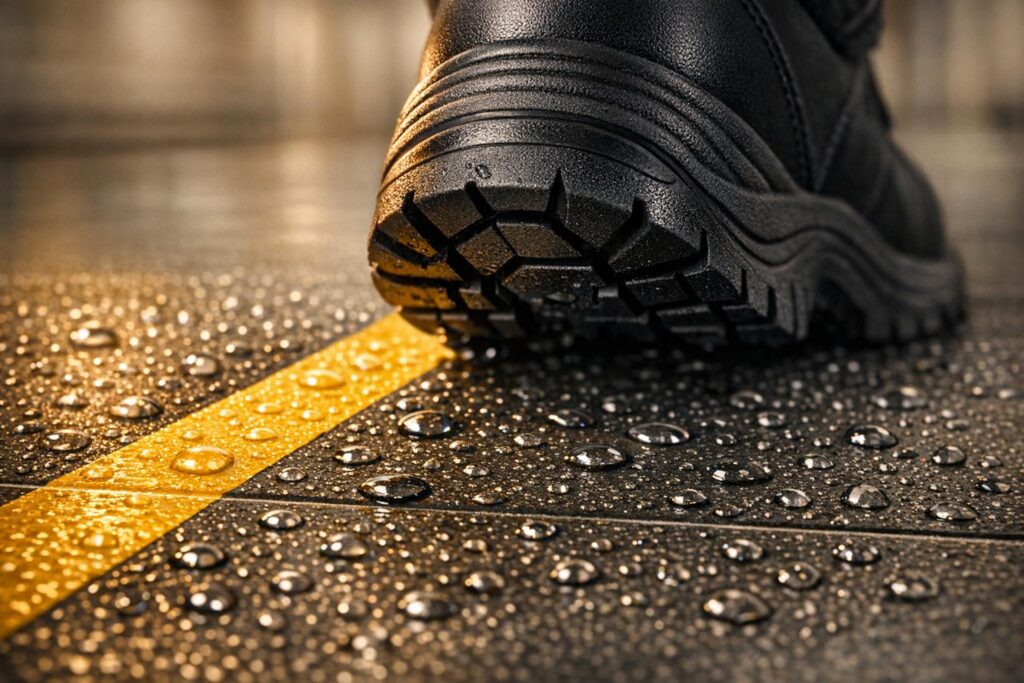
Slips, trips, and falls are a major workplace hazard, costing U.S. businesses over $80 billion annually and causing nearly 700 fatalities each year. OSHA‘s 29 CFR 1910.22 regulation mandates clean, dry, and slip-resistant floors to prevent these accidents. Non-compliance can lead to fines, legal issues, and increased workers’ compensation claims.
Key Takeaways:
- OSHA does not specify a numeric slip-resistance standard but encourages using industry benchmarks like ANSI A326.3-2021, which recommends a minimum DCOF of 0.42 for wet interior floors.
- Flooring options like polyurea coatings, rubber, and textured tiles offer durable solutions tailored to industrial needs.
- Regular DCOF testing and maintenance (e.g., cleaning spills immediately, avoiding slippery cleaning products) are critical to ensure continued compliance and safety.
Slip-resistant flooring not only meets OSHA requirements but also reduces liability risks, enhances worker safety, and minimizes downtime. For industrial facilities, investing in durable, compliant flooring is a smart choice to protect both employees and the bottom line.
Prevent Slips, Trips, and Falls: OSHA Walking-Working Surfaces Explained
sbb-itb-4b4bb37
OSHA Standards for Slip-Resistant Flooring
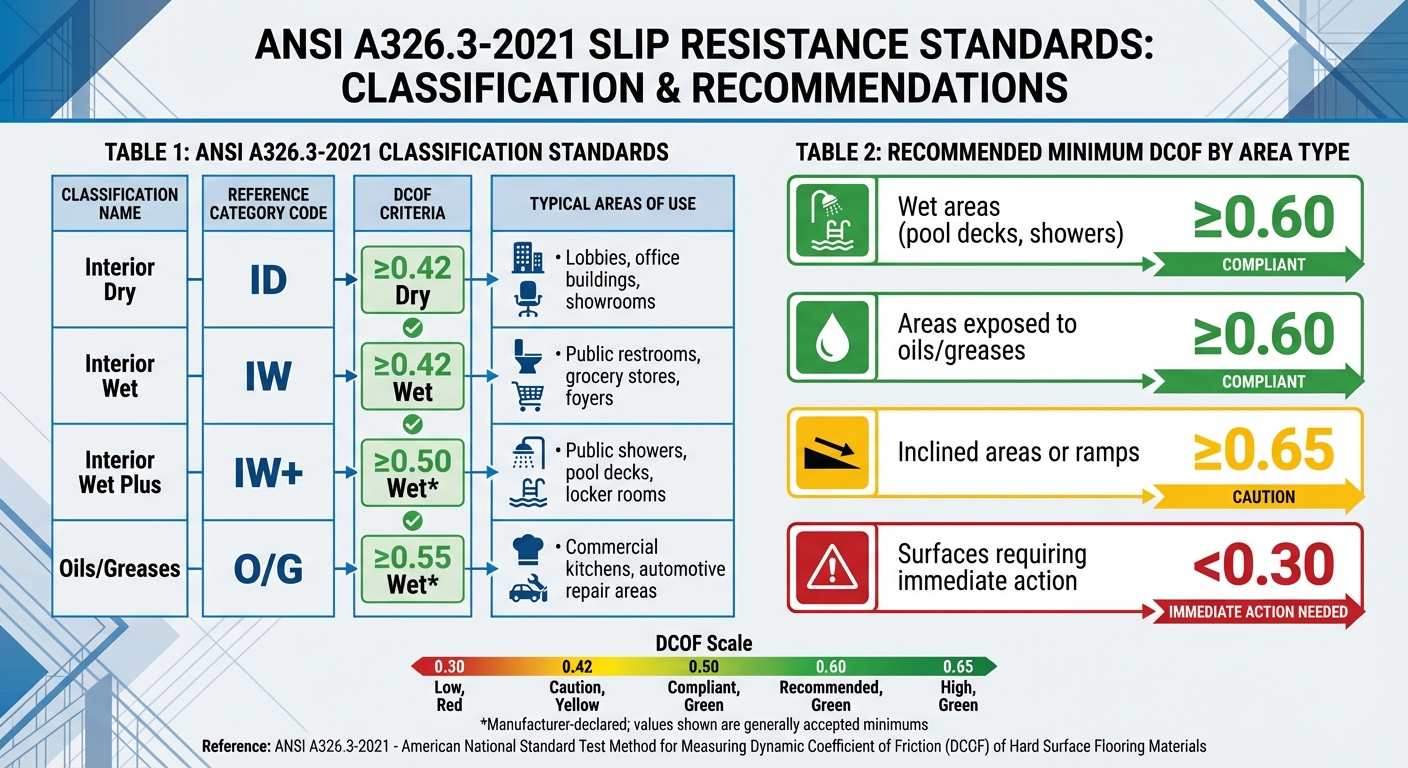
ANSI A326.3-2021 Slip Resistance Standards and DCOF Requirements by Area Type
OSHA’s regulation 29 CFR 1910.22 emphasizes that walking-working surfaces must remain clean, orderly, and sanitary. When wet processes are involved, facilities are required to provide proper drainage and dry standing areas – such as mats, platforms, or false floors – to reduce hazards. Employers are also tasked with conducting regular inspections and addressing risks like spills, leaks, loose boards, and corrosion promptly.
Interestingly, OSHA does not set a specific numeric requirement for slip resistance. While the agency previously referenced a non-mandatory guideline of a 0.5 coefficient of friction (COF) based on a University of Michigan study, it now relies on performance-based assessments. Richard E. Fairfax, Director of OSHA’s Directorate of Enforcement Programs, clarified:
"OSHA does not have any standards that mandate a particular COF for walking/working surfaces." – Richard E. Fairfax, Director, Directorate of Enforcement Programs, OSHA
In the absence of a strict numeric standard, OSHA encourages the use of industry benchmarks to ensure compliance and worker safety.
ANSI A326.3-2021: Dynamic Coefficient of Friction (DCOF) Standards
The ANSI A326.3-2021 standard is the go-to reference in the U.S. for measuring slip resistance on hard surface flooring. Unlike static methods, this standard measures the Dynamic Coefficient of Friction (DCOF), which evaluates friction while a person is in motion. It recommends a minimum DCOF of 0.42 for interior floors that are expected to be walked on when wet.
The standard also classifies slip resistance into specific categories:
| Classification | Reference Category | DCOF Criteria | Typical Areas of Use |
|---|---|---|---|
| Interior, Dry | ID | ≥ 0.42 (Dry) | Lobbies, office buildings, showrooms |
| Interior, Wet | IW | ≥ 0.42 (Wet) | Public restrooms, grocery stores, foyers |
| Interior, Wet Plus | IW+ | ≥ 0.50 (Wet)* | Public showers, pool decks, locker rooms |
| Oils / Greases | O/G | ≥ 0.55 (Wet)* | Commercial kitchens, automotive repair areas |
*Manufacturer-declared; values shown are generally accepted minimums.
For environments exposed to oils, greases, or constant wet conditions, higher DCOF values are essential. Tasks like carrying objects, pushing equipment, or navigating ramps may demand an even higher COF than the earlier 0.5 guideline.
Achieving these DCOF thresholds is crucial to maintaining safe working conditions and avoiding costly consequences.
The Cost of Non-Compliance
Failing to adhere to slip-resistant flooring standards can lead to staggering financial losses. Slip-and-fall incidents cost U.S. businesses over $80 billion annually. This figure includes direct expenses like workers’ compensation claims and medical bills, alongside indirect costs such as lost productivity, higher insurance premiums, and legal fees.
Beyond OSHA fines for unsafe surfaces, the more substantial costs often stem from liability lawsuits following workplace injuries. These cases can lead to expensive litigation and significant operational disruptions. Additionally, property owners risk damage to their reputation and further insurance hikes after such incidents.
For industries operating with tight budgets, even one severe accident can result in financial repercussions far greater than the cost of installing compliant flooring. Choosing flooring systems that align with ANSI standards isn’t just about regulatory compliance – it’s a proactive step to avoid the far-reaching consequences of workplace injuries. The financial risks make it clear: investing in slip-resistant surfaces is a necessity, not an option.
Slip-Resistant Flooring Options for Industrial Facilities
Meeting OSHA’s safety standards requires choosing flooring that balances safety, durability, and practicality. The right flooring not only protects workers but also helps manage long-term costs. Industrial environments face unique challenges like heavy traffic, exposure to chemicals, and extreme wear and tear. Flooring in these settings must provide dependable slip resistance while withstanding tough conditions.
Polyurea-Based Concrete Floor Coatings
Polyurea-based coatings are increasingly popular for industrial facilities that need both high slip resistance and durability. These coatings form a seamless, chemical-resistant layer that bonds directly to concrete surfaces. They can also be customized with textures to improve traction. One major advantage of polyurea is its rapid curing time, allowing facilities to resume operations within 24 hours – much faster than traditional epoxy systems.
This material shines in environments exposed to oils, greases, and industrial solvents, thanks to its strong chemical resistance. When textured, polyurea coatings can achieve DCOF values above 0.55, meeting the ANSI A326.3-2021 standards for wet and oil/grease conditions. Companies like Atlas Concrete Coatings offer tailored polyurea systems that provide UV resistance, consistent slip resistance, and the strength to handle heavy loads. These qualities make polyurea an excellent choice for manufacturing plants, warehouses, and automotive repair facilities, where safety and durability are critical.
Other Material Options: Rubber, Vinyl, and Textured Tiles
While polyurea is a standout option, other materials can meet specific needs in industrial settings:
- Rubber flooring: Known for its natural slip resistance, even when wet, rubber is ideal for areas where workers stand for long periods. It also provides cushioning to reduce fatigue and dampens noise in busy spaces like assembly lines. However, rubber is less suitable for environments with oils and fats, as these substances can degrade the material over time.
- Vinyl flooring: This cost-effective option offers textured surfaces for moderate-to-high slip resistance. Vinyl resists moisture and requires minimal upkeep, making it a good fit for break rooms, administrative areas, or light-duty production zones. However, it’s less durable under heavy machinery compared to resinous coatings or sealed concrete.
- Textured tiles and treated concrete: These materials enhance traction through raised patterns or rough finishes. While they provide good slip resistance, maintenance can be a challenge. Grooves and patterns may trap debris, oils, and moisture, which can reduce their effectiveness if not cleaned regularly. For facilities with limited cleaning resources, smoother options like polyurea may perform better in the long run.
The best flooring choice depends on factors like traffic levels, chemical exposure, and ergonomic needs. For areas with heavy forklift activity, durable options like polyurea or epoxy are essential. Meanwhile, spaces requiring worker comfort, such as standing workstations, may benefit from rubber’s cushioning properties. By evaluating these factors alongside OSHA standards, facilities can invest in flooring that safeguards employees while optimizing operational efficiency.
Testing and Maintaining Slip-Resistant Flooring
Installing slip-resistant flooring is just the beginning. To maintain OSHA compliance and keep workers safe, regular testing and upkeep are essential. Without these, even the most effective flooring can lose its grip – literally – putting employees at risk and leaving your facility vulnerable to liability.
Dynamic Coefficient of Friction (DCOF) Testing
DCOF testing measures how much friction a surface provides while in motion, focusing on the heel strike phase of walking – when most slips occur. This is typically done using a controlled-speed digital tribometer, like the BOT-3000E. Walkway Management Group emphasizes:
"You can’t improve what you haven’t measured. DCOF Testing using a tribometer like the BOT-3000E provides accurate readings of your floor’s slip potential".
To get a full picture, test multiple locations in your facility, as factors like wear, traffic, and contaminants vary. For flat indoor surfaces that are wet, a minimum DCOF value of 0.42 is required to meet ANSI A326.3 standards. Areas exposed to oils or greases, such as kitchens or automotive bays, need a higher threshold of 0.60 or more. Experts suggest conducting professional DCOF testing annually or semi-annually. This ensures compliance and catches potential issues before they become hazards.
| Area Type | Recommended Minimum DCOF |
|---|---|
| Wet areas (pool decks, showers) | ≥ 0.60 |
| Areas exposed to oils/greases | ≥ 0.60 |
| Inclined areas or ramps | ≥ 0.65 |
| Surfaces requiring immediate action | < 0.30 |
A case study highlights the importance of regular testing: Since 2006, McDonald’s has used the "Sustainable Slip Resistance" standard to predict how a tile’s slip resistance will hold up after one to two years of heavy use and improper cleaning.
By staying on top of testing, facilities can develop targeted maintenance strategies to keep floors safe.
Maintenance Practices for Long-Term Slip Resistance
Even the best slip-resistant floors can become dangerous without proper care. Immediate spill cleanup and regular deep cleaning are critical. Since wet floors account for roughly 80% of slip-and-fall claims, spills should be addressed immediately. Daily cleaning should use neutral pH cleaners and avoid oil-based or waxy products, which can leave slippery residues. Grease combined with leftover soap can create a waxy film, making surfaces even more hazardous.
To minimize risks, use tools like microfiber mops, which use less liquid and dry floors faster. Dual-chamber mopping systems are another great option because they keep dirty water separate from clean, ensuring contaminants are removed rather than spread. High-traffic areas – like entrances and transition zones – should undergo regular deep cleaning to remove buildup of minerals, dirt, and soap that can obscure the floor’s texture .
Routine inspections are also key. Look for leaks, spills, or worn finishes, and after applying anti-slip treatments or changing cleaning products, run a new DCOF test to confirm safety standards are still being met. Keeping these records not only demonstrates due diligence but also provides evidence to defend against potential slip-and-fall claims .
Choosing the Right Flooring for Your Facility
Identifying High-Risk Areas and Facility Requirements
Start by walking through your facility to pinpoint areas prone to slips, such as production lines, loading docks, and wash zones where moisture or chemicals tend to accumulate.
Pay close attention to traffic patterns. Spaces with frequent forklift use or heavy machinery need flooring that complies with OSHA’s guidelines (29 CFR 1910.22(d)) to bear the expected weight without collapsing. Evaluate both foot traffic and equipment loads to determine the appropriate load-bearing capacity for your flooring.
Material selection is key. For example, rubber provides excellent traction in dry areas but deteriorates when exposed to oils, making it less suitable for environments like food processing. On the other hand, epoxy coatings with grit additives excel in high-traffic areas and places exposed to harsh chemicals. Durable flooring in these zones is critical to handle the demands of machinery and foot traffic while maintaining worker safety and production efficiency.
Don’t overlook visual safety. OSHA regulation 29 CFR 1910.144 requires clear hazard markings using color codes. Permanent color-coded zones and safety striping incorporated into your flooring not only ensure compliance but also streamline workflow and improve overall safety.
Once you’ve identified high-risk zones, implementing tailored coating solutions can address these specific challenges effectively.
Custom Coating Solutions from Atlas Concrete Coatings
Atlas Concrete Coatings specializes in polyurea-based chip floor coatings designed to meet OSHA standards while addressing the unique challenges of your facility. These industrial-grade flooring systems can be customized with anti-slip grit additives, ensuring floors stay clean, dry, and safe for daily operations. By targeting the high-risk areas identified during your assessment, Atlas delivers precise solutions where they’re needed most.
In addition to slip resistance, Atlas integrates permanent color-coded zones and safety striping directly into the flooring. This eliminates the hassle of temporary tapes that can wear out or peel, ensuring long-lasting compliance and clear visual guidance in hazardous areas.
Atlas’s polyurea coatings are built to withstand heavy traffic, exposure to liquids, and harsh chemicals while protecting the concrete underneath. Quick repairs for cracks or uneven surfaces help prevent trip hazards and maintain compliance with safety standards.
Whether your facility is a small production area or a large warehouse, Atlas offers free consultations to evaluate your specific risks. They’ll recommend the ideal combination of slip-resistant additives, color-coded markings, and durability features to keep your operations safe and efficient.
Conclusion
OSHA requires floors to be clean, dry, and slip-resistant. Ignoring these regulations can lead to hefty fines – thousands of dollars per violation – and increased liability risks. Considering U.S. businesses spend over $80 billion annually on slip and fall accidents, investing in proper flooring can protect both your bottom line and your workforce.
But it’s not just about meeting compliance. The right flooring system offers a range of safety and operational advantages. It minimizes downtime, shields concrete from damage, and uses color-coded markings to enhance workflow efficiency. By adhering to industry friction standards, these floors provide the necessary traction, even when exposed to water, oils, or chemicals.
"Investing in workplace safety not only protects your employees but also contributes to the overall success and reputation of your business." – Surface Technology Inc.
Atlas Concrete Coatings specializes in polyurea-based flooring solutions designed to tackle your facility’s specific needs. Their team provides free consultations to identify high-risk areas and installs slip-resistant coatings with integrated safety striping. Thanks to their rapid-cure technology, installations can often be completed during off-hours to avoid disrupting your operations.
Take proactive steps to safeguard your facility and team. Contact Atlas Concrete Coatings today for a professional assessment and see how durable, compliant flooring can transform your workplace safety.
FAQs
How do I prove my floors are OSHA-compliant?
To meet OSHA safety standards for floors, it’s crucial to focus on slip resistance and proper maintenance. Start by conducting slip resistance testing to ensure your flooring meets the required safety levels. Regularly inspect and repair any flooring issues, and maintain thorough records of these activities. Consider applying anti-slip coatings, such as polyurea, to reduce the risk of slips and falls. Additionally, clearly mark any hazardous areas to alert employees and visitors. Keeping detailed documentation of all these efforts will help you demonstrate compliance during audits or inspections.
How often should my facility perform DCOF testing?
To ensure your facility meets OSHA standards for slip resistance, regular DCOF (Dynamic Coefficient of Friction) testing is essential. This testing helps maintain a safe environment by reducing the risk of slip-and-fall injuries. How often you should test depends on factors like foot traffic levels and environmental conditions. High-traffic areas or spaces exposed to moisture may require more frequent checks to stay compliant and safe.
Which flooring works best for oily or constantly wet areas?
Polyurea coatings work well in areas that are oily or consistently wet. They stand up strongly against chemicals, impacts, and abrasion. When mixed with aggregates, they can also help reduce slipping hazards, making them a smart option for boosting safety in tough workplace conditions.