

Polyurea coatings are a highly durable flooring solution, outperforming epoxy and acrylic in strength, flexibility, and lifespan. Designed for high-traffic areas like garages, patios, and driveways, these coatings resist wear, impacts, chemicals, and extreme temperatures (-40°F to 250°F). They cure quickly (walkable in 2–4 hours, vehicle-ready in 24 hours) and last 20–25 years with proper installation and maintenance. Key benefits include:
- Strength: Up to 4x stronger than epoxy, with tensile strengths up to 40 MPa.
- Flexibility: Absorbs impacts and accommodates concrete movement without cracking.
- Chemical Resistance: Shields against oils, cleaners, and moisture.
- UV Stability: Aliphatic formulations prevent yellowing in outdoor spaces.
Professional installation ensures long-term performance, with costs averaging $5,000 for a standard garage. Routine cleaning and periodic topcoating extend its lifespan, making polyurea a cost-effective, long-term investment for residential and outdoor surfaces.
Durability Characteristics of Polyurea Coatings
Wear and Abrasion Resistance
The durability of polyurea coatings stems from the unique urea linkages formed during application. These linkages create a tightly cross-linked network that effectively blocks oils, solvents, and corrosive substances from seeping into the surface. Unlike traditional surface coatings, polyurea penetrates the pores of concrete, forming a permanent bond that resists delamination even under heavy traffic.
Marc Broekaert of Huntsman International LLC highlights this strength:
"Polyurea coatings combine high flexibility with hardness. They are the most suitable coatings when… extreme abrasion resistance [is] required."
Lab tests further back this up, showing that adding glass fibers can boost tensile strength to 60.7 MPa (8.8 ksi), which is about 1.4 times stronger than pure polyurea. Standard formulations typically achieve tensile strengths of 23 MPa (around 3.3 ksi) with elongation rates up to 430%, though these values heavily depend on precise mixing during application. For projects that demand greater resistance to mechanical wear, manufacturers often increase the isocyanate (NCO) content in the prepolymer, enhancing the coating’s surface hardness. This combination of mechanical toughness also contributes to its strong chemical resistance.
Chemical and Environmental Resistance
Beyond its mechanical durability, polyurea’s dense molecular structure acts as a strong shield against automotive fluids, household cleaners, acids, and solvents. Its seamless, non-porous finish creates a waterproof barrier capable of withstanding 100% humidity and extended exposure to moisture.
Polyurea also performs well in extreme temperatures, staying stable between –40°F and 250°F. This adaptability allows it to expand and contract along with concrete during seasonal temperature changes, preventing cracks or peeling. However, UV exposure can cause standard aromatic polyurea to yellow over time. To address this, aliphatic formulations, often referred to as polyaspartics, provide full UV stability. These coatings retain their glossy finish and resist discoloration, making them ideal for outdoor spaces like patios and driveways. Garage Living explains:
"Floortex™ polyaspartic floor coating’s top-notch UV protection properties are one of the biggest differences it has with polyurea coatings. Floortex™ holds its color and shiny finish much longer than any polyurea or epoxy coating and will never yellow."
Flexibility and Impact Resistance
One of the standout features of polyurea is its elastomeric nature, which sets it apart from more rigid coatings like epoxy. This elasticity allows it to absorb impacts, preventing cracks even when subjected to heavy loads or dropped objects. This flexibility also eliminates issues like "hot tire pickup", where warm tires can pull brittle coatings off the floor, ensuring the coating remains intact despite substrate movement.
Garage Flooring LLC explains:
"Epoxy coating systems are actually harder than Polyurea… Hardness is not the key. These urethane-based systems are hard enough to resist scratching but their flexibility allows them to resist impact."
With the ability to stretch up to 430% of its original length, polyurea accommodates substrate shifts without failing. This combination of elasticity and deep penetration into the substrate is why many high-quality polyurea systems come with residential warranties lasting up to 15 years.
Must See! Watch The 100% Polyurea Hammer Test! – TruTech Concrete Coatings
Factors That Affect Polyurea Coating Lifespan
When installed and maintained properly, polyurea coatings can last between 20 and 25 years in high-traffic areas. However, poor application or neglect can cut this lifespan down to just a few years. Let’s explore how proper installation and regular upkeep play a role in their durability.
Surface Preparation and Installation Quality
The key to a long-lasting polyurea coating lies in its bond with the underlying concrete. Achieving this requires precise surface preparation, such as diamond grinding or shot blasting, to create the necessary surface texture, typically a Concrete Surface Profile (CSP) of 2–3.
Crayton Caudill, an expert from Level 10 Coatings, emphasizes this point:
"Proper surface preparation, including diamond grinding or shot blasting, ensures the coating bonds well to the concrete. Once that strong bond is formed, daily wear won’t degrade the coating as quickly."
In addition to surface preparation, moisture vapor tests and the use of vapor barriers are critical to prevent delamination. Repairing cracks and imperfections before applying the coating also minimizes the risk of micro-fractures, which can lead to deeper damage over time.
The application process itself is highly technical. Polyurea components must be mixed under pressures of 150 to 250 bar and heated to temperatures between 149°F and 176°F (65°C to 80°C) during spraying. Specialized equipment is essential to achieve the correct mix and application. While professional installation for a standard garage may cost around $5,000, it can save homeowners as much as $15,000 to $20,000 in future concrete replacement costs.
Maintenance and Care Requirements
Even with a high-quality installation, regular maintenance is critical to ensure the coating reaches its full potential lifespan. Daily sweeping with a soft-bristle broom or microfiber dust mop helps remove grit and debris, which can act like sandpaper on the coating. Weekly cleaning with a pH-neutral cleaner keeps the surface in top condition. For routine cleaning, a diluted solution of Simple Green (1:8 ratio) with warm water works well. For tougher stains, use a mixture of ½ cup clear ammonia in one gallon of warm water. Harsh cleaners like bleach, vinegar, or mild soaps should be avoided, as they can dull or damage the coating’s finish.
Automotive fluids, such as oil and antifreeze, should be cleaned up immediately to prevent staining. Additionally, applying a fresh polyaspartic top coat every 10–15 years can restore the coating’s shine and add another layer of protection. Combined with consistent cleaning, this periodic refresh ensures the coating can meet or even exceed its anticipated service life.
sbb-itb-4b4bb37
Polyurea vs. Other Coating Materials
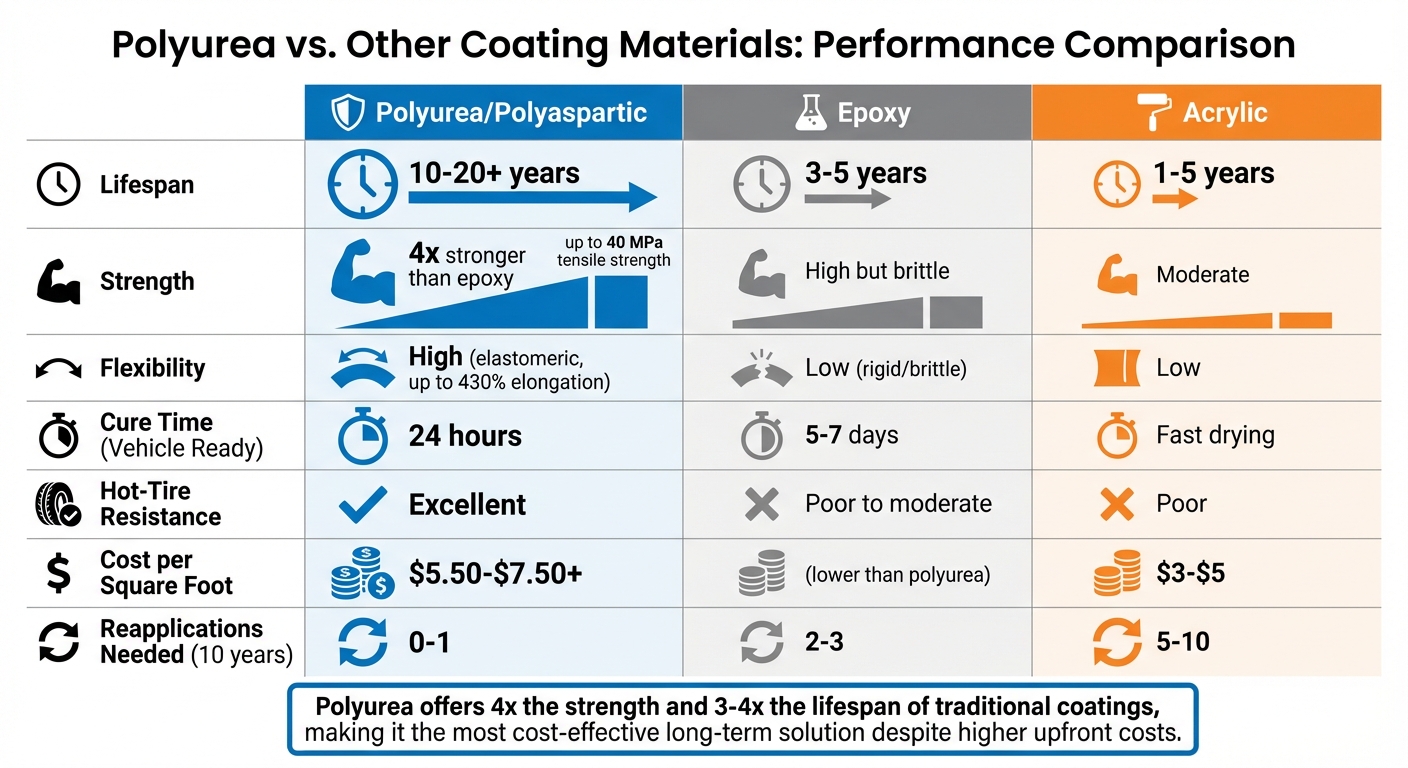
Polyurea vs Epoxy vs Acrylic Coatings: Durability and Performance Comparison
Durability and Lifespan Comparison
When it comes to durability, not all coatings are created equal. Polyurea outshines traditional options like epoxy and acrylic in both strength and lifespan. For instance, polyurea coatings are four times stronger than epoxy and can last 10 to 20+ years in residential settings. Compare that to epoxy, which typically holds up for only 3 to 5 years, or acrylic coatings, which last a mere 1 to 5 years.
The secret lies in how these materials handle stress. Polyurea is elastomeric, meaning it flexes under pressure and absorbs impacts – whether it’s from dropped tools or heavy machinery – without chipping. Epoxy, on the other hand, is rigid and prone to cracking under seasonal concrete movement. This flexibility also makes polyurea highly resistant to "hot-tire pickup", a common garage issue where warm tires peel coatings off the floor.
| Feature | Polyurea / Polyaspartic | Epoxy | Acrylic |
|---|---|---|---|
| Lifespan | 10–20+ years | 3–5 years | 1–5 years |
| Strength | 4x stronger than epoxy | High (brittle) | Moderate |
| Flexibility | High (elastomeric) | Low (rigid/brittle) | Low |
| Cure Time | 24 hours to vehicle traffic | 5–7 days for vehicles | Fast drying |
| Hot-Tire Resistance | Excellent | Poor to moderate | Poor |
Another standout feature of polyurea is its seamless, non-porous surface. It penetrates deeply into the substrate, creating a strong bond. While epoxy coatings wear down and delaminate over time, polyurea remains resilient, maintaining its strength and integrity.
Cost Efficiency Over Time
Though polyurea comes with a higher upfront price – professional installation typically costs $5.50 to $7.50+ per square foot compared to $3 to $5 per square foot for acrylic – its long-term value is hard to beat. Over a 10-year span, the cost of ownership tilts heavily in favor of polyurea. Epoxy coatings, for example, might need 2 to 3 reapplications within the same period, adding to labor, material, and downtime expenses.
Roy Magnuson, Owner of Allsource Supply Inc., explains it well:
"Polyurea coatings can last over a decade with proper care. Their resistance to UV, chemicals, and abrasion makes them a long-term solution for both residential and commercial applications".
Acrylic coatings, which seem budget-friendly at first, require reapplication every 1 to 2 years just to maintain basic protection. This frequent maintenance turns into an ongoing expense that quickly adds up.
Polyurea also saves on hidden costs thanks to its rapid cure time. While epoxy needs 5 to 7 days before vehicles can be parked on it, polyurea is ready for use in as little as 24 hours. For businesses, this means minimal downtime and a quicker return to normal operations. Plus, polyurea’s seamless surface is easy to maintain – routine cleaning with pH-neutral solutions is all it takes, avoiding the high upkeep costs associated with other coatings.
Common Uses for Polyurea Coatings in High-Traffic Areas
Garage Floors and Driveways
Garages and driveways endure a lot of wear and tear daily, but polyurea coatings are designed to handle the challenge. Unlike epoxy coatings, which can peel when exposed to hot tires, polyurea resists this issue entirely, staying intact even under extreme conditions . Its flexibility allows it to expand and contract with the concrete during temperature changes, reducing the risk of cracking. Plus, it creates a tough, impermeable barrier that protects against road salts, oil, gasoline, and other chemicals that often stain or damage concrete surfaces .
"Unlike epoxy floors that suffer from hot tire damage, polyurea coatings withstand extreme temperatures and moisture." – Innovative Concrete Coatings
Another benefit? Installation is quick, minimizing downtime, which is especially important for busy garages . For outdoor areas like driveways and garage aprons, polyurea’s UV stability ensures that surfaces won’t yellow or fade under constant sunlight. Adding vinyl chips not only enhances durability but also creates a slip-resistant surface . These qualities make polyurea coatings a top choice for high-traffic residential spaces.
And the benefits don’t stop at indoor applications.
Patios and Outdoor Spaces
Polyurea’s proven durability also makes it ideal for patios, pool decks, and walkways. Unlike epoxy, which tends to yellow and chalk when exposed to sunlight, aliphatic polyurea and polyaspartic formulations stay UV-stable. This makes them perfect for outdoor areas that face constant sun exposure.
Polyurea’s hydrophobic properties repel water, offering protection during freeze-thaw cycles . It performs reliably across a broad temperature range – from -40°F to 250°F – making it a resilient option in any climate. For wet areas like pool decks, slip-resistant aggregates can be added to improve safety .
"Regardless of the system you use, it’s a good idea to topcoat with a clear polyaspartic aliphatic polyurea. This will give you better chemical resistance, hot tire resistance, and UV stability." – Bob Harris, Decorative Concrete Institute
Thanks to its fast curing time, outdoor spaces coated with polyurea are usually ready to use within 24 hours . Additionally, its antimicrobial properties help prevent mold and mildew in damp environments, making patios easier to maintain. These features make polyurea a standout choice for high-traffic outdoor areas.
For a durable and attractive finish, reach out to Atlas Concrete Coatings to transform your space.
Conclusion
Polyurea coatings are built to last, offering a lifespan of 20–25 years in high-traffic areas. They deliver incredible strength – up to four times that of epoxy – and provide two to three times the abrasion resistance. Thanks to their elastomeric properties, these coatings can flex with concrete during temperature shifts, from -40°F to 350°F, effectively preventing issues like cracking and peeling.
In addition to their durability, polyurea coatings boast 100% UV stability, ensuring outdoor surfaces such as patios and driveways won’t yellow or fade over time. They also resist damage from oils, salts, and household cleaners. Plus, their fast curing time means floors are walkable within 2–4 hours and ready for vehicles in just 24 hours.
"Polyurea coatings significantly advance protective coating technology, offering unmatched durability, flexibility, and rapid curing times." – Tyler Gleckler, Chemist
However, to achieve these impressive results, professional application is key. Atlas Concrete Coatings employs certified technicians who use specialized equipment and diamond grinding to create a permanent bond, ensuring the coating’s long-term performance. Their polyurea systems come with a 15-year warranty for residential floors, providing peace of mind that DIY kits simply can’t guarantee.
For homeowners looking to make a smart, durable investment, polyurea coatings are an excellent choice for garages, driveways, patios, and pool decks. Reach out to Atlas Concrete Coatings at https://atlasonedayfloors.com to schedule a free consultation and see how professional-grade polyurea can transform your surfaces into long-lasting, high-performance spaces.
FAQs
Is polyurea more durable than epoxy for high-traffic areas?
Polyurea stands out as a more durable option compared to epoxy, particularly in areas with heavy use, like garages and patios. One of its key advantages is its flexibility – it can stretch far more than epoxy, which makes it less prone to cracking under constant foot or vehicle traffic. This flexibility also helps it handle impacts better, reducing the chances of chipping or cracking.
Another major benefit is its ability to endure high temperatures. Polyurea remains stable at temperatures up to 266°F and can even tolerate short bursts of heat up to 430°F. In contrast, epoxy tends to become brittle when exposed to extreme heat. Plus, polyurea resists UV damage, meaning it won’t yellow or degrade under sunlight, making it a great choice for outdoor spaces. For those looking for a long-lasting and tough coating, polyurea offers excellent performance and durability.
How can I maintain polyurea coatings to ensure they last in high-traffic areas?
To keep your polyurea-coated floors looking great and lasting longer, consistent upkeep is essential. Start by sweeping or vacuuming regularly to get rid of dirt and debris. When it’s time to clean, use a damp mop with a mild, non-abrasive cleaner. Steer clear of harsh chemicals – they can damage the finish over time.
For added longevity, consider reapplying a polyurea sealer every 6 to 12 months, depending on how much foot traffic the area gets. If you notice any chips or cracks, repair them right away to avoid further damage. Also, avoid dragging heavy furniture or using abrasive tools directly on the surface to keep it in top shape.
With the right care, polyurea coatings can handle the wear and tear of busy spaces like garages and patios while keeping their sleek, polished look for years.
Are polyurea coatings suitable for outdoor areas exposed to sunlight?
Polyurea coatings, particularly aliphatic polyurea, are built to withstand UV exposure, making them a solid option for outdoor areas like patios and pool decks. They retain their strength and look even after prolonged exposure to direct sunlight.
Atlas Concrete Coatings provides top-tier polyurea solutions specifically designed for outdoor applications, ensuring durability and protection in sun-drenched environments.