
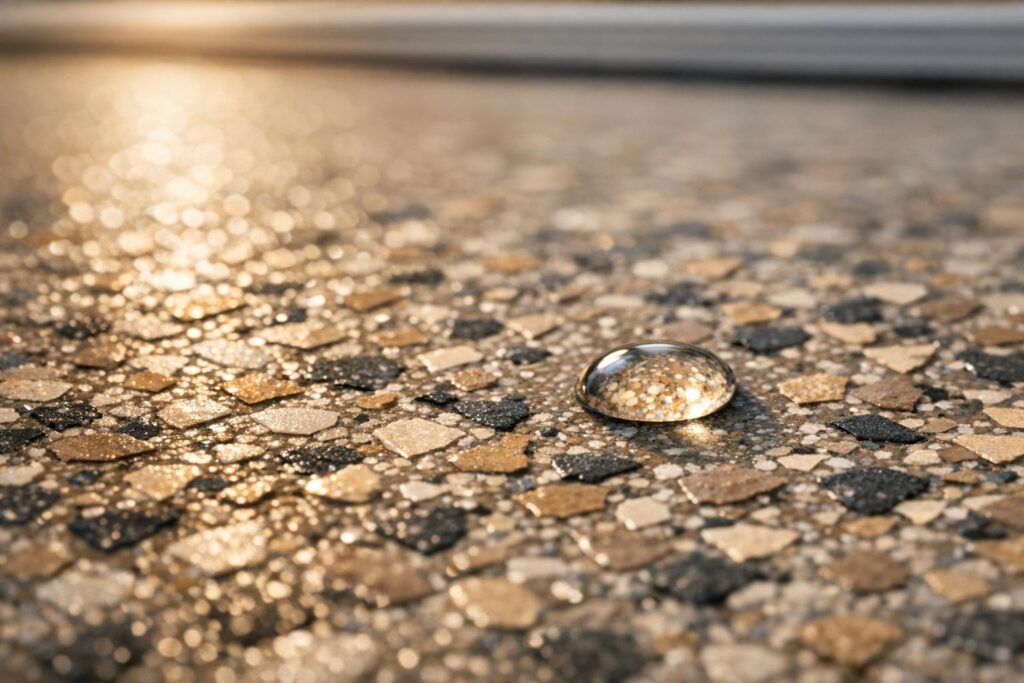
Polyurea coatings are a durable and visually appealing solution for concrete surfaces, offering a natural stone finish that combines strength with aesthetic versatility. These coatings cure quickly, resist chemicals, and endure heavy traffic, making them ideal for residential, commercial, and industrial spaces. Key benefits include:
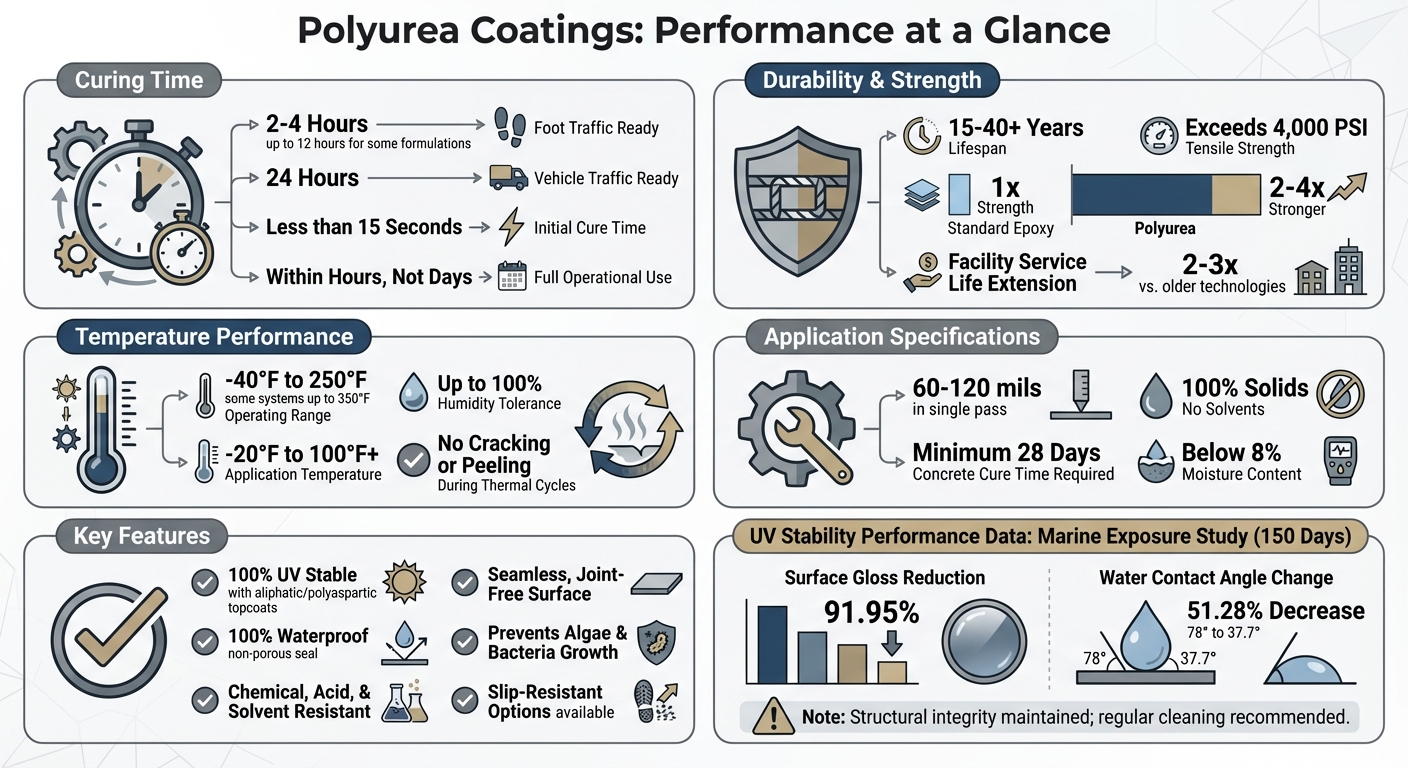
- Fast curing: Foot traffic is safe within 12 hours, and vehicles within 24 hours.
- Durability: Lifespan ranges from 15 to 40+ years, with tensile strengths exceeding 4,000 PSI.
- UV stability: Aliphatic and polyaspartic formulations prevent yellowing and fading.
- Customization: Options include decorative vinyl flakes, earthy tones, and even real stone aggregates for a premium look.
- Weather resistance: Performs in temperatures from -40°F to 250°F without cracking or peeling.
These coatings are applied using advanced spray systems, ensuring a seamless, joint-free surface that resists stains, algae, and bacteria. Whether for garages, pool decks, or industrial facilities, polyurea coatings deliver long-lasting performance with a refined natural stone appearance.
Polyurea Coatings Performance Specifications and Benefits
Polyurea Concrete Coatings In-Depth: Problems & Benefits
sbb-itb-4b4bb37
Performance Properties of Polyurea Coatings
Polyurea coatings stand out for their impressive performance attributes, particularly when paired with natural stone finishes. Thanks to their closed-molecule structure, these coatings resist chemical penetration while offering exceptional mechanical strength. This combination makes them an excellent choice for applications requiring both durability and visual appeal.
Studies indicate that polyurea coatings can extend the service life of facilities by 2 to 3 times compared to older coating technologies, especially in terms of their resistance to chemicals and abrasion. On top of that, their quick curing process and efficient installation add to their appeal.
Fast Curing Time and Installation Speed
One of the defining features of pure polyurea systems is their incredibly fast curing time – often less than 15 seconds. This allows facilities to resume operations within hours instead of days. For example, foot traffic can typically restart in just 2–4 hours, while even slower-curing formulations are ready for use within 24 hours.
This speed advantage is partly due to polyurea’s ability to be applied at full thickness (60 to 120 mils) in a single pass. Unlike multi-layer systems that require drying time between coats, polyurea’s one-coat application reduces labor costs and downtime. Additionally, because polyurea is made up of 100% solids with no solvents, the wet film thickness remains the same after curing, eliminating shrinkage concerns.
Polyurea also performs well in extreme conditions, tolerating temperatures from near freezing to over 100°F and humidity levels up to 100%. This makes it a reliable choice for a wide range of environments, ensuring minimal disruption during installation.
Mechanical Strength and Chemical Resistance
Polyurea coatings offer mechanical strength that is 2 to 3 times greater than standard epoxy floors, with some systems rated at up to 4 times stronger. This durability helps them withstand heavy foot traffic and rolling loads, preserving the appearance of decorative stone finishes. Their closed-molecule structure also prevents the absorption of corrosive chemicals, acids, and solvents. As Jose Ibarra, owner of Crown West Inc., puts it:
"Being 100 percent solids, it’s a closed-molecule system. It doesn’t bleed, it doesn’t open up, it doesn’t allow for growth of algae and bacteria".
This chemical resistance is particularly critical in challenging environments like garages, commercial kitchens, and industrial facilities where spills are common. Additionally, polyurea remains stable across a wide temperature range, from -40°F to 250°F. This prevents cracking or delamination during thermal cycles or freeze-thaw conditions, ensuring the surface stays intact while maintaining the natural stone finish’s aesthetic.
Atlas Concrete Coatings (https://atlasonedayfloors.com) takes advantage of these advanced properties, offering flooring solutions that combine long-lasting durability with the refined look of natural stone finishes.
Durability and Long-Term Performance
When professionally applied, polyurea coatings with natural stone finishes can last an impressive 15 to 25+ years. This durability is thanks to the material’s microphase separation, which combines soft segments with hard urea bonds that form hydrogen bonds. This unique structure gives polyurea its exceptional tensile strength and resilience.
"Film properties as far as the gloss and the physical property of toughness are superior to most other coatings"
Mark Glendrange, Technical Director at Versatile Building Products, emphasizes the toughness of polyurea coatings. These properties make them capable of handling diverse environmental and usage conditions without compromising performance.
UV Stability and Weather Resistance
Outdoor surfaces like patios and pool decks are constantly exposed to sunlight, rain, and fluctuating temperatures. Polyurea’s elastomeric nature enables it to flex with the concrete substrate during extreme temperature shifts, preventing cracking and peeling that often plague stiffer coatings. Its 100% waterproof, non-porous seal blocks water, chemicals, and salts, which helps stop algae growth and protects the underlying structure.
For added UV protection, polyaspartic-modified polyurea coatings are specially designed to avoid discoloration. As Ultimate Linings explains:
"Polyaspartic is specifically designed to be more UV resistant than even specially made UV resistant polyurea coatings. Polyaspartic coatings don’t change color under the sun, and they don’t crack or weaken in sunlight"
Many high-quality systems even come with lifetime UV stability guarantees to ensure long-lasting vibrant colors.
However, research shows that while polyurea retains its structural integrity, extended outdoor exposure can impact its surface appearance. For example, marine exposure studies over 150 days showed a 91.95% decrease in surface gloss due to increased surface roughness and minor cracking. Additionally, the water contact angle dropped by approximately 51.28% (from 78° to 37.7°), making the surface more likely to attract dirt and other contaminants. Regular cleaning with mild soap solutions can help maintain the natural stone finish’s aesthetic over time. This weather resistance ensures polyurea performs reliably, even in high-stress outdoor environments.
Performance Under Heavy Loads and Traffic
Garage floors and industrial spaces demand coatings that can withstand constant vehicle traffic and heavy equipment. Polyurea’s toughness gives it an edge over comparable floor coatings. Its closed-molecule structure prevents the surface from breaking down or “bleeding” under stress, preserving both its structural integrity and decorative finish.
In high-traffic areas, a thin epoxy primer (approximately 2 mils) is often applied before the polyurea coating. This step ensures a strong bond and prevents delamination. Proper surface preparation, such as diamond grinding, further enhances adhesion by creating a mechanical bond. It’s also critical to apply the coating to concrete that has cured for at least 28 days with a moisture content below 8% to avoid adhesion issues.
Long-term studies back up polyurea’s durability. In marine exposure tests, the coating initially showed an increase in tensile strength due to molecular cross-linking, followed by a gradual decline after 150 days. This performance highlights polyurea’s ability to maintain its protective qualities in tough conditions, making it a dependable choice for both residential and commercial spaces where a natural stone finish must endure heavy use for years.
Natural Stone Finish Options and Customization
Polyurea coatings are a great way to replicate the look of natural stone while adding a layer of protection to concrete surfaces. These coatings can be fine-tuned with multi-layer pigmentation, where different colors are applied in separate layers during the process. This technique creates a sense of depth and variation that closely resembles the earthy tones and subtle patterns of real stone.
Some advanced systems, like LuxuryStone, take things a step further by combining polyurea or polyaspartic resins with actual stone aggregates such as marble, granite, travertine, or slate. This method delivers a finish that goes beyond what pigmentation alone can achieve. While the upfront cost is higher, the added durability makes it a worthwhile investment. This approach also opens the door to more personalized designs in both color and texture.
Color Options and Pigmentation Techniques
For those looking to add depth and texture, multi-layer pigmentation is just one option. Full broadcast flake systems offer another way to mimic natural stone textures. These systems use decorative vinyl flakes embedded in a polyurea base coat to create patterns that resemble materials like terrazzo or granite. Beyond aesthetics, these flakes also enhance the coating’s impact resistance. To improve safety in areas prone to moisture, like pool decks, texture additives such as silica powder can be included for better slip resistance. These features not only enhance the natural stone look but also align with polyurea’s durability.
To maintain the vibrancy of these finishes, installers use aliphatic polyurea or polyaspartic topcoats, which are fully UV-stable. Unlike traditional epoxy coatings that often yellow over time, these topcoats retain their clarity and prevent discoloration, even with constant sun exposure.
Continuous Surface Application
One of the standout features of polyurea is its spray application, which creates a seamless, joint-free surface. This monolithic design enhances both the appearance and functionality of the coating by eliminating areas where dirt or water might collect. Its non-porous surface also resists deep stains from spills and inhibits algae or bacteria growth, making cleaning easy with pH-neutral products.
This seamless finish is especially appealing for commercial showrooms and residential garages, where a polished, uniform look is often preferred. Customization options, like embedded logos or stenciled patterns, can also be integrated into the natural stone design. Plus, with the ability to apply polyurea in temperatures ranging from -20°F to over 100°F, it performs reliably in a wide range of climates. These seamless surfaces are not only visually striking but also built for long-lasting performance.
For more details on achieving these natural stone-inspired finishes, Atlas Concrete Coatings uses cutting-edge polyurea technology to create durable and visually appealing concrete floor coatings for residential, commercial, and industrial spaces.
Installation Process and Surface Compatibility
Getting a durable natural stone finish starts with proper installation.
Surface Preparation Requirements
Preparation begins with the concrete itself. The surface needs to be ground using commercial walk-behind grinders or shot-blasters to eliminate dirt, oil, dust, or any existing coatings. This process mechanically profiles the concrete, opening its pores and creating a rough texture that helps the base coat stick. As one installer puts it:
"Grinding is performed not only to assist with cleaning the existing concrete surface, the scarification produces a rough, grooved surface ideal for polyaspartic primer adhesion." – A1 Concrete Coating
For edges and tight spaces, hand-held angle grinders are essential. Cracks or chips in the concrete are routed with a grinder to open them up, then filled with a fast-curing compound. Once dry, these areas are smoothed out. After grinding, use a HEPA vacuum to remove fine dust, which could otherwise interfere with adhesion. After cleaning, apply a polyaspartic or specialized primer. This primer not only strengthens the bond but also protects against moisture damage. One expert emphasizes the importance of a solid substrate:
"Think of your floor as building structure, if your foundation is cracked, damaged or weak, then so will be the structure that you build upon it." – A1 Concrete Coating
Once the surface is prepped, the focus shifts to precise application.
Application Methods for Concrete
With the substrate ready, polyurea is applied using high-pressure spray equipment. This system uses plural component spray machines that heat the material to 140°F–160°F and deliver it through heated hoses at a 1:1 ratio. The high-pressure spray works well on both horizontal and vertical surfaces. Additionally, polyurea’s unique formulation allows it to be applied in temperatures as low as –20°F and makes it resistant to humidity during application.
Since polyurea cures in just 15 seconds, an epoxy-based primer is used to ensure a strong bond. The natural stone finish is achieved through a three-layer system: first, apply the primer; second, broadcast decorative flakes or aggregates; and finally, seal it with a polyaspartic topcoat. The intermediate layer dries in 2–3 hours, allowing foot traffic shortly after .
Atlas Concrete Coatings employs this professional spray method to deliver quick installations while maintaining the elegant natural stone finish their clients expect. This precise process ensures not only rapid curing but also the seamless look that makes these coatings so appealing.
Conclusion
Polyurea coatings with natural stone finishes bring together durability, strength, and visual appeal in one package. These systems cure quickly – often ready for foot traffic within just 24 hours – and deliver mechanical strength up to four times greater than epoxy. They also offer strong resistance to chemicals, moisture, and abrasion, which can extend the lifespan of facilities by two to three times compared to older coating technologies.
What sets these coatings apart is their ability to maintain 100% UV stability when paired with aliphatic polyaspartic topcoats. They also adapt to temperature fluctuations ranging from –40°F to 350°F without yellowing, fading, or cracking, issues that are common with other finishes. In fact, these systems have been used in high-performance infrastructure projects with lifespans of up to 125 years.
Beyond performance, natural stone finishes add a layer of aesthetic versatility. By incorporating aggregates like marble, granite, travertine, or slate, these coatings can replicate the look of high-end stone flooring. Whether you prefer subtle earth tones or bold, vibrant colors, and finishes ranging from matte to high-gloss, these coatings deliver both style and functionality. They’re also designed for outdoor use, offering heat reflectivity and slip resistance.
The closed-molecule structure of polyurea coatings makes them especially useful in environments like healthcare and food processing. Their non-porous surface is easy to clean with pH-neutral solutions, helping maintain both hygiene and appearance in high-traffic areas. This makes them a great choice for residential garages, commercial showrooms, and industrial warehouses where cleanliness is critical.
Atlas Concrete Coatings uses these advanced polyurea systems to provide flooring solutions that combine fast installation with lasting performance. Whether it’s a residential, commercial, or industrial application, polyurea coatings with natural stone finishes deliver the strength, longevity, and stylish appearance needed for today’s demanding spaces.
FAQs
Is polyurea safe for my garage or pool deck?
Polyurea is a solid choice for both garages and pool decks. It’s tough, requires minimal upkeep, and can handle exposure to water, chemicals, and harsh outdoor elements with ease. Plus, it’s designed to last over a decade and is environmentally friendly, making it a dependable and responsible option for these surfaces.
How do I keep the stone-look finish clean long-term?
To keep your polyurea coating looking like new with its stone-like finish, stick to a simple maintenance routine. Regularly sweep or vacuum using soft tools to clear away dirt and debris. For deeper cleaning, mop weekly or monthly with a microfiber mop and a pH-neutral cleaner.
If spills happen, blot them up right away to avoid stains. Steer clear of harsh chemicals or abrasive tools, as they can damage the surface. In high-traffic areas, consider using mats and furniture pads to minimize wear. Lastly, inspect the coating periodically, and take care of any chips or dull spots as soon as you notice them.
Will it peel or crack if my concrete has moisture?
Polyurea coatings stand out for their strong resistance to moisture, making them less likely to peel or crack even if the concrete has some moisture content. That said, proper surface preparation and thorough moisture testing are crucial steps before applying these coatings. Taking these precautions ensures their durability and reliable performance over time.