
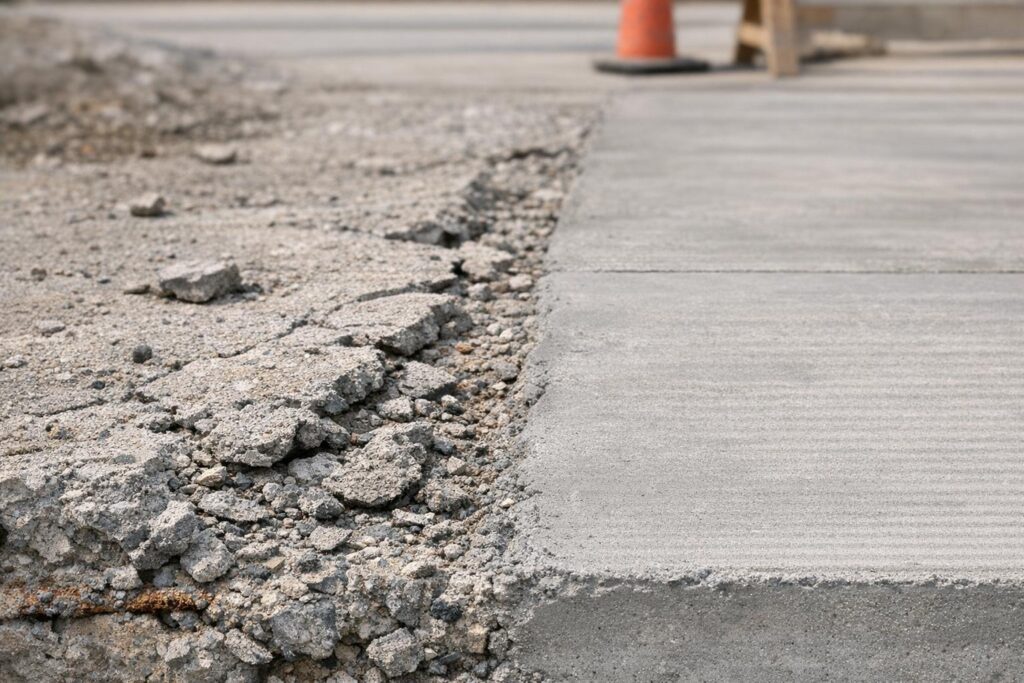
Spalled concrete – those chips, flakes, or pits on a slab’s surface – is more than an eyesore. It can signal deeper issues affecting safety, costs, and structural durability. The decision to repair or replace depends on factors like damage depth, structural stability, and long-term costs. Here’s the breakdown:
- Repair: Best for minor, shallow damage (less than 1 inch deep or small areas). Costs are lower ($4–$10 per sq. ft.), with minimal downtime.
- Replace: Necessary for severe damage (over 6 inches deep), exposed rebar, structural risks, or slabs nearing the end of their 20–30 year lifespan. Costs are higher ($10–$20+ per sq. ft.), but it ensures longevity (20–50 years).
Key takeaway: Repairs save money short-term but may not hold up if the slab is old or structurally compromised. Replacement offers a long-term solution but requires higher upfront investment. Evaluate the slab’s condition carefully or consult a professional to make the right call.
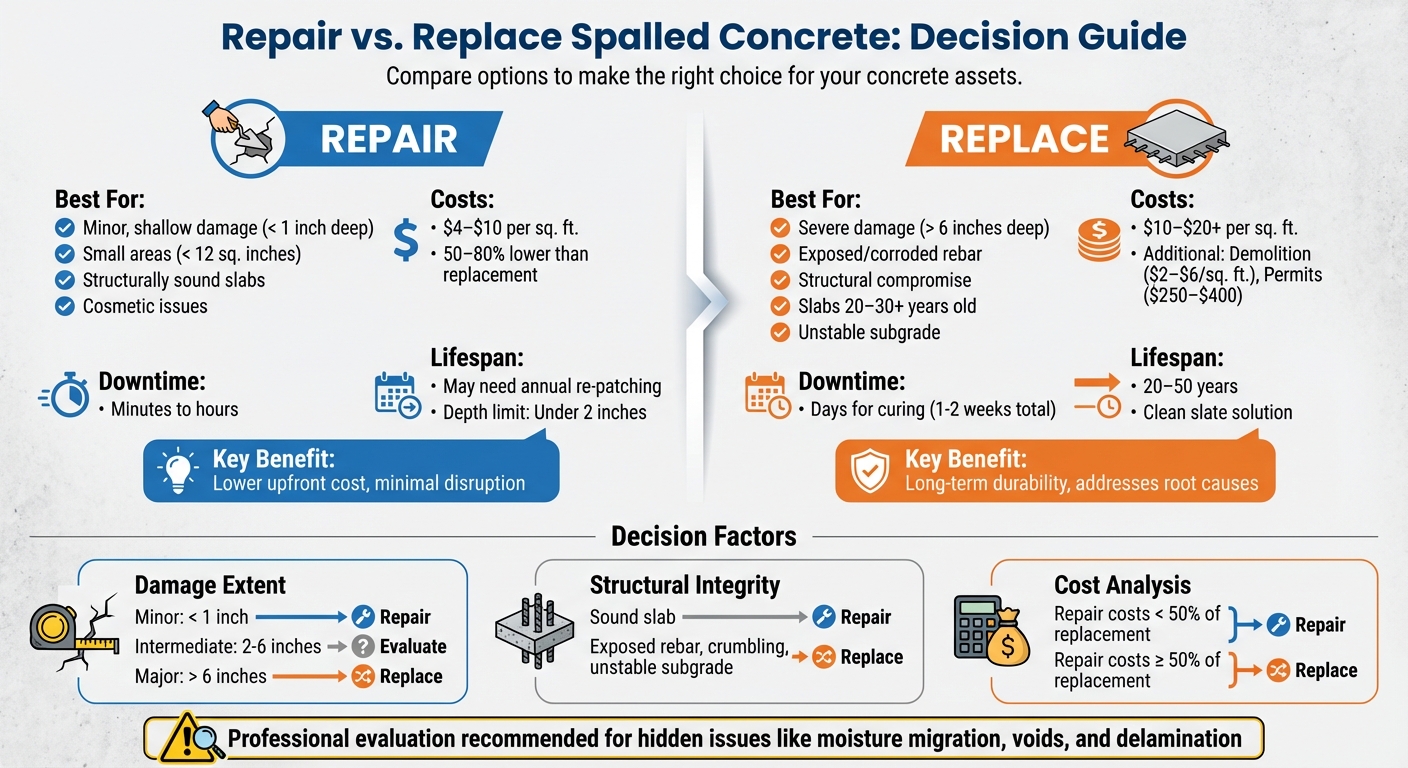
Concrete Repair vs Replacement Decision Guide
How To: Spalled Garage Concrete Repair by Shotblast and Urethane Patch
Factors That Determine Repair or Replacement
When deciding between repairing or replacing concrete, three main factors come into play: the extent of the damage, the structural stability, and the overall cost-effectiveness.
Extent and Depth of Spalling
The severity of spalling plays a key role in determining the appropriate course of action. Minor spalling, where the damage is less than 1 inch deep and affects an area smaller than 12 square inches, can typically be fixed with standard patching materials. However, intermediate spalling – damage ranging from 2 to 6 inches deep – requires more intensive repairs. If over 50% of a reinforcing bar is exposed, this also qualifies as intermediate damage.
When repairs demand more than 2 inches of material, replacement often becomes the more practical and economical choice. For damage exceeding 6 inches in depth, you’ve entered major spalling, which compromises the structural capacity of the slab. At this stage, full replacement is usually the only viable solution.
These depth and area measurements serve as a starting point for evaluating the structural health of the concrete.
Structural Integrity and Longevity
Beyond surface damage, it’s crucial to assess how spalling impacts the long-term stability and safety of the structure. Signs like crumbling, buckling, or spreading cracks suggest that repairs may not be sufficient.
"Replacing concrete… may also be appropriate for concrete older than 30 years and when structural integrity is compromised"
– Holly Richards-Purpura, Groundworks
If the subgrade beneath the slab is unstable, replacement becomes necessary. Similarly, for load-bearing areas such as driveways or steps, exposed and corroded rebar signals that the slab can no longer safely support weight, making replacement a must.
Once you’ve evaluated the damage and structural risks, it’s time to weigh the financial and logistical factors.
Cost and Disruption Considerations
Repairs generally offer a more affordable and quicker solution compared to replacement. Repairing concrete can cost 50–80% less than replacing it and typically involves minimal downtime, ranging from minutes to a few hours. On the other hand, replacement costs $8–$15 per square foot and requires days for curing. Additional expenses, such as demolition and disposal ($2–$6 per square foot) and permits ($250–$400), can also add up.
That said, if the concrete is nearing the end of its lifespan (20 to 30 years) and has extensive damage, replacement provides a clean slate with a lifespan of up to 50 years. While the upfront costs and disruption are higher, replacement can be the smarter long-term investment.
| Factor | Repair (Patching/Leveling) | Full Replacement |
|---|---|---|
| Upfront Cost | 50–80% lower | $8–$15 per sq. ft. |
| Downtime | Minutes to hours | Days for curing |
| Depth Limit | Under 2 inches | Necessary beyond 6 inches |
| Lifespan | May need annual re-patching | 20–50 years |
| Best For | Isolated, shallow damage | Structural failure, old slabs |
When to Repair Spalled Concrete
If an evaluation confirms that repair is possible, addressing spalled concrete can restore both its function and appearance while keeping costs and time in check.
Conditions That Favor Repair
Repairing spalled concrete makes sense when the damage is purely cosmetic, confined to a small area, and the slab itself remains structurally sound. Minor spalls and popouts can often be repaired without affecting the overall stability of the concrete.
"If spalls and popouts are addressed quickly, your concrete contractor may be able to seal the concrete or install an overlay that protects it from further issues." – American Paving
Catching the damage early is crucial. When the affected area is limited, and the concrete is relatively new with many years of service life left, repair is usually a practical and cost-effective alternative to full replacement. Once deemed repairable, it’s essential to choose the right method for the specific type of damage.
Common Repair Methods
The best repair approach depends on the severity and location of the damage. For minor spalls, using neat epoxy or epoxy mortar is effective. These materials create a strong bond and act as a waterproof barrier, helping to slow down corrosion. Cracks, on the other hand, require a flexible concrete caulk that moves with the natural expansion and contraction of the concrete, reducing the risk of further cracking or chipping.
In cases where the slab is structurally sound but the surface layer is weak or "sandy", removing the top ½ to 1 inch and applying a stamped or polymer-modified overlay can rejuvenate the surface.
For long-term prevention, applying a penetrating waterproofing sealer is highly recommended. Ideally, this sealer should be applied 28 days after the concrete is poured and refreshed every few years. This step helps block moisture and de-icing salts, the main culprits behind freeze-thaw damage.
Benefits of Adding Protective Coatings
To ensure repairs last longer, protective coatings are a smart addition. Polyurea-based coatings, for example, create a waterproof barrier that prevents water intrusion – the leading cause of spalling. These coatings also stand up to freeze-thaw cycles and de-icing salts.
Atlas Concrete Coatings offers polyurea-based chip floor coatings that provide both protection and customization. Their systems include a polyurea basecoat and topcoat, which are slip-resistant, UV-resistant, and available in a variety of colors and finishes. Whether you’re repairing a garage floor, pool deck, or commercial space, these coatings not only extend the life of the concrete but also enhance its appearance.
Protective coatings do more than prevent further damage – they also improve the look of repaired surfaces. This makes them a great choice for high-visibility areas like driveways, patios, and commercial floors.
sbb-itb-4b4bb37
When to Replace Spalled Concrete
Sometimes, repairs just don’t cut it. If the damage is too severe or the concrete has simply outlived its usefulness, it’s time to think about replacement.
Scenarios That Call for Replacement
Structural damage is one of the clearest signs you need to replace spalled concrete. When spalling exposes rebar and compromises the slab’s ability to bear weight, replacement becomes critical. Keith Whallett, CEO of The Foundation Works, explains:
"As the rebar absorbs water, it begins to rust. As it rusts, it expands, and as it expands… it literally creates a greater expansive force than the surrounding concrete’s resistive force. Eventually, the concrete will yield to that overwhelming force and begin to fracture, crumble and break down."
Extensive surface damage is another red flag. If tapping the concrete with a metal tool produces a hollow or echo-like sound, it’s a sign of delamination – the surface has separated from the underlying layer.
Unstable subgrade or drainage problems can also make surface repairs pointless. Issues like shifting soil, frost heaves, or poor compaction cause damage that patches or overlays won’t fix for long [8,17]. For example, if the slab feels spongy or moves when stepped on, the ground beneath has likely settled. Worse yet, if the concrete no longer drains water properly – causing pooling or directing water toward your home – replacement is necessary to regrade the slab for proper drainage.
Old age and repeated failures are practical reasons to replace concrete. If the slab is 20 to 30 years old and shows widespread wear, it’s often more cost-effective to replace it than to keep patching [6,8]. Additionally, if previous repairs didn’t hold or the damage requires more than two inches of new material, replacement is the smarter financial choice.
Once these conditions are identified, it’s time to focus on the replacement process and what it can offer.
Replacement Process and Benefits
Replacing spalled concrete provides a long-term fix. The process involves demolishing the damaged slab, removing debris, regrading the subgrade, and pouring fresh concrete [6,17]. Typically, this takes 1 to 2 weeks, including curing time. Although replacement costs $10 to $20+ per square foot (compared to $4 to $10 per square foot for repairs), it delivers a new service life of 20 to 30+ years [6,8,17].
Modern concrete mixes used during replacement offer added durability. For example, freeze-thaw–resistant mixes with air entrainment create tiny chambers inside the concrete, relieving internal pressure during temperature swings and reducing the likelihood of future spalling. Replacement also allows you to fix underlying soil issues, improve drainage with proper slope adjustments, or even add features like ADA-compliant ramps [8,17].
For high-traffic areas like garages, pool decks, or commercial spaces, replacement followed by protective coatings is a smart investment. Companies like Atlas Concrete Coatings can apply durable polyurea-based systems over newly poured concrete, creating a waterproof barrier that protects against moisture and extends the life of your concrete.
How to Evaluate Spalled Concrete
Evaluating spalled concrete accurately is essential to decide whether repairs will suffice or if a full replacement is the better option. A quick but thorough assessment can help differentiate between minor damage and more severe issues requiring immediate attention.
Step-by-Step Evaluation Checklist
- Measure the Depth and Area:
Start by measuring how deep and widespread the spall is. If the damage is less than 1 inch deep and covers an area smaller than 12 square inches, it’s generally considered minor. Anything deeper or larger could indicate more serious problems. - Inspect for Exposed Rebar:
Look for exposed reinforcing steel. If more than half of the rebar’s circumference is visible, it could signal structural concerns that require professional intervention. - Perform a Soundness Test:
Use a metal tool to tap around the spalled area. A hollow sound suggests delamination, meaning the surface has separated from the underlying layer. Before repairs can be made, the unsound concrete must be removed. As ConcreteNetwork.com puts it:
"More repairs fail because of poor surface preparation than from any other cause. All unsound concrete must be removed, leaving sound, clean, and suitably roughened surfaces."
- Check for Movement or Deflection:
Walk over the slab to feel for spongy spots, uneven surfaces, or sinking areas. These symptoms often point to subgrade failure, which surface repairs alone won’t fix. Also, keep an eye out for spreading cracks, as they may indicate ongoing structural movement. - Evaluate Repair Versus Replacement Costs:
Consider the bigger picture. If the concrete is over 20 years old, has undergone multiple failed repairs, or would require more than 2 inches of new material, full replacement might be more cost-effective than patching isolated areas .
After completing this checklist, seeking a professional opinion can help confirm whether repairs or a replacement is the best course of action.
Professional Assessment and Solutions
While the checklist above offers a solid starting point, professionals can uncover hidden problems like moisture migration, voids in the subgrade, or chemical damage. For example, Atlas Concrete Coatings provides free consultations to determine whether your concrete can be salvaged with high-performance coatings or if structural replacement is necessary. Their team uses advanced tools to measure deflection, assess moisture levels, and evaluate bonding conditions. From long-lasting polyurea coatings to complete replacement, they’ll recommend the best solution to restore your concrete.
Conclusion
Deciding between repairing and replacing concrete depends on several factors: the slab’s structural integrity, the extent of damage, its age, and the overall cost. For minor, localized spalling that doesn’t affect the slab’s load-bearing capacity, repairs can be a cost-effective option – saving up to 50% compared to a full replacement. But when damage is extensive, the concrete is over 20–30 years old, or repair costs near 50% of replacement expenses, opting for a complete replacement often provides better long-term value.
It’s also crucial to address the underlying causes of the damage, such as poor soil compaction, drainage problems, or a subpar concrete mix. Without tackling these issues, surface repairs are unlikely to hold up over time. If repair costs reach 50% or more of the replacement cost, replacement becomes the more practical choice.
A professional evaluation is essential to uncover hidden problems like moisture migration, voids in the subgrade, or delamination. Companies like Atlas Concrete Coatings offer free consultations to help determine whether your concrete is suitable for high-performance polyurea coatings or if structural replacement is necessary – ensuring a solution that stands the test of time.
No matter the route you take, proper surface preparation and high-quality protective coatings are key to preventing future issues like moisture infiltration or freeze-thaw damage. For both repaired and replaced slabs, Atlas Concrete Coatings provides durable and customizable finishes that not only guard against future spalling but also deliver a seamless, polished appearance.
FAQs
How can I determine if spalled concrete is compromising the structural integrity of my slab?
If the spalling goes deeper than 1 inch, reveals a large section of the reinforcing bar, or comes with other problems like cracks, buckling, uneven surfaces, or visible deformation, it could point to more serious structural issues. These are signs that the damage might not just be cosmetic but could potentially compromise the integrity of the slab.
When you notice these red flags, it’s wise to bring in a professional to evaluate the damage. They can determine whether repairs will suffice or if a full replacement is necessary. Acting quickly can help stop the problem from escalating and protect the safety and durability of your concrete structure.
How do the costs compare between repairing and replacing spalled concrete?
Repairing spalled concrete is often a much more budget-friendly option compared to a full replacement. For instance, filling cracks usually costs about $1–$3 per square foot, while resurfacing tends to fall between $3–$5 per square foot. This means that fixing a typical driveway could run you anywhere from $800 to $2,000. On the other hand, replacing the concrete entirely can cost $8–$15 per square foot, making repairs around 50–80% less expensive in most cases.
For larger areas, opting for repairs instead of replacement can save you thousands of dollars. That said, if the damage is severe or affects the structural integrity, replacement might be the smarter long-term choice. To make the best decision for your situation, consulting experts like Atlas Concrete Coatings can provide valuable guidance.
How do I know if I need a professional to evaluate spalled concrete?
If the spalling has spread extensively, created deep pits that expose reinforcement, or allowed water to seep into the concrete, it’s time to seek professional help. Damage that compromises the structural integrity of the slab or involves failed previous repairs also calls for expert evaluation. When in doubt about the severity of the problem or the right way to address it, consulting a professional can save you both time and prevent further complications.
For reliable and lasting repairs, Atlas Concrete Coatings provides expert concrete repair services designed for residential, commercial, and industrial projects. Their skilled team ensures your concrete surfaces are restored with precision and efficiency.