
Polyurea is a standout solution for protecting concrete surfaces from thermal stress caused by temperature fluctuations, freeze-thaw cycles, and UV exposure. Its flexibility, resistance to cracking, and ability to bond tightly to concrete make it a reliable choice for long-term durability in residential, commercial, and outdoor settings. Here’s what you need to know:
- Thermal Stress: Concrete expands and contracts with temperature changes. Rigid coatings like epoxy often fail, leading to cracks and delamination. Polyurea’s elasticity prevents these issues.
- Freeze-Thaw Cycles: Polyurea forms a waterproof barrier, stopping water infiltration that causes freeze-thaw damage. It performs well even at low temperatures (-20°C/-4°F).
- UV and Heat Resistance: Aliphatic polyurea resists UV degradation and maintains color under sunlight. It also handles high temperatures without softening or peeling.
- Applications: Ideal for garage floors, pool decks, warehouses, parking decks, and outdoor structures. It cures quickly and withstands heavy use.
- Durability: With proper application and maintenance, polyurea coatings can last 20–25 years, making them a cost-effective investment.
Polyurea’s ability to handle extreme conditions, combined with low maintenance requirements, makes it a top choice for protecting concrete surfaces from thermal stress.
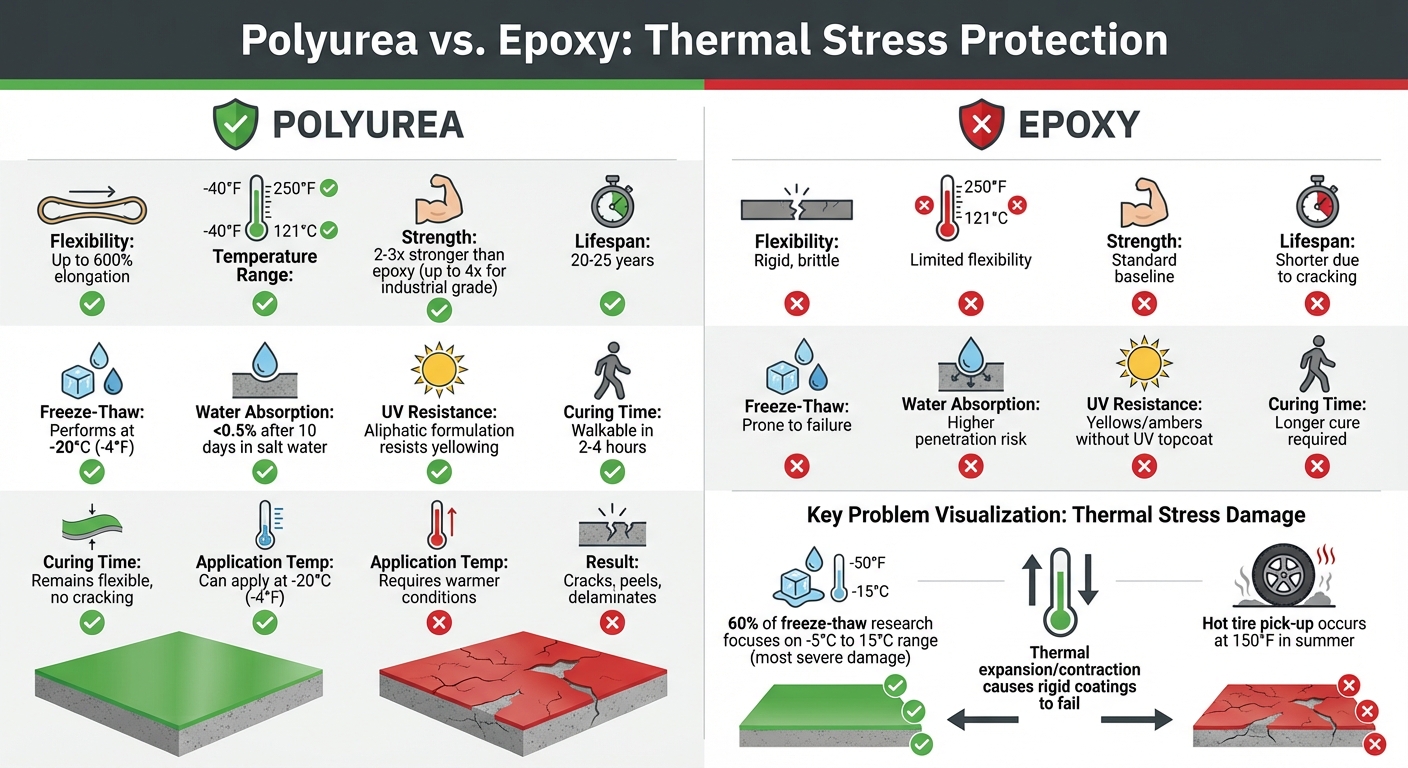
Polyurea vs Epoxy Coating Performance Comparison for Thermal Stress Protection
How Thermal Stress Damages Concrete Floors
Thermal Expansion and Contraction
Concrete naturally expands and contracts as temperatures rise and fall, which puts stress on its surface. When the protective coating on the concrete can’t move with these changes, trouble starts. Rigid coatings, like epoxy, tend to crack and become brittle because they lack the flexibility to adjust to the concrete’s movement. This often leads to peeling and delamination.
Over time, repeated cycles of heating and cooling weaken the bond between the concrete and its coating. This results in visible cracks, flaking, and even structural damage. The problem is especially pronounced in areas with extreme temperature shifts, where coatings without elasticity struggle to keep up with the concrete’s constant expansion and contraction. Freeze-thaw cycles only make these issues worse by introducing additional stress.
Freeze-Thaw Cycles
Concrete is porous, which means water can seep into it. When temperatures drop below freezing, the trapped water turns to ice, expanding and creating pressure that damages the concrete.
Studies indicate that around 60% of freeze-thaw research focuses on temperature ranges between -5°C and 15°C (23°F to 59°F), as this is when the most severe damage occurs. Repeated freeze-thaw cycles lead to spalling, where the surface chips away, and scaling, which appears as flaking or peeling. Over time, these processes make the concrete more porous, allowing harmful substances like chlorides and CO2 to penetrate deeper. This can corrode the reinforcing steel inside, significantly shortening the floor’s lifespan.
"The porous surface of concrete flooring allows water and soluble contaminants to penetrate into a structure, which can lead to premature degradation."
– Duraamen Engineered Products
In addition to freeze-thaw damage, exposure to UV rays and heat also takes a toll on concrete coatings.
UV and Heat Exposure
Long-term exposure to UV rays can discolor concrete and cause chalking. On the other hand, extreme heat can soften coatings, making them tacky or prone to deformation.
This becomes even more problematic in high-traffic areas. For instance, vehicle tires heated to 150°F during summer months can weaken a coating’s adhesion. This process, called "hot tire pick-up", occurs when the softened coating sticks to the tire and peels away from the concrete. Standard epoxy coatings are especially vulnerable – they tend to yellow or amber under sunlight unless protected by UV-resistant topcoats.
"Extreme temperatures can wreak havoc on coatings, causing them to crack, peel, or degrade prematurely."
– FloorTech Concrete Coatings
Polyurea Resins – Session 1
How Polyurea Protects Against Thermal Stress
Polyurea offers exceptional protection for concrete under thermal stress through its unique combination of flexibility, resistance to freeze-thaw cycles, and UV/heat resilience.
Flexibility and Adhesion
One of polyurea’s standout features is its ability to stretch up to 600%, allowing it to act as a flexible membrane that absorbs the natural movement of concrete without cracking. This high degree of elongation enables it to bridge small cracks and adapt to substrate shifts, all while maintaining its structural integrity across a wide temperature range – from -40°F to 250°F. Additionally, polyurea forms an immediate and strong bond with concrete surfaces, reducing the risk of delamination even under intense thermal stress. This flexibility is a key factor in protecting concrete from damage caused by freeze-thaw cycles.
Resistance to Freeze-Thaw Cycles
Polyurea creates a seamless, waterproof barrier that effectively prevents water from penetrating the concrete surface. By blocking water infiltration, it addresses the root cause of freeze-thaw damage, where trapped water expands as it freezes, leading to cracks and deterioration. Some polyurea formulations absorb less than 0.5% water even after 10 days of immersion in salt water. Its ability to cure at temperatures as low as -20°C (-4°F) makes it suitable for cold climates. Moreover, polyurea can be applied to damp or nearly saturated surfaces without causing blistering, ensuring reliable performance in challenging conditions.
UV and Heat Resistance
Polyurea also stands out for its durability under UV exposure and heat. Aliphatic polyurea, in particular, offers long-lasting UV protection, maintaining its color and resisting degradation when exposed to sunlight. This is achieved through the use of UV inhibitors and absorbers, which dissipate harmful radiation as heat, shielding the concrete beneath. While aromatic polyurea may yellow over time, it still provides effective protection. Thanks to its high flexibility, polyurea accommodates thermal expansion, ensuring the coating remains firmly adhered to the concrete surface even during extended periods of heat exposure.
sbb-itb-4b4bb37
Where Polyurea Coatings Are Used
Polyurea coatings are designed to thrive in environments where temperatures can shift dramatically. Thanks to their resilience against thermal expansion, they perform exceptionally well across a variety of practical applications in residential, commercial, and outdoor settings. Let’s take a closer look at how they deliver in these areas.
Residential Applications
In residential spaces, polyurea coatings shine in areas like garage floors, pool decks, patios, driveways, and basements. These surfaces often face rapid temperature changes, heavy loads, and exposure to the elements. For instance, garage floors experience sudden shifts in temperature that can cause traditional coatings to fail. Polyurea, however, stays flexible in extreme cold or heat, resists becoming soft under intense sunlight, and prevents water infiltration during freeze-thaw cycles.
Aliphatic polyurea formulations go a step further, maintaining their appearance under harsh sunlight without becoming sticky – unlike epoxy, which tends to soften and lose its durability. Additionally, its moisture-resistant nature allows it to handle the natural expansion and contraction of concrete foundations without cracking.
Commercial and Industrial Spaces
When it comes to commercial and industrial settings, polyurea coatings are built to endure. Facilities like warehouses, manufacturing plants, cold storage units, and parking decks require coatings that can handle extreme thermal cycling and repeated freeze-thaw stress. Polyurea’s quick curing time – often walkable within 2 to 4 hours – minimizes downtime, which is a huge benefit for businesses that can’t afford prolonged closures.
Its elastomeric properties allow it to bridge minor cracks caused by the constant expansion and contraction of concrete. Plus, these coatings are tough enough to withstand industrial cleaning methods, such as steam cleaning and high-pressure washing, thanks to their excellent thermal resistance.
Outdoor Structures
Outdoor environments can be punishing, with surfaces exposed to blazing sun, freezing temperatures, and everything in between. Polyurea coatings create a durable, UV-stable barrier that protects against these elements. Unlike epoxy, which requires warmer application conditions, polyurea can be applied and cured even in temperatures as low as -20°C (-4°F). This makes it an excellent choice for walkways, bridges, and containment liners that need year-round protection.
Its water-repellent properties help prevent corrosion and spalling, ensuring long-lasting durability. For areas exposed to direct sunlight, aliphatic polyurea formulations resist yellowing, fading, or degradation over time. With regular maintenance, these coatings can last an impressive 20 to 25 years.
What to Consider When Using Polyurea Coatings
Getting the best out of polyurea coatings boils down to proper application and consistent upkeep. The difference between a coating that lasts for decades and one that fails prematurely often hinges on a few key factors.
Coating Thickness and Application
The thickness of the coating is a crucial factor. For industrial applications, the required thickness can range from 8 to 10 mils up to 1/4 inch, depending on environmental conditions and the level of stress the surface is expected to endure. For floors exposed to significant thermal changes or substrate movement, elastomeric polyurea is often applied at 10 to 100 mils. This helps bridge minor cracks and allows for expansion and contraction.
However, thickness alone doesn’t guarantee success. Since polyurea cures in seconds, even small mixing errors can drastically reduce its tensile strength – by as much as 40%, dropping from 23 N/mm² to 14 N/mm². To ensure proper mixing and uniform thickness, high-pressure spray equipment operating at 150 to 250 bar is essential.
"The success of the project is very equipment- and applicator-dependent, and we believe that the high entry barrier can only guarantee quality services from specialized and skilled operators." – Marc Broekaert
Temperature control during application is another critical factor. Polyurea films applied at 80°C exhibit better performance compared to those sprayed at 65°C. Additionally, preparing the concrete surface mechanically – using methods like diamond grinding or shot blasting – ensures the coating adheres properly and resists delamination during thermal cycling.
When applied correctly, polyurea coatings offer durability with minimal maintenance.
Maintenance and Longevity
One of the perks of polyurea coatings is their low-maintenance nature. A daily sweep with a soft-bristled broom and a weekly mop with warm water and mild detergent are usually sufficient to keep them in good shape. Avoid using abrasive pads or harsh chemicals.
Spills, especially oil, grease, or battery acid, should be cleaned up immediately. For oil spills, blot the area and use a degreaser. Acidic spills can be neutralized with a paste made from baking soda and water, followed by a thorough rinse. Regular inspections for wear or damage are essential, and minor scratches can be fixed with touch-up kits provided by the manufacturer.
With proper application and basic care, polyurea coatings can last 20 to 25 years, even in challenging industrial environments. This makes them a solid investment for spaces that experience constant thermal stress, such as warehouse floors cycling through extreme temperatures or outdoor patios enduring freeze-thaw cycles year after year.
Conclusion
Polyurea coatings offer dependable protection for concrete floors, particularly against thermal stress, thanks to their elastomeric flexibility and seamless waterproofing. These qualities make them a solid choice for long-term durability in challenging conditions.
Studies repeatedly highlight that polyurea is 2 to 3 times stronger than traditional epoxy floors, with some industrial-grade systems boasting up to 4 times the strength. Even with higher initial costs, polyurea coatings can last 20 to 25 years with minimal upkeep, making them a cost-effective solution over time.
However, achieving these results requires precision. Specialized high-pressure spray equipment and experienced applicators are crucial for ensuring uniform coverage and strong adhesion. Since polyurea cures almost instantly, proper surface preparation – like diamond grinding or shot blasting – is essential to its long-term effectiveness.
Whether it’s a warehouse, an outdoor patio, or a commercial space exposed to extreme thermal cycles and UV rays, polyurea provides the thermal resilience concrete floors need. Its ability to handle up to 100% humidity makes it suitable for nearly any climate.
FAQs
How does polyurea perform compared to epoxy under thermal stress?
Polyurea is an excellent choice for protecting concrete floors from thermal stress, thanks to its impressive flexibility and durability. It can stretch up to 400% of its original length without cracking, making it well-suited for managing the expansion and contraction caused by temperature changes. Plus, it stays stable across an extensive temperature range – from a frigid -40°F to a scorching 350°F. This means it performs reliably in freezing conditions, extreme heat, or even rapid temperature shifts.
On the other hand, epoxy coatings tend to be more rigid and can crack under freeze-thaw cycles or thermal expansion. Its slower curing process and tendency to shrink over time can lead to reduced effectiveness. For a tougher, longer-lasting solution that stands up to thermal stress, UV exposure, and freeze-thaw cycles, polyurea-based coatings – like those available from Atlas Concrete Coatings – offer a dependable alternative.
Why is polyurea ideal for protecting concrete in freeze-thaw conditions?
Polyurea stands out as a reliable choice in freeze-thaw conditions, thanks to its flexibility, low water absorption, and rapid curing – even in temperatures below 32°F. These qualities enable it to withstand the expansion of freezing water without cracking or damaging the surface.
Its toughness and ability to resist drastic temperature shifts make it an excellent option for shielding concrete surfaces from the wear and tear caused by repeated freezing and thawing. This ensures durable protection, even in the most challenging climates.
How do UV rays and heat impact polyurea coatings over time?
Polyurea coatings are built to handle UV exposure and high temperatures much better than many other flooring materials, thanks to their UV-stable chemistry. That said, extended exposure to intense sunlight and heat can, over time, weaken some chemical bonds in the material. This gradual process might lead to a slight decrease in hardness and flexibility.
Even with these effects, polyurea remains a solid option for protecting concrete surfaces across various environments. Its resilience against UV rays, thermal expansion, and freeze-thaw cycles ensures it performs well in both residential and commercial settings for years to come.