

Industrial flooring faces constant challenges: heavy machinery, foot traffic, chemical spills, and extreme temperatures. Slip-resistant polyurea coatings solve these problems with durability, safety, and efficiency. Here’s why they’re a smart choice for industrial facilities:
- Improved Safety: High-traction surfaces reduce slip and fall risks, even in wet or oily conditions. OSHA compliance is easier with these coatings.
- Durability: With tensile strengths of 2,500–3,800 PSI and flexibility to stretch up to 400%, polyurea resists cracking and handles impacts better than epoxy.
- Fast Installation: Polyurea cures in as little as 24 hours, minimizing downtime compared to epoxy, which can take days.
- Low Maintenance: Non-porous and hydrophobic surfaces repel dirt, water, and chemicals, making cleanup simple and reducing upkeep costs.
- Cost Savings: Longer lifespan (15–20+ years) and reduced repair needs offset the higher upfront cost, saving money over time.
These coatings are ideal for high-traffic areas like warehouses and manufacturing facilities, offering long-term performance and safety benefits.
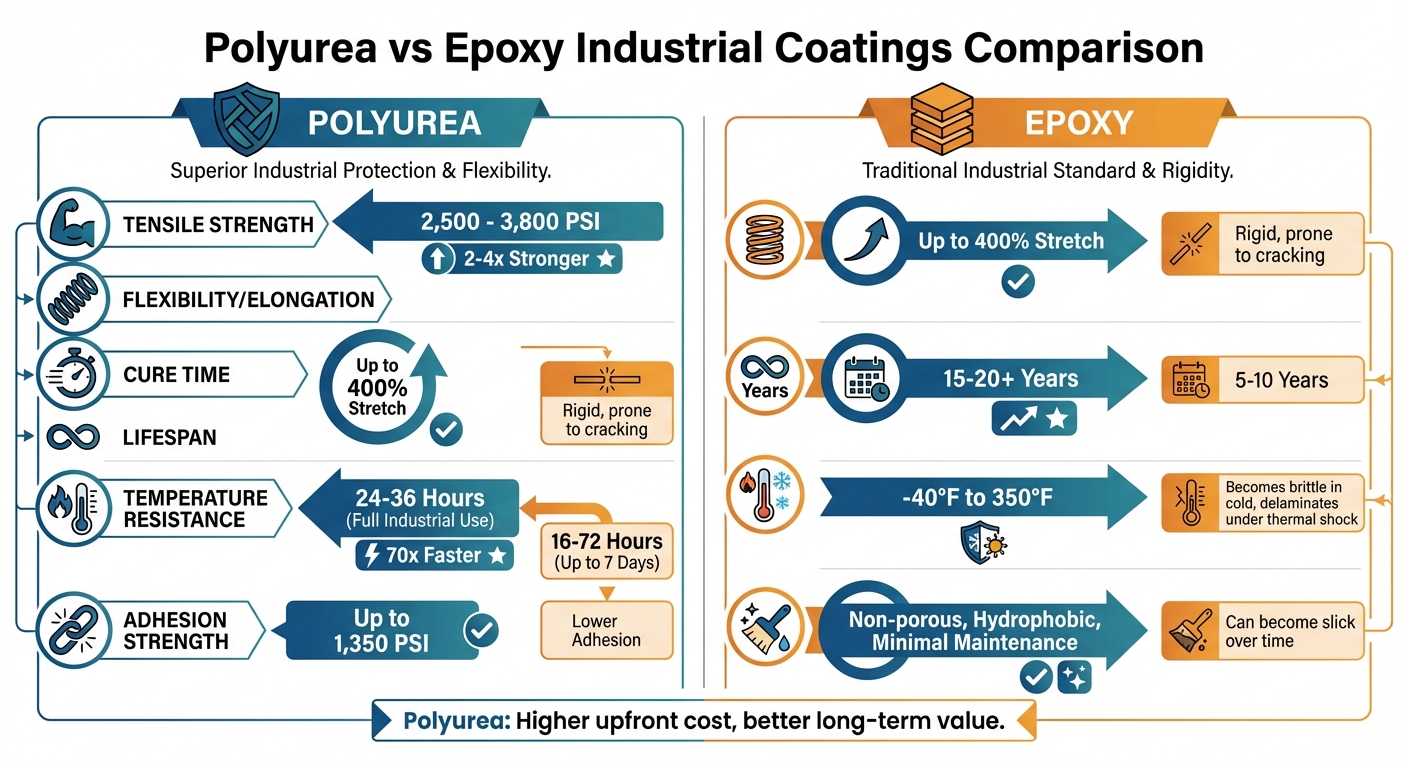
Polyurea vs Epoxy Industrial Coatings Comparison Chart
Industrial Floor Painting with POLYUREA FLOOR COATING by DUROSTICK
1. Improved Workplace Safety
Slip and fall accidents are a major issue in industrial settings. According to OSHA, "tripping, slipping, or falling" ranks as one of the top causes of warehouse injuries, with nearly 5 out of every 100 warehouse workers experiencing an injury each year. Polyurea coatings help tackle this problem by creating a high-traction surface that stays grippy even when exposed to water, oils, or chemical spills.
Thanks to its hydrophobic properties, polyurea repels water, keeping liquids on the surface for easy cleanup. Its tightly cross-linked structure prevents oils and chemicals from seeping in, ensuring the slip-resistant surface remains effective over time.
To further boost traction, specialized additives like Shark Bite, Gator Bite, recycled rubber crumbs, or quartz aggregates can be incorporated. Atlas Concrete Coatings uses these anti-slip materials as part of their multi-layer system, including a chip layer specifically designed to enhance grip in busy industrial areas. This added texture helps minimize slip hazards in high-traffic zones.
These textured surfaces also help facilities comply with OSHA’s Surface Conditions Directive 1910.22, which requires safe walking surfaces. With adhesion strengths reaching up to 1,350 PSI, the slip-resistant coating stays firmly attached to concrete, even under heavy, constant use.
Unlike traditional epoxies that can become slick over time, polyurea’s flexibility and ability to deeply bond with concrete provide long-lasting slip resistance, making it a more reliable choice for safety.
2. Long-Lasting Durability
Industrial floors endure a relentless barrage of challenges – heavy machinery, constant impacts, and chemical spills, to name a few. Polyurea coatings are specifically designed to handle these stresses without breaking down. Thanks to their elastomeric flexibility, which allows them to stretch up to 400%, polyurea coatings absorb impacts and stresses without cracking. Compare this to rigid epoxy floors, which often crack under the same conditions, and the difference becomes clear.
This impressive toughness comes from polyurea’s unique molecular structure. Its densely cross-linked design delivers tensile strengths ranging from 2,500 to 3,800 PSI, significantly higher than polyurethane’s range of 1,000 to 3,000 PSI. This tightly woven molecular network also acts as a barrier against oils, acids, and corrosive solvents, preventing them from seeping in and weakening the bond with the concrete underneath.
Polyurea also thrives in extreme temperatures, from -40°F to 350°F, maintaining its adhesion even during dramatic thermal changes. This makes it a perfect fit for facilities that experience steam cleaning or freeze-thaw cycles. Unlike epoxy, which can become brittle in cold weather and delaminate under thermal shock, polyurea expands and contracts with the concrete, holding firm without cracking or losing adhesion.
On average, industrial-grade polyurea coatings last 10 to 15 years under normal conditions, and some formulations can exceed 20 years with proper care. Atlas Concrete Coatings uses polyurea systems that are 2 to 4 times stronger than standard epoxy. This durability makes them an excellent choice for warehouses, manufacturing facilities, and distribution centers, where floors must withstand decades of heavy use. As an added bonus, these coatings also incorporate slip-resistant features, making them a safe and reliable option for demanding industrial environments.
3. Fast Installation with Minimal Downtime
Time is money, especially when downtime impacts your bottom line. That’s where polyurea coatings shine – they cure incredibly fast, helping facilities get back to business far quicker than traditional materials.
Polyurea coatings cure in just seconds to minutes and are ready for foot traffic within 2–4 hours. For full industrial use, including handling heavy equipment, they typically require only 24–36 hours to fully cure. Compare that to epoxy, which can take anywhere from 16–72 hours – and sometimes up to 7 days – to handle full loads. This makes polyurea up to 70 times faster than epoxy. Industry experts back this up:
"Polyurea’s rapid cure supports fast application and minimal downtime."
- John Davidson, Partner and VP of Operations, SprayWorks Equipment
This speed makes polyurea coatings a game-changer for 24/7 operations like hospitals, grocery stores, and warehouses, where even a short shutdown can lead to lost revenue. Some professional installers, such as Atlas Concrete Coatings, even offer one-day services. They can prep, coat, and finish a floor in a single day, ensuring your facility is fully operational by the next morning.
Another bonus? Polyurea cures quickly in extreme temperatures, making it ideal for challenging environments like walk-in refrigerators and outdoor loading docks. By scheduling installations to take advantage of the 24-hour full-cure window, businesses can avoid multi-day interruptions and keep operations running smoothly.
sbb-itb-4b4bb37
4. Simple Maintenance Requirements
Polyurea-coated floors are incredibly easy to maintain – regular sweeping and the occasional mopping are usually all you need. Thanks to their seamless, non-porous surface, there are no joints, grout lines, or crevices for dirt, grease, or bacteria to hide in. This low-maintenance requirement pairs perfectly with their durability in high-traffic industrial environments.
Atlas Concrete Coatings provides polyurea systems designed to enhance both safety and durability while simplifying upkeep. The coating’s cross-linked structure forms a hydrophobic barrier that repels water, oils, and chemicals, making cleanup a breeze. As one expert notes:
"Polyurea’s densely cross-linked network structure has the ability to limit the diffusion of chemical molecules through its coatings. This can prevent oils and chemicals from penetrating through its surface."
For routine cleaning, a soft-bristle broom or microfiber dust mop is ideal for removing abrasive dirt that could dull the finish over time. When needed, a mild detergent mixed with water works well – just be sure to rinse thoroughly to avoid leaving slippery residues. In larger industrial settings, these floors can handle mechanical scrubbers or high-pressure washers without issue, as they’re built to withstand extreme temperatures ranging from -40°F to 350°F.
The chemical resistance of polyurea floors is another standout feature. Even when exposed to harsh industrial cleaners, acids, or solvents, the coating remains intact. This makes it a great choice for environments like food processing plants or medical facilities, where cleanliness is critical. Some formulations even include antimicrobial properties to help combat bacteria and mold growth.
With polyurea flooring, maintaining a clean and professional workspace is simple. The absence of porous surfaces and cracks means less time spent scrubbing and more time focused on essential operations. This reduced maintenance not only minimizes interruptions but also contributes to long-term cost savings, making polyurea a practical choice for demanding industries.
5. Long-Term Cost Savings
Polyurea coatings may require a higher upfront investment, but their long-term benefits make them a cost-effective choice. These coatings typically last 15 to 20+ years with proper care, compared to epoxy systems that often need replacing every 5 to 10 years. That extended lifespan means fewer reinstallation projects and less disruption to your operations.
The durability of polyurea directly impacts your bottom line. With a tensile strength of 2,500 to 3,800 psi and the ability to stretch up to 400% of its original size, these coatings can withstand heavy impacts and constant activity without cracking. This reduces the need for frequent repairs or emergency fixes. As John Davidson, Partner and VP of Operations at SprayWorks Equipment, explains:
"Polyurea coatings are used to prolong the lifespan of structures by providing them with qualities that result in reduced repairs and replacements."
Lower maintenance costs also contribute to savings. The slip-resistant texture of polyurea coatings helps reduce workplace injuries, which can significantly cut down on injury-related claims. Considering that over 1,000,000 people seek treatment annually for slips and falls, this feature alone can make a big difference in financial terms.
Another advantage is the rapid curing time. Polyurea coatings can return to service in as little as 1 to 4 hours, minimizing downtime and revenue loss. As Jarrett Holmes from Extreme Industrial Coatings notes:
"Time is money in commercial operations. Our polyurea coatings cure 20 times faster than traditional epoxy systems, getting your facility back to work faster."
When you look at the total cost of ownership over 15 years, polyurea consistently proves to be a better value. It not only protects surfaces from corrosive damage but also helps avoid costly structural repairs. Long-term warranties further solidify this investment as a smart choice for demanding industrial environments.
Conclusion
Slip-resistant polyurea coatings bring a range of benefits to industrial facilities. They boost workplace safety with customizable traction and chemical resistance, offer exceptional durability, and minimize downtime thanks to their quick curing times. Plus, their non-porous surface means less maintenance, and they help cut costs by reducing repair needs, workplace injuries, and operational interruptions. These advantages, backed by impressive performance metrics, highlight the value of polyurea coatings.
With tensile strengths reaching up to 3,800 psi and elasticity of 400%, polyurea coatings are built to last. They not only reduce repair and maintenance costs but also help lower accident rates, making the financial benefits hard to ignore.
For businesses in Pennsylvania and New Jersey, Atlas Concrete Coatings offers professional, one-day polyurea installations using a multi-layer system that forms a permanent bond with concrete. Their quick installation process minimizes downtime, and they stand behind their work with both lifetime and 5-year warranty options. Free consultations are available to assess the specific needs of your facility.
Atlas Concrete Coatings specializes in creating slip-resistant solutions for high-traffic industrial spaces like warehouses, manufacturing plants, and production facilities. Serving Pennsylvania and New Jersey, their certified team brings expert installation directly to your site. Discover the impact of professional polyurea installation tailored to your facility’s demands.
FAQs
How do polyurea coatings enhance safety in industrial settings?
Polyurea coatings play a key role in improving safety within industrial settings by offering slip-resistant surfaces. These coatings are designed to reduce the likelihood of accidents, meeting important standards like ANSI A326.3. To further enhance traction, they can be tailored with slip-resistant aggregates, ensuring stability even on wet or oily floors.
This focus on safety makes polyurea coatings a smart choice for high-traffic industrial areas where maintaining a secure and efficient workspace is a top priority.
Why are polyurea coatings more durable than epoxy coatings?
Polyurea coatings are celebrated for their durability, often holding up for 15–20 years or even longer. What sets them apart from epoxy is their flexibility, which helps them resist cracking – even in high-traffic areas or places with fluctuating temperatures. On top of that, polyurea provides excellent UV resistance and chemical protection, making it a go-to choice for industrial environments exposed to tough conditions. These features allow polyurea coatings to retain both their performance and appearance over the years with very little upkeep.
How does the fast curing time of polyurea coatings benefit businesses?
Polyurea coatings stand out for their incredibly fast curing time, which can make a big difference for businesses. Facilities can resume operations in just hours rather than waiting days, cutting downtime to a minimum and helping avoid potential revenue losses. This quick application and drying process means projects stay on track, boosting efficiency across the board.
What’s more, the rapid curing ensures surfaces are ready to endure heavy use much sooner, making these coatings a perfect fit for industries where extended delays simply aren’t an option. With their blend of speed and long-lasting durability, polyurea coatings offer a practical solution for businesses aiming to stay productive without compromising on quality.