
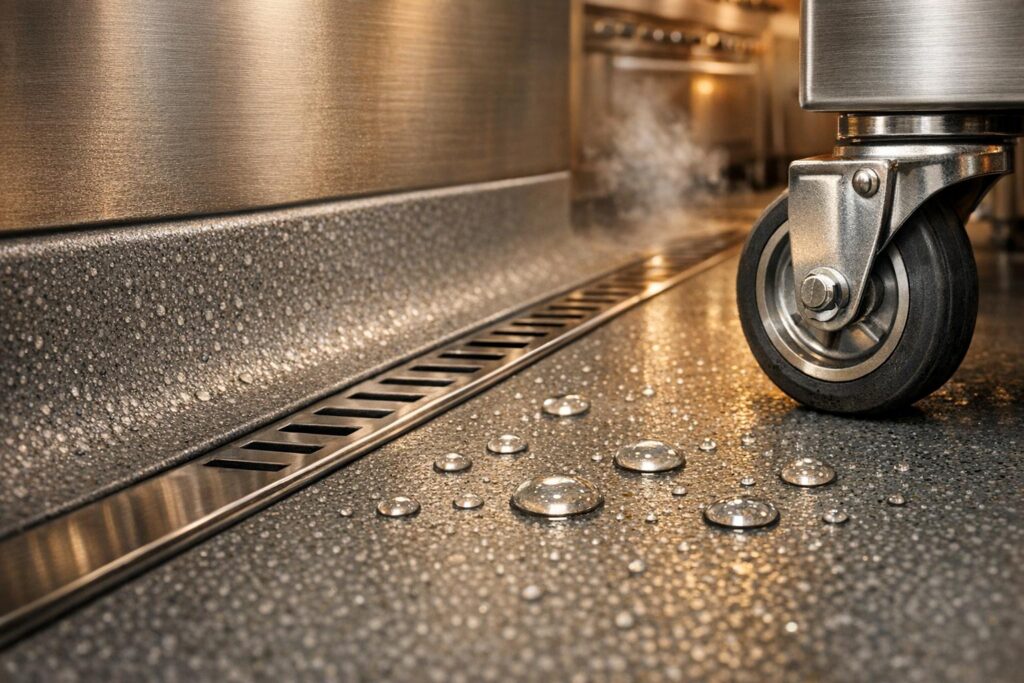
Restaurant kitchens demand flooring that can handle extreme wear, spills, and frequent cleaning. Polyurea coatings outperform epoxy in durability, flexibility, and fast curing times, making them a better choice for high-traffic kitchens. Here’s why:
- Strength: Polyurea is 4x stronger than epoxy and lasts up to 15 years, compared to epoxy’s 5–10 years.
- Temperature Resistance: Withstands –40°F to 250°F, ideal for thermal shocks from hot oil to freezing conditions.
- Fast Curing: Ready for use in 24 hours, while epoxy takes 3–5 days.
- Hygiene & Safety: Non-porous and antimicrobial to prevent bacteria growth, with slip-resistant surfaces.
- Cost-Effectiveness: Higher upfront cost ($2,000–$2,800 for 400 sq. ft.) but fewer repairs and longer lifespan reduce long-term expenses.
Though epoxy is cheaper initially, its brittleness, longer downtime, and higher maintenance make polyurea a smarter investment for busy restaurant kitchens.
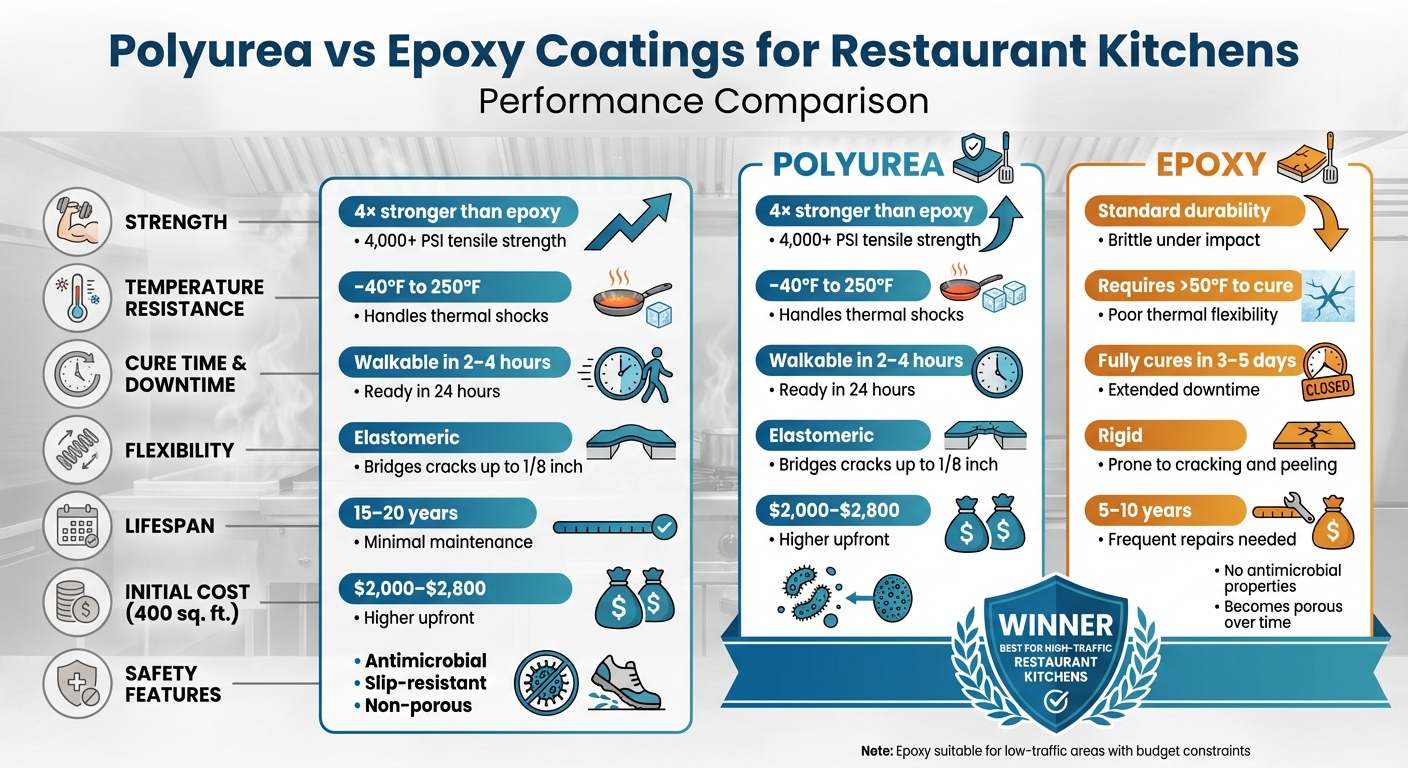
Polyurea vs Epoxy Coatings for Restaurant Kitchens Comparison
Commercial Kitchen Polyurea Floor Project
sbb-itb-4b4bb37
1. Polyurea Coatings
Polyurea has earned its reputation as a top-tier coating option for commercial kitchens. It’s formed through a rapid chemical reaction between isocyanates and resin blends containing amines, creating a dense, impermeable surface that surpasses traditional coatings in performance .
Chemical Resistance
The tightly bonded molecular structure of polyurea acts as a powerful shield, preventing corrosive kitchen substances from penetrating the surface. Unlike other coatings that may degrade over time, polyurea holds up against food acids, hot grease, industrial solvents, and harsh cleaning agents. Its non-porous surface also keeps oils and food residues from seeping into the substrate, reducing the risk of contamination and making compliance with health regulations more manageable . This chemical resistance, combined with its durability, makes it a practical long-term solution.
Durability and Flexibility
Polyurea’s elastomeric nature allows it to flex and stretch without cracking or peeling, which is crucial in environments exposed to constant thermal changes. It can bridge concrete cracks up to 1/8 inch, maintaining a seamless surface even as buildings settle or shift. With a tensile strength exceeding 4,000 PSI – four times stronger than standard epoxy – it can endure heavy impacts from dropped pans, moving equipment, and the wear and tear of high-traffic areas. Polyurea also handles extreme temperatures, from –40°F to 250°F, making it suitable for a wide range of conditions .
"Polyurea is incredibly resistant to abrasions, chemicals, and stains, more so than epoxy. It withstands the rigors of a commercial kitchen environment much better, from the constant foot traffic to the frequent spills of hot liquids and harsh cleaning agents."
– Bear Mountain Painting
Cure Time and Downtime
Time is money, especially in commercial kitchens where every hour of downtime impacts revenue. Polyurea coatings excel in this area, becoming walkable within 2 to 4 hours and ready for full use in as little as 24 hours. The coating sets almost instantly when applied with specialized spray equipment, although professional installation is recommended to achieve a flawless finish .
Slip Resistance and Safety
Polyurea coatings improve safety with microtextured surfaces that provide traction, even when wet or oily. Many formulations also include antimicrobial properties to inhibit bacteria, mold, and mildew growth – an essential feature for passing health inspections. Additionally, some VOC-free versions are FDA-approved for direct food contact, making them ideal for food-processing areas . These safety features, combined with the coating’s ease of maintenance, enhance its value in demanding environments.
Maintenance and Cost-Effectiveness
The smooth, seamless surface of polyurea coatings prevents dirt and grease from accumulating, making them easy to clean with high-temperature methods. While the upfront cost of polyurea is typically 30–40% higher than epoxy, its extended lifespan – 15 to 20 years compared to epoxy’s 5 to 10 years – means fewer replacements and repairs. For a 400-square-foot area, the total investment usually falls between $2,000 and $2,800, making it a smart choice for high-traffic kitchens .
Atlas Concrete Coatings offers polyurea-based chip floor coatings tailored to meet these needs, providing restaurant kitchens with a durable, safe, and visually appealing flooring solution.
2. Epoxy Coatings
Epoxy has been a go-to option for commercial flooring for years, but in the high-stress environment of restaurant kitchens, its shortcomings become apparent. While it initially provides a hard, protective layer, it struggles to handle the intense demands of food service operations.
Chemical Resistance
Epoxy offers a decent level of resistance to chemicals, but it isn’t invincible. Over time, constant exposure to oils, food acids, and strong cleaning agents can wear it down. This repeated exposure makes the surface porous, which can trap bacteria – a serious concern in kitchens. Adding to the problem, epoxy lacks antimicrobial properties. It’s also not UV stable, meaning it can yellow, peel, or lose its shine under certain lighting conditions.
Durability and Flexibility
One of epoxy’s biggest weaknesses is its brittleness. It doesn’t handle heavy impacts or extreme temperature swings well.
"Epoxy can be brittle and prone to cracking under heavy impact or extreme temperature changes – these conditions describe most commercial kitchens."
– Bear Mountain Painting
Another issue is that epoxy doesn’t expand or contract with the concrete underneath it. This lack of flexibility makes it more likely to peel or delaminate over time. In a demanding kitchen environment, the typical lifespan of an epoxy floor is only about 5 to 10 years. Compare that to polyurea, which is rated as being four times stronger than standard epoxy.
Cure Time and Downtime
One of the biggest drawbacks of epoxy is the time it takes to cure. It generally requires 3 to 5 days before the floor can be used again, which can be a major disruption for a busy kitchen.
"The epoxy application process is lengthy; the coating requires a significant curing time, often extending to several days. This downtime can be a major inconvenience in a commercial kitchen, where every hour of operation counts."
– Bear Mountain Painting
Although quick-set formulations exist, they still don’t match the faster curing times of alternatives like polyurea. This extended downtime complicates routine maintenance and can hurt a business’s bottom line.
Maintenance and Cost-Effectiveness
While epoxy might seem like an affordable option upfront, the long-term costs tell a different story. Frequent chipping, cracking, and recoating are common in high-traffic kitchens, which can disrupt operations and reduce safety. As slip-resistant textures wear down, the floor may need resealing to maintain safety standards. When you factor in its shorter lifespan and higher maintenance needs, epoxy often ends up being more expensive in the long run despite its lower initial price tag.
Pros and Cons
When comparing polyurea and epoxy coatings, the differences are noticeable. For starters, polyurea is approximately 2 to 3 times stronger than standard epoxy floors and performs reliably across a wide temperature range, from –40°F to 250°F. Its elasticity allows it to flex with the concrete, reducing the likelihood of cracking or peeling – issues often seen with the more rigid epoxy coatings.
The installation process is another area where polyurea shines. It becomes walkable in just 2 to 4 hours, meaning kitchens can be back in full operation within 24 to 48 hours. In contrast, epoxy coatings take 3 to 5 days to fully cure, which can result in extended downtime and lost revenue for businesses. As an expert from TAGG Concrete Coatings pointed out:
"It is simply not financially beneficial to shut down their restaurant for a week to have the flooring updated."
From a financial perspective, the faster curing time of polyurea can be a game-changer for busy kitchens. While the upfront cost of polyurea is higher, its long-term advantages are hard to ignore. With a lifespan of up to 15 years and superior resistance to abrasion, polyurea often delivers better value over time. Epoxy, though generally more budget-friendly per square foot, has a tendency to be brittle. This makes it more susceptible to chipping and cracking under heavy use, which can lead to frequent repairs.
For high-traffic kitchens, where durability and low maintenance are critical, polyurea stands out. Here’s a breakdown of the key differences:
| Factor | Polyurea Coatings | Epoxy Coatings |
|---|---|---|
| Strength | 2–3× stronger than epoxy | Standard durability; brittle |
| Temperature Range | –40°F to 250°F | Requires >50°F to cure |
| Cure Time | Walkable in 2–4 hours | Fully cures in 3–5 days |
| Flexibility | Moves with the substrate | Rigid; prone to cracking |
| Chemical Resistance | Dense molecular structure resists penetration | Good resistance, but can become porous over time |
| Initial Cost | Higher upfront investment | More economical per square foot |
| Lifespan | Up to 15 years | Typically 5–10 years in high-traffic areas |
For kitchens that endure constant wear from hot grease, thermal shock, and frequent cleaning, polyurea’s durability and performance justify its higher cost. However, epoxy can still be a practical choice for low-traffic areas where budget constraints take precedence.
Conclusion
For restaurant kitchens dealing with constant thermal changes, heavy foot traffic, and exposure to harsh cleaning agents, polyurea coatings deliver a level of durability that epoxy simply can’t rival. Polyurea is four times stronger than epoxy, withstands temperatures from –40°F to 250°F, and offers a lifespan of up to 15 years compared to epoxy’s 5–10 years. Plus, its 24-hour return-to-service time significantly reduces costly downtime.
Polyurea also prioritizes food safety. Its seamless, non-porous surface with built-in antimicrobial properties prevents bacteria, mold, and mildew growth. Additionally, its slip-resistant micro-texture provides reliable traction, even in wet or greasy conditions.
While polyurea may come with a higher initial cost than epoxy, the long-term savings are undeniable. With reduced maintenance, fewer repairs, and minimal operational disruptions, the investment pays off over the lifespan of the flooring. For busy commercial kitchens where downtime directly affects revenue, these benefits translate into measurable financial returns.
These advantages are further amplified with professional installation. Atlas Concrete Coatings ensures expert polyurea application, reducing downtime and meeting the strict demands of food service environments. Their expertise guarantees a durable, hygienic surface that supports the rigorous standards of restaurant operations – without the prolonged closures often associated with traditional methods.
FAQs
How long does a polyurea kitchen floor actually last?
With the right maintenance and professional installation, a polyurea kitchen floor can last 15 to 20 years or even longer. Its toughness makes it a solid option for busy spaces like restaurant kitchens, where heavy foot traffic and wear are common.
Can polyurea handle hot oil spills and freezer-room temperatures?
Polyurea is exceptionally resistant to heat and extreme temperatures. It can handle hot oil spills without breaking down and remains durable even in freezer-room conditions as low as -20°F. Its flexibility and toughness make it a great option for settings like restaurant kitchens, where temperature fluctuations are a constant challenge.
How do you prep and repair concrete before applying polyurea?
Proper preparation is key to ensuring strong adhesion and long-lasting results. Start by inspecting the surface for any cracks, spalling, stains, or moisture problems. Address these issues by repairing damage, leveling uneven areas, and filling cracks as needed.
Next, mechanically profile the concrete using methods like diamond grinding or shot blasting. This step creates a textured surface while removing contaminants that could interfere with adhesion. Once the profiling is complete, thoroughly clean the surface and test it for moisture and porosity.
Following these steps helps avoid common problems like peeling or delamination, setting the foundation for a durable finish.