
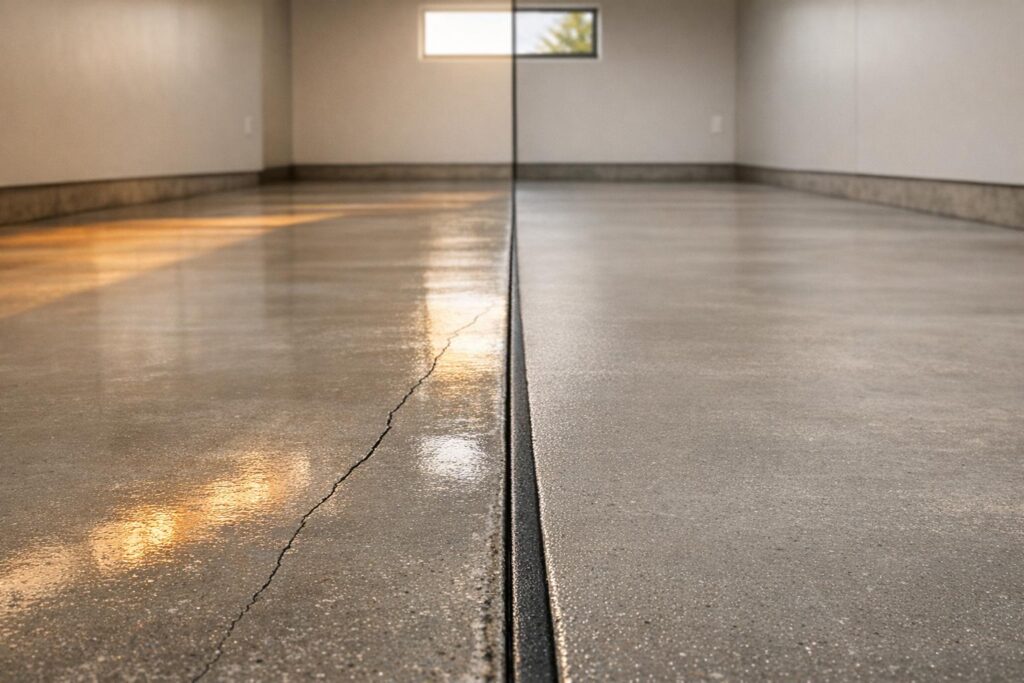
Concrete floors expand and contract with temperature changes, and the right coating can make or break their durability. Polyurea and epoxy are two common options, but they differ significantly in how they handle thermal stress. Here’s the key takeaway:
- Polyurea: Highly flexible (over 300% elongation), handles freeze-thaw cycles well, lasts 15–20+ years, and performs in extreme temperatures (-30°F to 140°F). Costs $7–$12 per square foot.
- Epoxy: Rigid (less than 10% elongation), prone to cracking under thermal stress, lasts 5–10 years, and requires temperatures above 50°F to cure. Costs $3–$7 per square foot.
Quick Comparison:
| Feature | Polyurea | Epoxy |
|---|---|---|
| Flexibility | Over 300% elongation | Less than 10% elongation |
| Thermal Tolerance | -30°F to 140°F | Above 50°F only |
| Lifespan | 15–20+ years | 5–10 years |
| UV Resistance | Good (with aliphatic) | Poor (needs topcoat) |
| Cost | $7–$12 per sq. ft. | $3–$7 per sq. ft. |
Polyurea is better for outdoor and thermally dynamic environments, while epoxy is suited for stable indoor spaces. Keep reading for more details on performance, durability, and application.
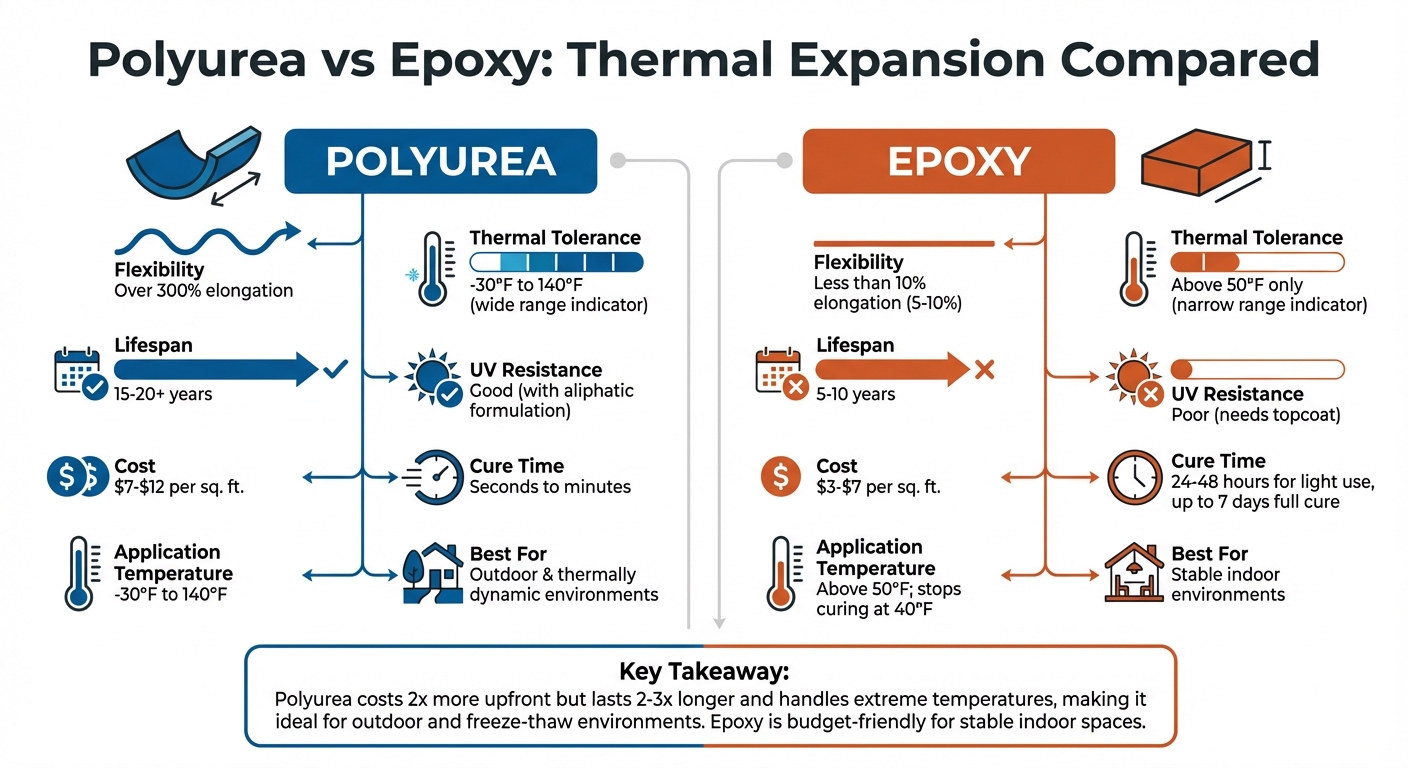
Polyurea vs Epoxy Coating Comparison: Thermal Performance and Durability
Epoxy Versus Polyurea Flooring (Which is Better?)
sbb-itb-4b4bb37
Properties of Polyurea and Epoxy Coatings
Building on the discussion of thermal stresses earlier, let’s dive into how the material properties of polyurea and epoxy influence their performance. These two materials are fundamentally different at their core. Epoxy is a rigid, tightly cross-linked thermosetting polymer – think of it as resembling hard plastic or even glass. Polyurea, on the other hand, is an elastic elastomer, functioning more like resilient rubber. This difference in structure plays a major role in how each material handles temperature changes and impacts their overall durability.
Polyurea: Characteristics and Performance
Polyurea’s standout feature is its flexibility, with elongation at break often exceeding 300%. This means it can handle the natural expansion and contraction of concrete without cracking. Its elastomeric nature creates a flexible protective layer that moves with the concrete, even during significant thermal shifts. This flexibility also gives polyurea impressive impact resistance and the ability to bridge cracks. For instance, when concrete develops hairline fractures due to thermal stress or settling, polyurea stretches to cover the gaps, maintaining a waterproof seal. This quality has made it a go-to material for applications like truck bed liners and mining equipment.
In environments with frequent thermal stress, polyurea coatings typically last 15–20+ years, which is two to three times longer than the 5–10 year service life of epoxy coatings.
Another key advantage is its temperature tolerance. Polyurea can be applied in extreme conditions, ranging from -30°F to 140°F, and it stays flexible even in freezing temperatures. Its auto-catalytic curing process allows it to set in seconds or minutes, enabling same-day return to service. These unique characteristics explain why polyurea performs so well in scenarios involving thermal expansion.
Epoxy: Characteristics and Performance
Epoxy coatings are known for their high compressive strength and hardness, making them ideal for static loads on stable concrete surfaces. However, their rigidity introduces serious limitations. With a flexibility of less than 10% elongation, epoxy struggles to handle movement. When concrete shifts due to thermal expansion, vibration, or freeze-thaw cycles, epoxy coatings are prone to cracking or splitting. Marvel Coatings highlights this issue:
"Epoxy, being rigid, often cannot cope with the subtle expansion. Coatings debond or crack after a few harsh winters".
Epoxy also has temperature-related restrictions. It requires a minimum of 50°F to cure, which makes it unsuitable for colder environments where temperatures drop below 40°F. Additionally, standard epoxies are aromatic, meaning they discolor and degrade under prolonged UV exposure. As Marvel Coatings puts it:
"There is no such thing as a truly UV-stable epoxy".
For outdoor use, epoxy always needs a UV-resistant topcoat, such as aliphatic polyurethane, to ensure durability. These limitations in flexibility, curing conditions, and UV resistance significantly affect its performance under thermal stress.
Thermal Expansion Performance: Polyurea vs. Epoxy
Flexibility and Thermal Cycling
Concrete naturally expands and contracts as temperatures fluctuate, so any coating applied to it must adapt to these changes. Polyurea acts like a "protective skin", stretching and rebounding with the concrete as it moves. This adaptability allows it to handle expansion and contraction effectively. On the other hand, epoxy is rigid and prone to cracking when the concrete beneath it shifts.
Polyurea boasts an impressive elongation capacity of over 300% before breaking, whereas epoxy typically only stretches 2–5%. This flexibility makes polyurea particularly effective during freeze-thaw cycles, where moisture in the concrete freezes, causing it to expand, and thaws, causing it to contract. While polyurea flexes and maintains its seal, epoxy often fails under these conditions, as field observations have repeatedly shown.
One notable example comes from the U.S. Army Corps of Engineers, which applied a polyurea liner to a concrete reservoir. The liner successfully handled hydraulic pressures and substrate shifts, lasting decades longer than rigid coatings previously used. This kind of flexibility ensures consistent performance across varying temperature conditions.
Temperature Range and Environmental Suitability
Temperature plays a big role in how these coatings perform, especially during application. Standard epoxies can only cure at temperatures above 50°F, and they struggle to cure at all below 40°F. This limitation makes cold-weather installations difficult unless the area is climate-controlled. Polyurea, however, can be applied in temperatures ranging from –30°F to 140°F, making it a practical choice for extreme climates throughout the year.
In regions with harsh winters, like Minnesota, Wisconsin, or Michigan, epoxy coatings often fail after repeated freeze-thaw cycles. They crack and debond, leaving the surface exposed. Polyurea, with its superior flexibility, maintains its seal even in these challenging conditions.
UV and Heat Resistance
Exposure to UV light presents challenges for both polyurea and epoxy, but their durability under these conditions differs. Epoxy coatings degrade with prolonged UV exposure unless topped with a UV-resistant layer, such as aliphatic polyurethane. Without this added protection, epoxy isn’t ideal for outdoor use.
Polyurea, by comparison, holds up better in outdoor environments. While aromatic polyureas may discolor under UV light, aliphatic polyurea formulations remain fully UV stable, retaining their color for years. Additionally, polyurea’s higher heat resistance prevents issues like hot tire delamination – a common problem with epoxy coatings where warm tires soften the surface, causing it to peel. This makes polyurea a more reliable choice for applications like garage floors and parking structures, where heat resistance is critical. These qualities ensure polyurea can handle the challenges of temperature changes and concrete movement effectively.
Durability and Longevity in Thermal-Stressed Environments
Impact of Thermal Stress on Structural Integrity
Concrete floors endure constant temperature fluctuations, which can challenge the adhesion of coatings. Epoxy, being rigid, struggles to handle the movement of the substrate caused by heat-induced expansion and cold-induced contraction. This rigidity often leads to debonding as the concrete shifts, highlighting epoxy’s limitations in environments with significant thermal stress.
Polyurea, on the other hand, acts like a flexible skin, maintaining its bond even as the substrate moves. Its elasticity allows it to adapt to both settlement and thermal expansion, effectively avoiding the cracking issues that rigid coatings like epoxy face. During freeze-thaw cycles, epoxy coatings tend to crack and lose adhesion because they cannot accommodate the substrate’s movement. This adaptability makes polyurea a better choice for environments where thermal stress is a constant factor.
When it comes to lifespan, polyurea outshines epoxy by a wide margin. While epoxy coatings typically last 5–10 years, polyurea can endure for 15–20+ years, significantly reducing the need for frequent maintenance and recoating. In places like parking garages, industrial facilities, or outdoor surfaces, polyurea’s durability means one application could last two decades, compared to the four to six recoating cycles epoxy would require in the same timeframe.
Polyurea also performs well on thin-walled steel tanks and pipes that expand in hot weather. Unlike epoxy, which can develop micro-cracks under such conditions, polyurea’s flexibility ensures it maintains its bond. While polyurea has a higher initial cost ($7–$12 per square foot compared to epoxy’s $3–$7 per square foot), its extended lifespan and reduced maintenance needs make it a more cost-effective choice in the long run.
Installation and Curing: Temperature-Specific Considerations
Curing Speed and Application Windows
Temperature plays a key role in the success of coating applications. Epoxy, for instance, stops curing when temperatures drop near 40°F and requires at least 50°F to properly install. In colder or damp environments, curing can take significantly longer. One field report even documented a case where epoxy applied to a cold substrate took as long as four months to fully cure.
Polyurea, on the other hand, operates on a completely different timeline. Its reaction is incredibly fast and is not significantly impacted by ambient temperatures. While epoxy coatings typically need 24–48 hours for light use and up to 5–7 days for full chemical curing, polyurea becomes tack-free in mere seconds and can often support foot traffic in under an hour. Some formulations of polyurea even have a gel time of just 30 seconds, allowing light use within 15 minutes.
These differences in curing times have significant implications for application timing and equipment needs.
Polyurea’s performance across a wide temperature range further sets it apart. It maintains its ultra-fast curing rate in conditions ranging from –30°F to 140°F. In contrast, epoxy requires careful climate control to cure effectively. When temperatures drop below 40°F, standard epoxy formulations won’t cure unless specialized low-temperature versions are used. Additionally, substrate movement caused by thermal stress often necessitates quick and reliable curing, an area where polyurea excels.
These distinctions have practical effects on project planning. Polyurea is ideal for one-day installations or winter projects in spaces without climate control. Epoxy, however, requires more careful scheduling and controlled conditions during installation. That said, polyurea’s rapid curing introduces its own challenges. Due to its extremely short pot life – often just a few seconds – it demands specialized plural-component high-pressure spray equipment, which can cost anywhere from $15,000 to $50,000, along with trained crews to operate it. In contrast, epoxy’s longer pot life of 20–60 minutes allows for simpler application methods, such as rollers or squeegees, making it more accessible for DIY projects in controlled settings.
Performance Comparison Table: Polyurea vs. Epoxy
Here’s a closer look at how polyurea and epoxy coatings stack up against each other. The table below lays out their key properties, especially focusing on how each handles thermal expansion and other critical factors.
| Property | Epoxy Coating | Polyurea Coating |
|---|---|---|
| Flexibility (Elongation at Break) | Very low (<5–10%); prone to cracking | Highly flexible (>300%); elastomeric |
| Thermal Expansion Tolerance | Poor – the rigid nature can lead to debonding or cracking during freeze-thaw cycles | Excellent – flexes with the substrate during thermal cycling |
| Application Temperature Range | Typically requires temperatures above 50°F; curing stops near 40°F | -30°F to 140°F; performs reliably in various humidity levels |
| UV Resistance | Poor – tends to yellow and chalk under sunlight | Moderate to excellent, with aliphatic formulations offering superior UV stability |
| Cure Time | Slow – about 24–48 hours for light use and up to 7 days for a full cure | Ultra-fast – cures in seconds to minutes, with full cure in hours |
| Service Life | Approximately 5–10 years; may become brittle over time | Approximately 15–20+ years; retains toughness and crack-bridging properties |
| Installed Cost | Around $3–$7 per sq. ft. | Around $7–$12+ per sq. ft. |
Data based on industry benchmarks.
Polyurea clearly outperforms epoxy in terms of flexibility and thermal expansion. Its ability to stretch and move with the substrate makes it far less likely to crack or lose adhesion during extreme temperature changes. On the other hand, epoxy’s rigidity and limited elongation often lead to failures, especially in regions with harsh winters and frequent freeze-thaw cycles.
While polyurea carries a higher initial price tag – nearly double that of epoxy – it offers a much longer service life, often lasting 15–20 years or more. This durability means fewer recoating cycles, which can save money in the long run, particularly in environments that experience significant thermal stress.
Choosing the Right Coating for Your Climate and Needs
Temperature changes, UV exposure, and moisture levels can all impact the performance of a coating. These environmental factors make it crucial to choose a flooring system that aligns with your specific climate. By understanding how different coatings respond to these conditions, you can avoid costly repairs and ensure long-term durability.
Best Applications for Polyurea
Polyurea shines in areas with extreme winters and frequent freeze-thaw cycles. Its flexibility helps prevent the cracking and detachment that often occur with more rigid coatings. For example, polyurea has proven effective in industrial settings like concrete reservoirs, where it handles the stress of crack movements caused by hydraulic pressure and thermal expansion.
This coating is particularly effective in outdoor environments. Surfaces like pool decks, patios, and driveways that are exposed to direct sunlight benefit greatly from aliphatic polyurea, which offers excellent UV resistance. A notable example is a Texas petrochemical plant that replaced its epoxy coating with an aliphatic polyurea system after the epoxy degraded and chalked within a year under intense UV exposure.
Another advantage of polyurea is its quick curing time, making it ideal for high-traffic areas that need to return to service quickly. Its ability to handle constant vibration and regular expansion and contraction makes it a top choice for outdoor and thermally dynamic applications. However, for stable indoor environments, epoxy often takes the lead.
Best Applications for Epoxy
Epoxy coatings work best in indoor spaces with consistent temperatures and minimal UV exposure. For instance, warehouses with heavy static loads, such as those used by forklifts, benefit from epoxy’s impressive compressive strength. Additionally, epoxy’s lower upfront cost – ranging from $3 to $7 per square foot compared to polyurea’s $7 to $12 – makes it appealing for budget-conscious indoor projects.
Specialized novolac epoxies are available for applications requiring chemical resistance in controlled environments. However, epoxy’s lack of flexibility makes it unsuitable for outdoor or thermally stressed areas, where cracking and other failures can occur.
If you’re looking for a coating solution that stands up to extreme temperature changes while delivering lasting performance, consider polyurea-based options from Atlas Concrete Coatings. Their products are designed to handle even the toughest climates with ease.
Conclusion
Polyurea coatings stand out when it comes to handling thermal expansion, especially when compared to epoxy. With an elongation capability of over 300% – compared to epoxy’s usual 5–10% – polyurea adapts to substrate movement in temperatures ranging from –30°F to 140°F. In contrast, epoxy’s rigid, thermosetting nature halts curing around 40°F, making it prone to cracking and debonding during freeze–thaw cycles. This distinction results in polyurea offering a service life of 15–20+ years, while epoxy typically lasts 5–10 years. As one expert put it:
"In applications once thought to require high‑solids epoxies, polyureas are winning at every turn".
These differences play a critical role in determining which coating is best for specific environments. For outdoor projects, areas with extreme temperature changes, or locations subject to frequent freeze–thaw cycles, polyurea’s flexibility and durability make it the better choice, even with its higher upfront cost of $7–$12 per square foot. On the other hand, epoxy, priced at around $3–$7 per square foot, may be suitable for indoor environments with more stable conditions.
Atlas Concrete Coatings provides advanced polyurea solutions designed to deliver unmatched flexibility, thermal resistance, and long-lasting durability – ensuring your coating investment can endure environmental challenges for years to come.
FAQs
How do I know if my concrete floor will move enough to crack epoxy?
Epoxy coatings can be prone to cracking if your concrete floor undergoes significant expansion or contraction caused by temperature shifts or ground movement. For floors that frequently face these kinds of fluctuations, a more flexible option like polyurea might be a better fit. It’s important to evaluate your local conditions and consult a professional to determine the most suitable choice for your specific needs.
What topcoat do I need for UV protection outdoors?
For outdoor surfaces, a UV-resistant polyurea coating works exceptionally well. Its natural resistance to UV rays helps prevent discoloration and damage from sunlight exposure. This makes it a reliable choice for maintaining the appearance and durability of areas constantly exposed to the elements.
Can polyurea be installed in winter without heating the space?
Polyurea can usually be applied during the winter months without needing to heat the area. Its quick curing time and efficient application process remain consistent, even in colder temperatures. This makes it a dependable choice for installations in chilly conditions.