
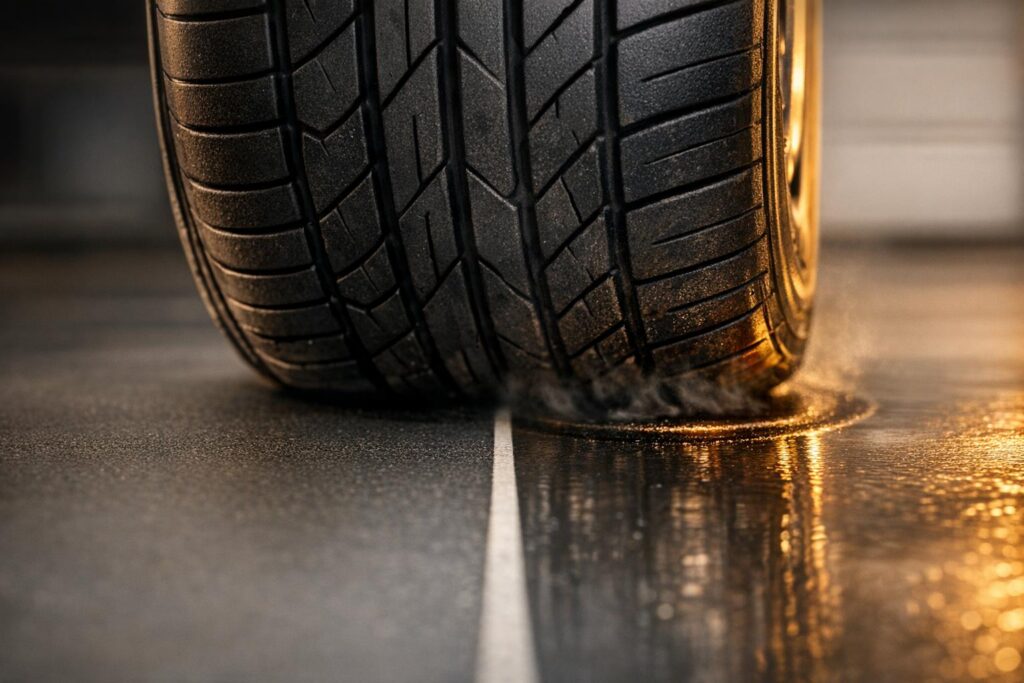
When choosing between polyurea and epoxy coatings, heat resistance is a key factor. Here’s what you need to know:
- Polyurea: Performs well in extreme temperatures (-40°F to 164°F+), resists cracking, and handles hot tire pickup effectively. It cures quickly (6–8 hours) and can be applied in cold weather (as low as -20°F). Its flexibility (300% elongation) makes it durable under thermal stress.
- Epoxy: Works best in controlled environments. Standard formulations handle up to 150°F, but high-heat industrial versions can tolerate up to 450°F or more at a higher cost. However, epoxy softens above 120°F, is prone to cracking under thermal stress, and requires warmer conditions (50°F+) for application.
Quick Comparison:
| Feature | Polyurea | Epoxy |
|---|---|---|
| Temperature Range | -40°F to 164°F+ | 50°F to ~120°F |
| Flexibility | High (>300% elongation) | Low (<10% elongation) |
| Hot Tire Pickup Risk | Very Low | High |
| Application Temp Min | -20°F | 50°F |
| Curing Time | 6–8 hours | 24–48 hours |
Key Takeaway: Polyurea offers better heat resistance, flexibility, and faster curing, making it ideal for garages, industrial spaces, and outdoor areas. Epoxy is better suited for indoor, temperature-controlled spaces like basements or showrooms.
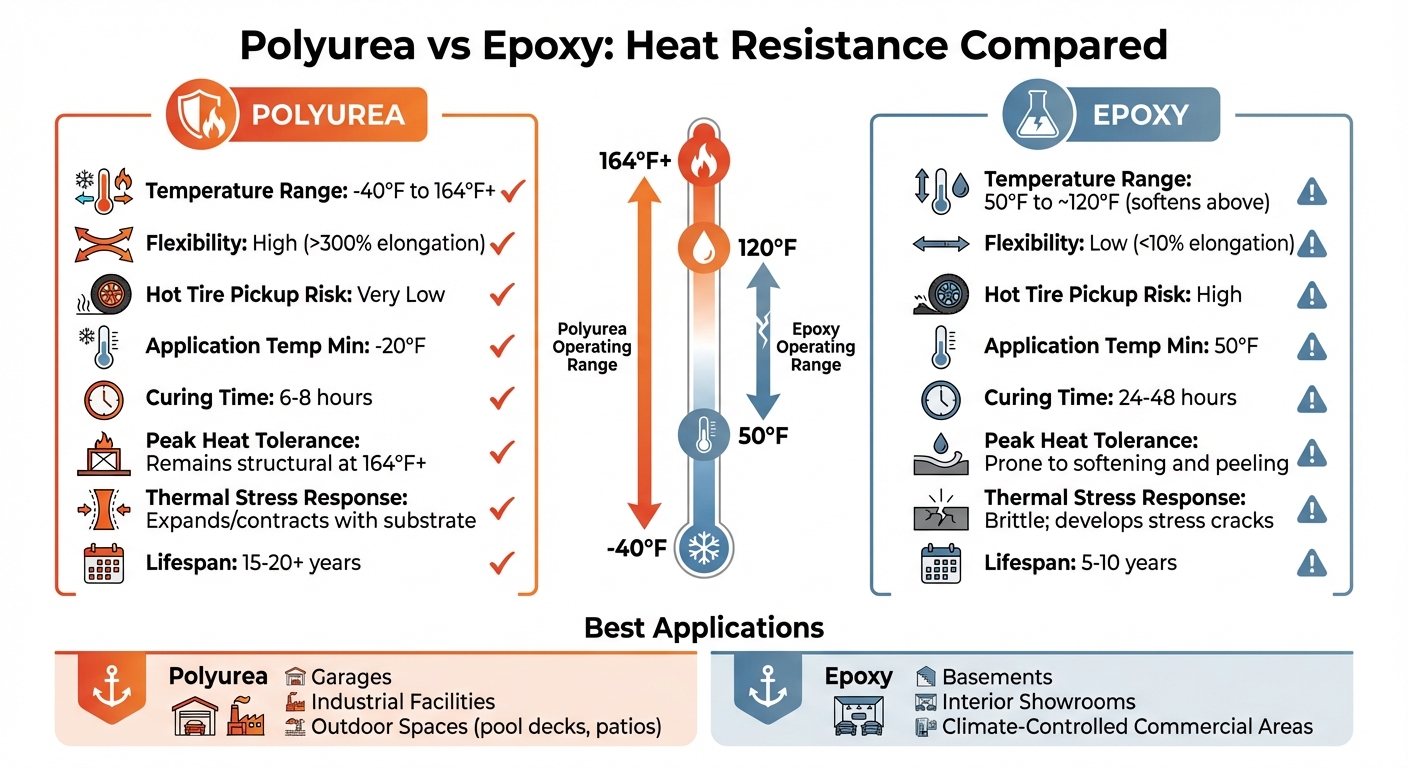
Polyurea vs Epoxy Heat Resistance Comparison Chart
Polyurea Heat Resistance
Temperature Range and Stability
Polyurea coatings stand out for their ability to perform consistently across a wide range of temperatures, making them suitable for various demanding conditions. Thanks to their elastomeric structure, they combine flexibility with durability. As FloorTech Concrete Coatings highlights:
Unlike epoxy, which can soften and become less effective in extreme heat, polyurea maintains its structural integrity.
Benefits in High-Heat Environments
Polyurea’s temperature stability and flexibility make it particularly effective in high-heat settings. Unlike epoxy, polyurea adapts to temperature fluctuations, expanding and contracting with the concrete. This prevents damage like cracking or delamination, especially during exposure to high temperatures, such as those caused by hot tires. Its flexibility is 10 times greater than epoxy, giving it a significant edge in durability.
The material’s elasticity – boasting over 300% elongation – helps it resist tearing and separation. Additionally, it creates a seamless, waterproof barrier that shields concrete from freeze-thaw cycles, which is crucial for outdoor areas like patios and pool decks.
Another advantage is its ability to be applied in cold weather. Polyurea can be installed at temperatures as low as -20°F, making it a reliable option for winter projects where epoxy might fail to cure properly. Its rapid curing time, often just a few hours, ensures it reaches full strength quickly, even in harsh conditions.
These attributes make polyurea an excellent choice for environments facing significant thermal challenges.
sbb-itb-4b4bb37
Epoxy Heat Resistance
Temperature Range and Stability
Epoxy coatings are known for their heat resistance, but their effectiveness largely depends on the specific formulation. Standard epoxy systems can handle temperatures up to 150°F (65°C), making them suitable for most household uses. However, for industrial or aerospace needs, specialized formulations can withstand temperatures as high as 450°F (232°C) or even 600°F (316°C) – though these come at a cost, often 2 to 4 times higher. As Denver Floor Coatings points out:
Standard epoxy systems typically top out around 150°F (65°C) – fine for many home applications, but not enough for serious heat exposure.
A critical factor in an epoxy’s heat performance is its Glass Transition Temperature (Tg). This is the point at which the material transitions from a rigid state to a more flexible one, causing a noticeable reduction in strength. While epoxy coatings can still function above their Tg, their mechanical strength is significantly reduced. For standard epoxies, molecular breakdown usually begins at temperatures between 300–350°C (572°F–662°F).
That said, while epoxy can handle impressive temperatures, its performance under sustained high heat has notable drawbacks.
Limitations in High-Heat Applications
Epoxy’s heat resistance does come with some important limitations, particularly in environments with prolonged high temperatures. Its inherent rigidity poses challenges, as epoxy has low elongation – typically less than 5% to 10% – which limits its ability to adapt to thermal expansion and contraction.
One common issue is tire-induced heat, which can soften epoxy coatings, causing them to peel over time. Prolonged exposure to extreme heat can lead to softening and distortion, as noted by Advantage Coating:
While epoxy is typically heat-resistant, exposure to extremely high temperatures beyond its specified tolerance can cause it to soften and distort.
Additionally, repeated cycles of heating and cooling can weaken the bond of the epoxy, resulting in cracking and delamination over time. These factors make it essential to consider the specific heat requirements of an application when choosing an epoxy coating.
Heat Resistance Comparison: Polyurea vs Epoxy
Heat Resistance Properties Table
Here’s a quick breakdown of how polyurea and epoxy compare when it comes to handling heat:
| Feature | Polyurea | Epoxy |
|---|---|---|
| Stable Temperature Range | -40°F to 164°F+ | 50°F to ~120°F (softens above) |
| Peak Heat Tolerance | High; remains structural at 164°F+ | Low; prone to softening and peeling |
| Flexibility (Elongation) | High (>300%) | Low (<10%) |
| Risk of Hot Tire Pickup | Very Low | High |
| Application Temp Min | -20°F | 50°F |
| Thermal Stress Response | Expands/contracts with substrate | Brittle; develops stress cracks |
Main Differences Explained
The table highlights the key contrasts, but let’s dig into what these differences mean in real-world conditions.
Polyurea stands out with its ability to remain stable from as low as -40°F to temperatures exceeding 164°F. This wide range makes it suitable for diverse environments, unlike epoxy, which softens above 120°F and requires warmer conditions to perform well. Its limited range can restrict where it can be applied effectively.
Flexibility is another area where polyurea excels. With elongation over 300%, it adapts to a substrate’s expansion and contraction during temperature shifts. This flexibility also prevents bonding with heated tire rubber – a common issue with epoxy. Epoxy’s lack of stretch (less than 10%) makes it brittle, often leading to stress cracks.
The "hot tire pickup" problem illustrates this perfectly. When a vehicle with warm tires parks on an epoxy-coated floor, the softened epoxy can stick to the rubber. As the car moves, the coating may peel away. Polyurea’s superior heat resistance and elasticity eliminate this risk, making it a more dependable option in high-temperature or high-stress settings.
Epoxy Versus Polyurea Flooring (Which is Better?)
Applications for Heat-Resistant Coatings
Choosing the right coating for specific conditions is crucial for maintaining thermal durability.
Polyurea for High-Heat Environments
Residential garages often deal with heat-related issues like hot tire pickup, where the coating softens and sticks to tires, peeling away as the car moves. Polyurea effectively prevents this problem, ensuring the surface remains intact.
Industrial facilities rely on polyurea for its ability to withstand high temperatures and heavy use. Whether it’s manufacturing plants or warehouses, polyurea holds up against the demands of heavy machinery, dropped tools, and constant thermal cycling without losing its structural integrity.
Outdoor spaces like pool decks, patios, and walkways face challenges from direct sunlight and intense UV exposure. Polyurea coatings provide stability even under high surface temperatures. For added durability, Bob Harris from the Decorative Concrete Institute advises:
Regardless of the system you use, it’s a good idea to topcoat with a clear polyaspartic aliphatic polyurea. This will give you better chemical resistance, hot tire resistance, and UV stability.
Polyurea also cures quickly, making it suitable for high-heat applications, though professional installation is recommended to avoid errors during application. Companies like Atlas Concrete Coatings specialize in polyurea-based chip floor systems, offering durable and heat-resistant solutions for garages, industrial spaces, and pool decks.
On the other hand, epoxy coatings are better suited for controlled environments.
Epoxy for Controlled Heat Settings
Epoxy coatings excel in indoor, climate-controlled spaces such as basements, interior showrooms, and temperature-regulated commercial areas.
Decorative applications in protected environments benefit from epoxy’s ability to fill minor concrete imperfections and cracks, especially when applied in thicker layers. This makes it a practical choice for enhancing the appearance of indoor spaces.
However, epoxy is not ideal for unheated garages or outdoor areas with extreme temperature changes. In such conditions, it can delaminate or crack over time. Additionally, in industrial settings with heavy machinery, epoxy tends to soften and become tacky under high heat, which can cause peeling and surface damage. Its brittleness under thermal stress limits its use in areas where heat resistance is essential.
Choosing the Right Coating for Your Needs
Comparison Summary
When it comes to thermal stability, polyurea takes the lead. It holds its structure in temperatures ranging from -40°F to over 164°F, while epoxy struggles – softening in high heat and becoming brittle in the cold. This durability gives polyurea a lifespan of 15–20+ years, compared to epoxy’s 5–10 years. Polyurea’s flexibility is another advantage, with over 300% elongation, meaning it can handle thermal stress without cracking. In contrast, epoxy, with its less than 10% elongation, is more likely to fail under fluctuating temperatures.
Polyurea also cures quickly, taking just 6–8 hours, and can be applied in temperatures as low as -20°F. Epoxy, on the other hand, requires 24–48 hours to cure and won’t set properly in temperatures below 40°F. While epoxy is initially more affordable per square foot, its heat limitations restrict it to indoor, climate-controlled spaces.
These differences make polyurea and epoxy suitable for distinct environmental and usage needs.
Application Recommendations
For areas exposed to extreme temperatures, polyurea is the better choice. It performs exceptionally well in residential garages, outdoor patios, pool decks, and industrial settings. Its resistance to hot tire pickup and the stress of heavy machinery makes it a reliable option for high-heat environments. Atlas Concrete Coatings offers polyurea-based chip floor systems designed for long-lasting durability in these demanding spaces.
On the other hand, epoxy is ideal for basements, interior showrooms, and commercial areas where temperatures are controlled. Its ability to fill small concrete imperfections makes it a good fit for decorative applications in these environments.
No matter which coating you choose, proper surface preparation is critical. Both polyurea and epoxy require the concrete to be ground and sanded to ensure the coating adheres effectively.
FAQs
What temperature will my garage floor actually reach?
Polyurea coatings can withstand temperatures as high as 266°F without softening or breaking down. In contrast, epoxy coatings fall short in heat resistance and may begin to struggle at temperatures below 50°F. Since garage floor temperatures fluctuate depending on surrounding conditions, polyurea stands out as the tougher option, performing reliably in extreme ranges from -20°F to 266°F.
Does UV exposure change heat performance outdoors?
Yes, UV exposure can affect how coatings perform in outdoor heat. Epoxy coatings are prone to yellowing and breaking down faster when exposed to prolonged sunlight, which shortens their lifespan. On the other hand, polyurea coatings are better at holding up against UV rays, keeping their color and durability intact over time.
Can epoxy be upgraded to prevent hot tire pickup?
Yes, you can improve epoxy flooring to resist hot tire pickup by adding a coating like polyurea or polyaspartic. These coatings are specifically formulated to withstand high temperatures and prevent peeling caused by hot tires, ensuring your floor stays durable and performs well over time.