

Restaurant floors are accident-prone due to grease, spills, water, and heavy foot traffic. Slip and fall incidents account for 86% of workplace injuries, with the food industry experiencing these accidents four times more often than other sectors. These incidents lead to costly claims, operational disruptions, and reputational damage. Traditional flooring materials often fail to provide adequate traction, especially when wet or greasy.
Polyurea coatings offer a durable, slip-resistant solution tailored for restaurant environments. They:
- Provide a high coefficient of friction (COF) for better traction.
- Resist wear, grease, and moisture damage.
- Require minimal maintenance and ensure long-term performance.
- Can be installed quickly, minimizing downtime.
Switching to polyurea flooring reduces risks, improves safety, and lowers maintenance costs, making it a smart choice for restaurant owners.
Common Slip Hazards in Restaurant Environments
Spills and High-Traffic Zones
Restaurant floors face a daily battle with safety hazards, especially when it comes to slips and falls. One of the biggest culprits? Kitchen grease. It doesn’t stay confined to the cooking area – it gets tracked out by shoes, splashes during food prep, and quickly spreads to dining spaces. As McCormick & Murphy P.C. explains, "Kitchen grease doesn’t just stay in the kitchen – it gets tracked out on shoes, splashes during cooking, and can create incredibly slick surfaces".
Entryways are another danger zone. Rain, snow, ice, and mud carried in by customers can make these areas slippery in no time. Add to that the liquid buildup around beverage stations, sinks, and deep fryers, plus leaks and condensation from equipment, and you’ve got a recipe for reduced floor traction.
The type of flooring used can make matters worse. Quarry tiles, for instance, are great for traction when clean but turn dangerously slippery when exposed to grease or moisture. Improper cleaning techniques, like mopping that spreads grease instead of removing it, can make things even worse. Over time, foot traffic polishes the floor, further reducing its slip resistance. These ongoing challenges highlight the need for better slip-resistant measures in fast-paced restaurant environments.
The constant presence of these hazards doesn’t just threaten safety – it opens the door to serious financial and legal risks.
Consequences of Slip and Fall Accidents
Slip and fall accidents can be a nightmare for restaurant owners, both financially and legally. Under premises liability laws, owners are required to inspect for hazards and address them quickly. For example, leaving a spill unattended for just 30 minutes could result in legal liability. In a bustling restaurant, that’s a risk owners can’t afford to ignore.
The financial impact of these accidents can be staggering. Even seemingly minor injuries can lead to emergency room visits costing thousands of dollars. What’s worse, some injuries – like concussions, internal bleeding, or spinal damage – might not show immediate symptoms but require extensive treatment later. Beyond medical costs, restaurants face legal fees, rising insurance premiums, administrative headaches, and potential damage to their reputation.
"The combination of food service, alcohol, high traffic, constant cleaning, and inherent environmental hazards creates what I like to call the ‘perfect storm’ for slip and fall incidents".
It’s clear that addressing slip hazards isn’t just about safety – it’s about safeguarding the business itself.
sbb-itb-4b4bb37
Limitations of Standard Flooring Materials
Poor Traction When Wet
Standard flooring materials can become dangerously slippery when wet, making them a safety hazard. This is tied to the coefficient of friction (COF), which measures how slip-resistant a surface is. A COF of 0.5 or higher is considered safe, but most flooring materials fall well below this mark when exposed to water or grease.
Take terrazzo flooring, for example. Its COF drops from 0.64 when dry to just 0.16 when wet. Similarly, smooth glazed ceramic tiles plummet from a COF of 0.7 to a perilous 0.1 when wet. Even ceramic tiles designed with added grit for traction see their COF drop from 0.62 to 0.34, which is below the recommended safety level.
The issue isn’t just surface wetness. Materials like quarry tiles have natural pores that provide grip, but in environments like restaurants, grease, oils, and food debris clog these pores, turning them into slick surfaces. Poor drainage or improper sloping worsens the problem by creating pools of liquid – “ponding” – that further reduce traction. Thick films of contaminants, whether water or grease, make even textured surfaces slippery.
"Often… there is a conflict between cleaning and surface roughness of a floor. While the supervisor… may be looking for a rough, anti-slip floor for safety’s sake, the maintenance manager may prefer a smooth surface that is easy to clean instead." – Ari Tanttu, Market Development Manager, Sika Services AG
Adding to the problem, many standard tiles rely on abrasive materials like aluminum oxide for traction. However, these additives wear away after just a few years of mechanical cleaning. Traditional mopping methods don’t help much either – they often spread grease into the floor’s pores instead of removing it. Protective waxes and sealants, while offering some defense, fill in the ridges and grooves that create slip resistance. Over time, foot traffic polishes the surface, further diminishing its grip.
These traction challenges not only compromise safety but also accelerate wear and maintenance issues.
Wear and Maintenance Problems
High-traffic areas face rapid deterioration, especially when standard flooring materials are used. Heavy foot traffic gradually smooths out the rough textures that provide grip, while the constant movement of furniture like chairs and tables leaves scrapes and dents. Dirt and debris, ground into the surface by countless footsteps, erode finishes and contribute to wear.
In areas with quarry or ceramic tiles, grout joints are particularly vulnerable. They absorb grease and moisture, leading to bacterial growth, while heavy cleaning breaks them down further. Epoxy coatings, often used for durability, can lose up to 40% of their thickness after curing, leaving them prone to chipping and peeling. Sheet vinyl flooring isn’t immune either – adhesive failures can cause seams to separate, creating trip hazards.
Frequent cleaning with harsh chemicals strips protective finishes, exposing the underlying material to even more damage. Intense mechanical scrubbing, often necessary to maintain hygiene, accelerates the loss of surface texture.
"Constant application of intense and frequent mechanical cleaning may wear down the floor surface and result in lower slip-resistance over time than what was originally specified." – Ari Tanttu, Market Development Manager, Sika Services AG
Damaged grout lines and cracked surfaces create more than just an unsightly appearance – they become breeding grounds for bacteria, mold, and mildew. This makes it harder to meet health standards and increases the risk of serious hygiene issues. For restaurant owners, this combination of safety hazards and cleanliness challenges can lead to legal liabilities, operational disruptions, and harm to their reputation.
How Polyurea Coatings Solve Slip Resistance Problems
Slip-Resistant Surface Properties
Polyurea coatings are a game-changer for improving traction in high-traffic areas like restaurants. Thanks to their rapid curing process – taking half the time of epoxy coatings – they effectively lock in slip-resistant aggregates, ensuring a safe and textured surface. This quick setup not only preserves the natural roughness of concrete but also enhances grip through the addition of silica aggregates.
When properly installed, a polyurea-coated floor can achieve a coefficient of friction (COF) of 0.42, meeting the national standard for non-slip surfaces. This is crucial for preventing slip-and-fall accidents, which cost U.S. businesses over $80 billion annually. Beyond just safety, these coatings also provide long-term protection, making them a reliable solution for reducing workplace hazards.
Long-Lasting Performance
Polyurea doesn’t just solve immediate safety concerns – it’s built to last. Its tough finish resists abrasion, cracking, and moisture issues like mold and mildew. Unlike polished concrete, which often requires costly annual re-polishing to maintain safety and appearance, polyurea holds up over time without the need for frequent touch-ups.
This durability also translates to less maintenance and fewer disruptions to operations. As Floor Shield Coatings explains, "The quick cure time of polyurea… means your business can resume normal operations sooner without lengthy downtimes". For restaurant owners, that means easier upkeep and lower long-term costs. However, the extremely short working window of polyurea makes professional installation a must to ensure a smooth, high-quality finish.
Durable & Safe: The Perfect Flooring for Commercial Kitchens!
Polyurea vs. Other Flooring Materials
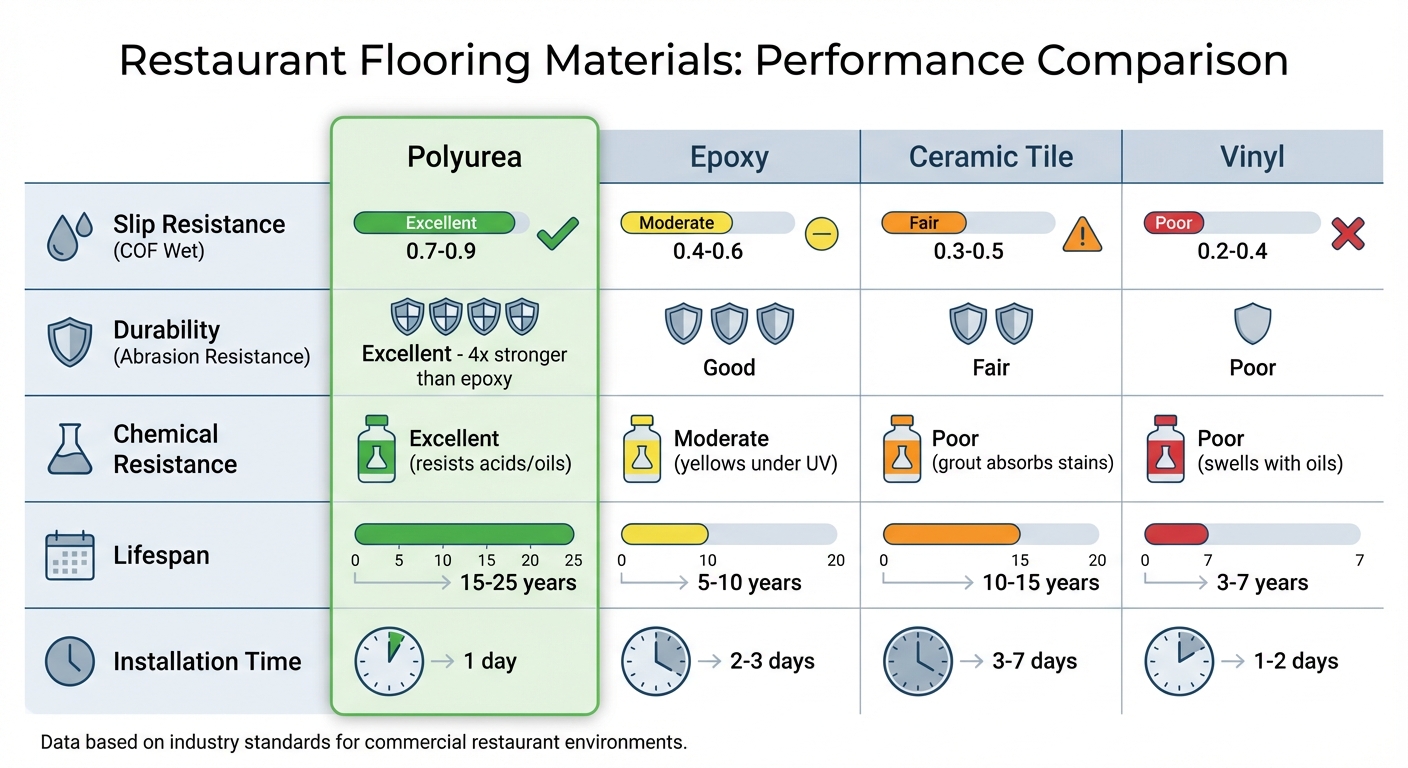
Restaurant Flooring Materials Comparison: Polyurea vs Epoxy vs Ceramic Tile vs Vinyl
Selecting the right flooring for a busy restaurant is no small task. Floors endure constant wear, spills, and heavy foot traffic, so durability and safety are key. When compared to traditional options like epoxy, ceramic tile, and vinyl, polyurea coatings deliver unmatched performance in both safety and longevity.
Take real-world examples: A Florida diner switched from slippery ceramic tiles to polyurea flooring and saw an 80% reduction in workers’ compensation claims over five years. The polyurea floor maintained a wet coefficient of friction (COF) of 0.85, offering exceptional slip resistance. Contrast that with a restaurant chain using epoxy flooring, where 40% of their floors failed within three years due to grease exposure. In Texas, a restaurant with polyurea flooring has enjoyed 12 years of durability despite 500 daily patrons, while their previous vinyl flooring needed replacement every four years, according to Atlas Concrete Coatings.
Flooring Material Comparison Chart
| Material | Slip Resistance (COF Wet) | Durability (Abrasion) | Chemical Resistance | Lifespan | Installation Time |
|---|---|---|---|---|---|
| Polyurea | 0.7-0.9 | Excellent (4x stronger than epoxy) | Excellent (resists acids/oils) | 15-25 years | 1 day |
| Epoxy | 0.4-0.6 | Good | Moderate (yellows under UV) | 5-10 years | 2-3 days |
| Ceramic Tile | 0.3-0.5 | Fair | Poor (grout absorbs stains) | 10-15 years | 3-7 days |
| Vinyl | 0.2-0.4 | Poor | Poor (swells with oils) | 3-7 years | 1-2 days |
Polyurea’s standout feature is its ability to stretch up to 300%, making it far more flexible than brittle materials like epoxy or ceramic tile. This flexibility helps prevent cracks caused by heavy foot traffic or thermal expansion. Additionally, its seamless surface eliminates grout lines, which are notorious for trapping grease and bacteria. Polyurea also resists oils and acids across a wide pH range (2-12), making maintenance a breeze – cleaning requires just a simple hose-down, unlike the frequent resealing, grout scrubbing, or waxing required by other materials.
These attributes clearly highlight why polyurea is a game-changer for restaurant flooring and why so many businesses are opting for installations with Atlas Concrete Coatings.
Installing Slip-Resistant Flooring with Atlas Concrete Coatings
For restaurant owners in Pennsylvania and New Jersey, Atlas Concrete Coatings provides a slip-resistant flooring solution that’s both efficient and tailored to your needs. Since 2010, Atlas has specialized in durable, fast-curing polyurea floors designed to handle the demands of bustling dining spaces – all while minimizing downtime.
Customer Ben Bender shared his experience, saying, "The floors were done same day and we are very happy with the results." This highlights the speed and reliability of Atlas’s polyurea installations, which are ready for use within just 24 hours. Beyond speed, their solutions are customized to match your restaurant’s unique requirements.
Custom Design Options
Who says slip-resistant flooring can’t look great? Atlas offers chip systems that not only enhance traction but also deliver a sleek, upscale appearance. According to the company, "Our various composites make it easy to customize your level of protection, traction, and personalized style." This means you can work with their experts to design blends tailored to different areas of your restaurant, ensuring maximum safety in spill-prone zones.
What’s more, Atlas uses UV-resistant materials, so your flooring’s colors and finishes stay vibrant for years. Whether you’re aiming for a polished aesthetic or prioritizing functionality, Atlas combines both without compromising installation speed or quality.
Fast Installation Process
Atlas completes installations in just one day, and the floors are ready to use within 24 hours. Their polyurea floors are built to last at least 10 years, standing up to heavy traffic, chemical spills, and temperature fluctuations. Serving areas throughout Pennsylvania (like Philadelphia and Montgomery County) and New Jersey, Atlas ensures a hassle-free process for even the busiest restaurants.
Conclusion
Restaurant floors endure a lot – constant foot traffic, heavy equipment, grease spills, and harsh cleaning chemicals. Polyurea coatings are up to the task, offering the slip resistance, durability, and low-maintenance qualities that busy dining environments need. Unlike traditional tile, which has grout lines that can harbor bacteria, or epoxy, which tends to chip and peel, polyurea creates a seamless, non-porous surface. This makes it easy to clean, sanitize, and maintain for the long haul. Plus, with built-in traction, these coatings reduce the risk of slips in high-risk areas like dish rooms, cooking lines, and walk-ins, while antimicrobial properties help maintain hygiene standards.
Durability and efficiency are also key benefits. Polyurea coatings can often be installed overnight, allowing restaurants to reopen the next day with minimal downtime. They’re designed to withstand heavy equipment, heat, and frequent cleaning without breaking down – something many traditional flooring options simply can’t handle.
These features make polyurea an ideal solution for restaurant flooring. Atlas Concrete Coatings specializes in delivering these benefits through their polyurea chip systems. With customizable slip resistance, UV-resistant finishes, and a lifetime warranty, they offer a flooring solution that’s installed in just one day. Whether you’re upgrading a kitchen, dining area, or outdoor patio, their team works with you to create a floor that prioritizes safety, style, and long-term durability.
Keep your staff and customers safe – reach out to Atlas Concrete Coatings for a free consultation and explore how polyurea can transform your restaurant floors.
FAQs
What slip rating should a restaurant floor meet when wet?
For safety, restaurant floors need to have a Dynamic Coefficient of Friction (DCOF) rating of 0.42 or higher when wet. This standard is designed to lower the chances of slips and falls, especially in busy areas.
Will polyurea flooring stay slip-resistant after years of cleaning and foot traffic?
Polyurea flooring is built to last, handling heavy foot traffic and frequent cleaning with ease. That said, extended exposure to sunlight without adequate UV protection can gradually affect its slip resistance. To keep it performing well and ensure safety, regular upkeep and applying protective coatings are essential.
How can polyurea be installed with minimal restaurant downtime?
Polyurea coatings are a smart option for busy restaurants because they cure extremely fast, cutting downtime to a minimum. The process involves prepping the surface, applying the coating with specialized equipment, and waiting through a short curing period. This quick turnaround means restaurants can get back to serving customers faster, making it a perfect solution for high-traffic spaces where every minute counts.