
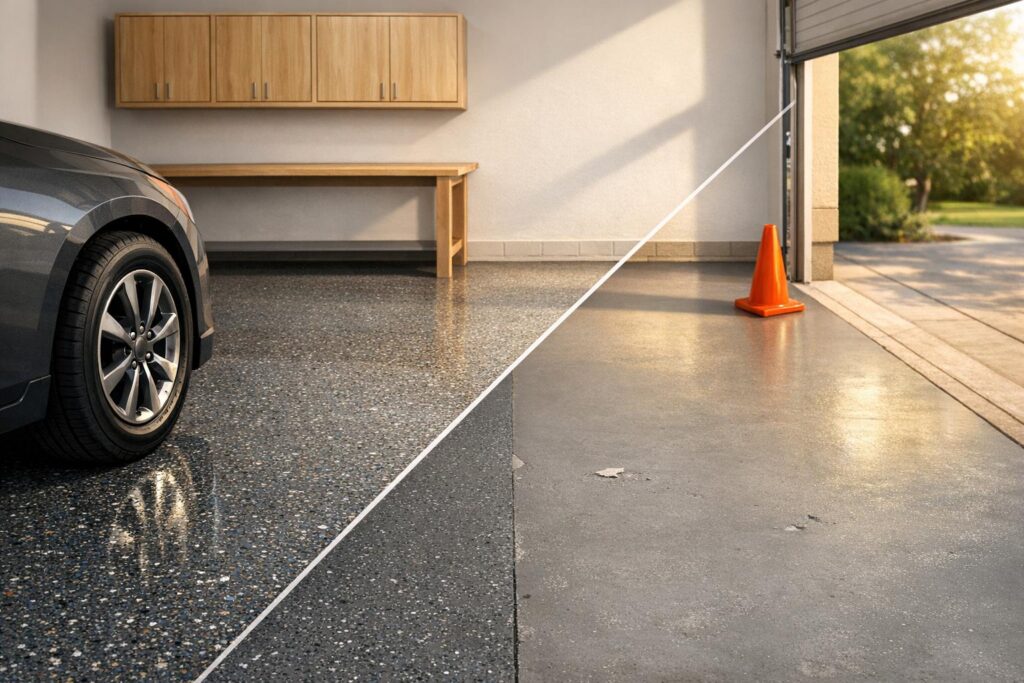
If you’re looking for a floor coating that outlasts epoxy and offers more customization, polyurea coatings might be the solution. They’re stronger, more flexible, and resistant to UV damage, making them ideal for garages, basements, and outdoor spaces. While the upfront cost is higher – typically $6–$13 per square foot – the long lifespan (15–25+ years) and low maintenance can save you money in the long run. Plus, you can add slip-resistant textures, decorative chips, or custom colors for a personalized finish.
Key Points:
- Durability: 4,000+ PSI strength and flexible to prevent cracking.
- Cost: $2,800–$4,400 for a 400 sq. ft. garage, with custom upgrades available.
- Lifespan: 15–25+ years vs. 5–10 years for epoxy.
- Maintenance: Non-porous surface resists stains and chemicals.
- Customization: Options include unique colors, metallic finishes, and slip-resistant features.
While epoxy is cheaper upfront, polyurea’s durability, quick curing time, and customization options make it a smarter long-term investment – especially with warranties that often cover a lifetime. For a long-lasting, attractive, and hassle-free floor, polyurea coatings are worth considering.
The True Cost of Garage Floor Coatings and Why Polyurea Is Worth It
sbb-itb-4b4bb37
Problems with Standard Flooring Options
Standard flooring options often fall short when it comes to durability, visual appeal, and safety. This is where custom polyurea coatings stand out as a practical alternative to address these persistent issues.
Durability and Maintenance Problems
One of the main drawbacks of standard epoxy flooring is its rigidity. With less than 10% flexibility, it struggles to adapt to shifts in the underlying concrete or withstand impacts. This lack of flexibility leads to chipping, cracks, and a gradual loss of its protective properties. These problems are magnified by temperature extremes – epoxy becomes brittle in cold weather and softens in high heat. Its functional temperature range is limited to between -10°F and 140°F. In high-stress environments, the lifespan of epoxy coatings typically shrinks to just 3–5 years, while concrete overlays may last only 2–3 years.
"Epoxy is like a hard shell that can crack under stress." – MotorCity Floors and Coatings
Epoxy’s performance further deteriorates under the heat generated by vehicle tires, often causing the coating to soften and lose its bond to the surface. Meanwhile, untreated concrete readily absorbs oil and chemicals, leaving unsightly stains. Standard coatings also struggle with moisture vapor transmission, which can result in bubbling, peeling, or delamination. Adding to the inconvenience, epoxy requires a curing period of 3 to 7 days before it can handle vehicle traffic, potentially disrupting daily routines. These performance limitations also restrict the range of aesthetic options available.
Limited Design Options
On top of durability issues, standard coatings offer limited design flexibility. Epoxy coatings, for example, lack UV stability, which leads to yellowing, fading, and chalking when exposed to sunlight. This makes floors look prematurely aged and poorly maintained. Rubberized finishes are typically available in only basic color options, while bare concrete’s porous surface makes it nearly impossible to maintain a clean or customized appearance once it has absorbed oils or chemicals.
Safety Issues
The shortcomings in durability and aesthetics also contribute to safety concerns. High-gloss epoxy surfaces can become dangerously slippery when wet, posing a hazard in garages, workshops, and commercial spaces. While anti-slip additives can be included, cracks in the coating often create uneven surfaces, increasing the likelihood of trips and falls. UV degradation further compromises the coating’s structural integrity over time, weakening its protective barrier. Additionally, extreme cold makes epoxy brittle and prone to peeling, while heat softens the material to the point where it loses its effectiveness.
What Custom Polyurea Coatings Cost
Price Range for Custom Polyurea Coatings
Installing polyurea coatings typically costs $6–$10 per square foot for standard applications. To put that into perspective, finishing a two-car garage (400–576 sq. ft.) runs about $2,400–$5,760. A single-car garage (250–350 sq. ft.) costs approximately $1,500–$3,500, while a three-car garage (600–850 sq. ft.) ranges from $3,600–$8,500.
If you’re aiming for custom finishes, expect to pay more. Add-ons like slip-resistance treatments cost $0.25–$0.50 per sq. ft., custom colors add around $300, and specialty Neo Chips average $450. For more intricate designs – think logos, patterns, or glitter finishes – prices can climb to $500–$2,000, often requiring extra labor and time.
Now, let’s dive into what drives these costs.
What Affects the Price
The state of your concrete plays a major role in determining the final price. Floors with cracks, damage, or old coatings need extra prep work, which increases both labor and material expenses. High moisture levels in the concrete might require a moisture-barrier primer to prevent issues like delamination. If you’re coating vertical surfaces like stem walls (the concrete extending up garage walls), that’s an added expense.
"Pricing varies per region in the United States… $7 to $13 is usually what you’ll find where we serve due to the amount of repair concrete needs from cracks and salting pitting." – Level 10 Coatings
Bigger projects, while more expensive overall, often benefit from lower per-square-foot costs due to economies of scale. Regional factors also play a role – areas with salt damage or freeze-thaw cycles typically require more repairs. Additionally, seamless joint fillers for cracks or gaps cost about $16.50 per linear foot.
Standard vs. Custom Polyurea Coatings Comparison
Here’s a quick breakdown of how standard and custom polyurea coatings differ:
| Feature | Standard Polyurea | Custom Polyurea |
|---|---|---|
| Base Cost | $6–$8 per sq. ft. | $7–$13 per sq. ft. |
| Visual Options | Standard flake blends | Custom colors, logos, glitter, neon chips |
| Safety Features | Standard texture | Enhanced slip-resistance ($0.25–$0.50 per sq. ft.) |
| Surface Preparation | Standard grinding | Moisture barriers, adhesive removal, joint filling |
| Lifespan | 15–25+ years | 15–25+ years |
While both options provide excellent durability – lasting 15–25+ years compared to epoxy’s 5–10 years – custom polyurea coatings offer more in terms of style, safety, and customization. The added features not only improve the look and feel of your floor but also make it a more worthwhile long-term investment.
For a personalized quote, reach out to Atlas Concrete Coatings. They provide free consultations to help you create a durable, attractive, and safe flooring solution tailored to your needs.
Why Custom Polyurea Coatings Work Better
Strength and Lifespan
Polyurea coatings are built to last, offering tensile strengths that exceed 4,000 PSI – far stronger than standard epoxy. They also have an elongation rate of over 300%, meaning they can flex with concrete as it expands and contracts with temperature changes. These coatings typically feature a two-layer system: an aromatic polyurea base coat that penetrates deeply into the concrete for a strong bond, and a polyaspartic topcoat that provides resistance against UV rays and chemicals. Together, this combination delivers a lifespan of 15–20+ years without needing replacement.
Polyurea can also handle heat up to 300°F, which prevents issues like hot tire pickup – when tires stick to and pull up epoxy coatings. On top of that, polyurea coatings cure quickly, allowing foot traffic within 4–8 hours and vehicle traffic in just 24 hours. Beyond their durability, these coatings also offer a range of aesthetic benefits.
Better Appearance Options
Polyurea’s durability doesn’t mean sacrificing style. Decorative vinyl chips, applied during installation, help hide imperfections while adding texture and depth. You can choose from a wide variety of custom colors and decorative blends, whether you’re looking for a sleek modern vibe or a glossy showroom finish.
The polyaspartic topcoat is UV-stable, so it won’t yellow, chalk, or fade under sunlight – perfect for areas like garages with windows or outdoor spaces like pool decks. For outdoor applications, an aliphatic (polyaspartic) topcoat ensures the surface maintains its appearance for years to come.
Easy Maintenance and Safety
Polyurea coatings form a seamless, non-porous surface that resists water, oil, gasoline, and harsh chemicals, keeping your floor intact and easy to clean. Maintenance is simple – just sweep and mop occasionally with mild detergents.
For added safety, custom installations can include slip-resistant additives or decorative chip textures, which improve traction in areas like pool decks, commercial kitchens, or busy walkways. Plus, the coating’s flexibility prevents brittle fractures, eliminating tripping hazards as it adapts to the concrete’s movement. This combination of easy upkeep and enhanced safety makes polyurea coatings a smart, long-term investment.
Atlas Concrete Coatings specializes in professional polyurea systems, offering customizable colors, chip blends, and slip-resistant finishes for residential, commercial, and industrial applications. Their lifetime warranty on chip systems ensures lasting durability and peace of mind.
Long-Term Value: Is It Worth the Cost?
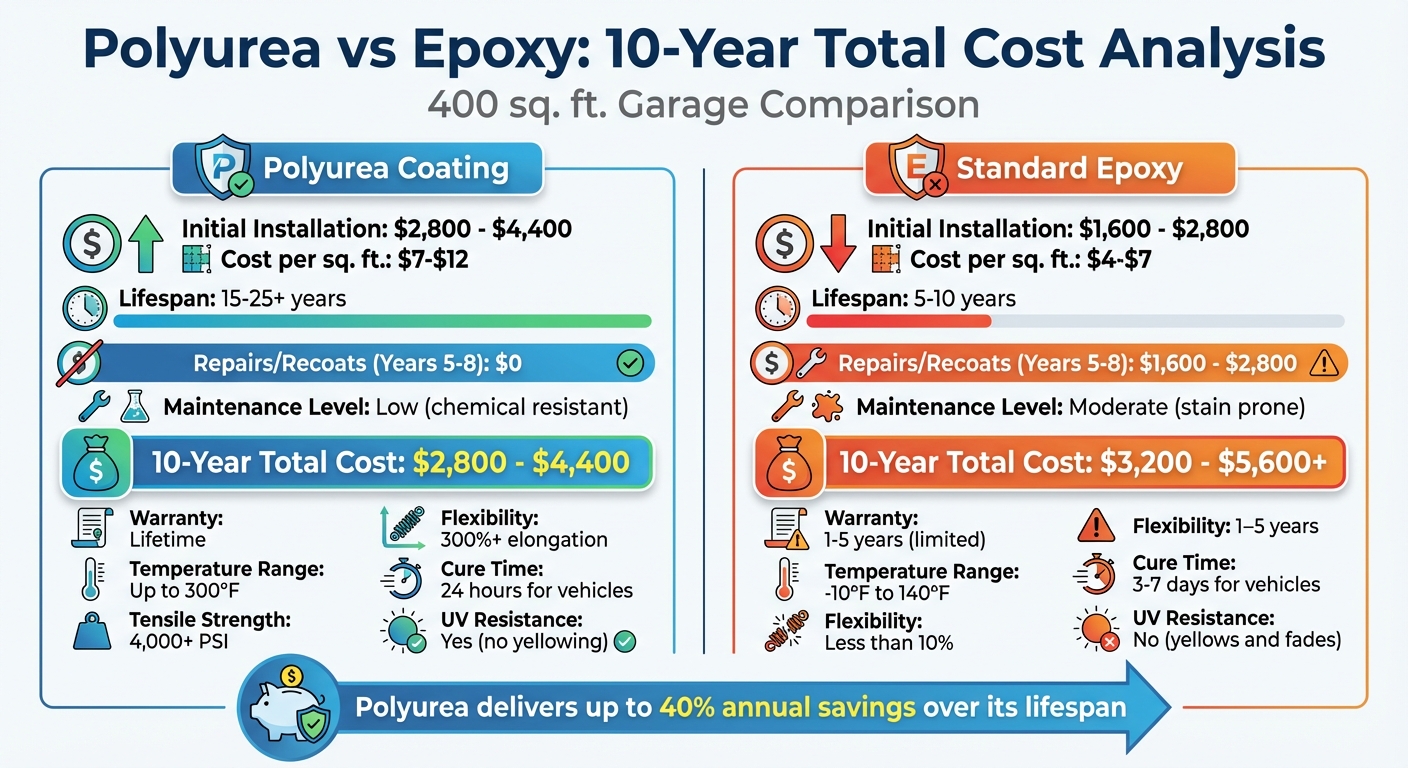
Polyurea vs Epoxy Flooring: 10-Year Cost and Performance Comparison
Polyurea coatings stand out not only for their durability and aesthetics but also for the long-term value they provide.
ROI for Residential and Commercial Projects
At first glance, the cost of polyurea coatings – ranging from $7–$12 per square foot – may seem high compared to standard epoxy, which costs around $4–$7 per square foot. For a 400-square-foot garage, this translates to an upfront investment of $2,800–$4,400 for polyurea versus $1,600–$2,800 for epoxy. However, polyurea’s durability and minimal maintenance needs make it a more appealing option over time.
Epoxy coatings typically require repairs or full replacement within 5–8 years, adding another $1,600–$2,800 to the total cost. Polyurea, with its longer lifespan, eliminates frequent recoating expenses and reduces the likelihood of unexpected repair costs. When you consider customization options and extended performance, the return on investment becomes even clearer.
This becomes especially apparent when comparing the total costs over a 10-year period.
10-Year Cost Comparison: Polyurea vs. Other Flooring
To illustrate the economic advantage, here’s a breakdown of the 10-year costs for a 400-square-foot garage:
| Cost Factor | Polyurea (Lifetime Warranty) | Standard Epoxy |
|---|---|---|
| Installation Cost | $2,800 – $4,400 | $1,600 – $2,800 |
| Repairs/Recoats (Year 5–8) | $0 | $1,600 – $2,800 |
| Maintenance/Cleaning | Low (Chemical resistant) | Moderate (Stain prone) |
| Total 10-Year Cost | $2,800 – $4,400 | $3,200 – $5,600+ |
Polyurea’s non-porous surface doesn’t just resist stains and chemicals; it also makes maintenance straightforward. Forget about specialized cleaners or intensive cleaning routines – a quick sweep and mop are usually all you’ll need.
Additionally, warranties play a crucial role in maximizing value.
Warranties and Extra Benefits
One of polyurea’s standout advantages is its lifetime warranty. For example, Atlas Concrete Coatings offers a lifetime warranty on its chip floor systems, covering defects and workmanship for as long as you own the property. This significantly reduces repair costs since any issues, like peeling or cracking, are handled by the provider.
In contrast, epoxy products often come with limited warranties, typically lasting 1–5 years. These leave homeowners responsible for expenses related to peeling, discoloration, or other issues. With polyurea’s lifetime warranty, you gain not only financial savings but also peace of mind, knowing that your investment is protected.
The key to achieving such longevity lies in professional installation. Using industrial planetary grinders ensures a molecular bond, which is essential for polyurea’s long-lasting performance.
Conclusion: The Value of Custom Polyurea Coatings
Key Takeaways
Custom polyurea coatings stand out for their unmatched durability and long-term cost efficiency. Compared to standard epoxy, polyurea’s superior strength can deliver up to 40% savings annually over its lifespan.
One of its standout features is the quick installation and curing process, which minimizes interruptions to your daily life or business operations. As Jake Lowry from MotorCity Floors and Coatings explains:
"Polyurea is like a flexible armor that moves with your concrete, absorbing impacts and temperature fluctuations without breaking down".
This "flexible armor" quality, combined with its chemical resistance and low-maintenance nature, makes it an ideal solution for those looking to avoid frequent repairs or recoating. Add in perks like a lifetime warranty, protection against hot tire pickup, and customizable colors and finishes, and you’re not just investing in a floor coating – you’re securing decades of dependable performance with enhanced safety and style.
Taking the Next Step
If you’re ready to experience these benefits, the first step is professional installation. Ensure your contractor uses diamond grinding for surface preparation instead of acid etching. This step is crucial for creating the molecular bond that gives polyurea its renowned durability.
For a tailored solution, reach out to Atlas Concrete Coatings for a custom quote. Their team will assess your concrete’s condition, discuss your specific needs – whether for a residential garage or a commercial space – and provide a detailed estimate. Don’t forget to ask for examples of their previous work, details on their surface preparation methods, the number of coating layers applied, and warranty coverage. By partnering with experienced professionals, you’ll enjoy a floor that’s built to last and designed to impress for years to come.
FAQs
How long does polyurea installation take?
Polyurea coatings are known for their quick installation process, often completed in under 24 hours. This timeframe includes everything: surface preparation, necessary repairs, priming, mixing, and application. Even the curing process is impressively fast, typically wrapping up within the same 24-hour period. This makes polyurea a convenient and efficient choice for those seeking durable floor coatings without lengthy downtime.
Will polyurea peel if my concrete has moisture?
Properly preparing the surface and testing for moisture are critical steps when applying polyurea coatings. If the concrete contains moisture issues, the coating can face problems like peeling, blistering, or even delamination. Tackling these moisture concerns before application helps the coating bond effectively, ensuring durability and longevity.
What custom options raise the price the most?
Custom features like decorative flakes, non-slip additives, custom colors, moisture barriers, and extra surface preparation can add a noticeable boost to the overall cost. These enhancements typically increase prices by anywhere from 15% to 40% or even higher, depending on how extensive the customization is and the condition of the surface being worked on.