

Concrete Surface Profiles (CSPs) are essential for ensuring coatings properly adhere to concrete surfaces. They measure the texture depth, ranging from CSP 1 (smooth) to CSP 10 (very rough). Proper preparation can prevent coating failures, save money, and extend durability.
Here’s what you need to know:
- CSP Levels: Defined by the International Concrete Repair Institute (ICRI), CSPs range from smooth (CSP 1) to rough (CSP 10).
- Why It Matters: Roughness creates better mechanical bonds. For example, a Midwest facility reduced repair costs from $9.50 to $1.20 per square foot by improving CSP levels.
- Measurement Methods:
- ICRI CSP Chips – Compare surface texture visually and by touch (affordable but subjective).
- Replica Tape (ASTM D7682) – Create putty impressions for visual or micrometer analysis (permanent but consumable).
- Depth Micrometers (ASTM D8271) – Provide precise, digital readings (efficient for large projects).
- Profilometers (ASTM E2157) – Offer detailed lab-grade surface maps (costly and impractical for field use).
For most projects, digital depth micrometers balance precision and practicality. Always match CSP levels to coating requirements to ensure long-lasting results.
Visual and Manual CSP Assessment Methods
How to Use ICRI CSP Reference Chips

To determine your concrete surface profile (CSP), compare the surface directly with the ICRI CSP reference chips. These chips, each about 16 square inches, represent CSP levels from 1 to 10. Using both sight and touch, you can identify the chip that most closely matches your surface texture.
Here’s how to do it: place the reference chip next to your prepared surface. First, visually assess which chip resembles the texture of your concrete. Then, use your hands to feel both the chip and the surface, confirming your visual match.
"Unlike steel, we can use tactile methods (touch/feel) in addition to visual assessments on concrete without concern for rust."
– Bill Corbett, KTA-Tator, Inc.
Once you’ve identified the closest match, record the corresponding CSP number. For instance, if CSP 5 is the best match, this indicates a medium shotblast profile with an approximate depth of 16 ± 2 mils. Always consult the coating manufacturer’s technical data sheet to ensure the required CSP level is achieved, avoiding unnecessary rework. While this method is straightforward, it does involve some level of subjectivity, as explained below.
Pros and Cons of Visual Assessment
Visual and manual assessment methods come with clear advantages and limitations. On the plus side, they are cost-effective (a set of ICRI chips costs about $76.00), require minimal training, and are widely accepted in the industry. The combination of sight and touch offers a more thorough evaluation compared to visual inspection alone, contributing to proper surface preparation for coating adhesion.
However, these methods are not without challenges. The process is qualitative and subjective, meaning different inspectors might interpret the same surface differently.
"Chips are arguably the most widely recognized and frequently specified method to assess concrete roughness; however, this method is qualitative and requires some judgment by the individual inspector."
– DeFelsko
This subjectivity can lead to disagreements, particularly in situations requiring precise, contractual measurements. Additionally, visual assessments do not provide exact depth measurements in mils or microns, which may be necessary for detailed quality control records.
sbb-itb-4b4bb37
Replica Tape Method (ASTM D7682)
How Replica Tape Captures Surface Texture
ASTM D7682 relies on a two-part replica putty to create an exact impression of concrete’s surface texture, including its deeper contours. This process forms a "reverse replica", capturing the peaks and valleys of the surface. To use, thoroughly mix the two-part putty and press it onto a clean concrete surface, ensuring it fills every void. Once cured, the replica can be analyzed either visually by comparing it to ICRI CSP chips (Method A) or measured with a micrometer (Method B). Unlike purely visual assessments, this approach provides a physical record of the surface texture, which can help resolve disputes over surface preparation quality in the future.
"This technique uses replica putty to make impressions of concrete surfaces for either visual comparison or for quantifying the surface roughness."
– David Beamish, General Manager, DeFelsko Corp.
Studies have found that measurements taken indirectly from epoxy putty replicas tend to show higher surface profile values and greater variability compared to direct measurements from the same surface. This discrepancy highlights the importance of clarifying which measurement method will be used, especially when contract specifications require precise surface profiles. Accurate measurements ensure effective quality control, which depends heavily on correct application techniques.
Tips for Accurate Replica Tape Application
For the most reliable results, proper preparation and application are key. Start by thoroughly cleaning the concrete surface to remove dust, debris, and any leftover blast media. Using cleaning putty can help ensure the surface is spotless before applying the replica putty. Contaminants trapped in the replica can lead to inflated readings, so this step is crucial.
When mixing the putty, combine both components completely, as the material cures quickly. Press the putty firmly into the surface to capture every detail, including all peaks and valleys. After curing, check the replica for any signs of contamination or incomplete impressions. Keep the replica as a permanent record for quality assurance. This method supports rigorous quality control in concrete coating projects, ensuring the surface is properly prepared for coatings like those used by Atlas Concrete Coatings in various residential, commercial, and industrial applications.
Precision Measurement Tools for CSP
Using a Depth Micrometer (ASTM D8271)
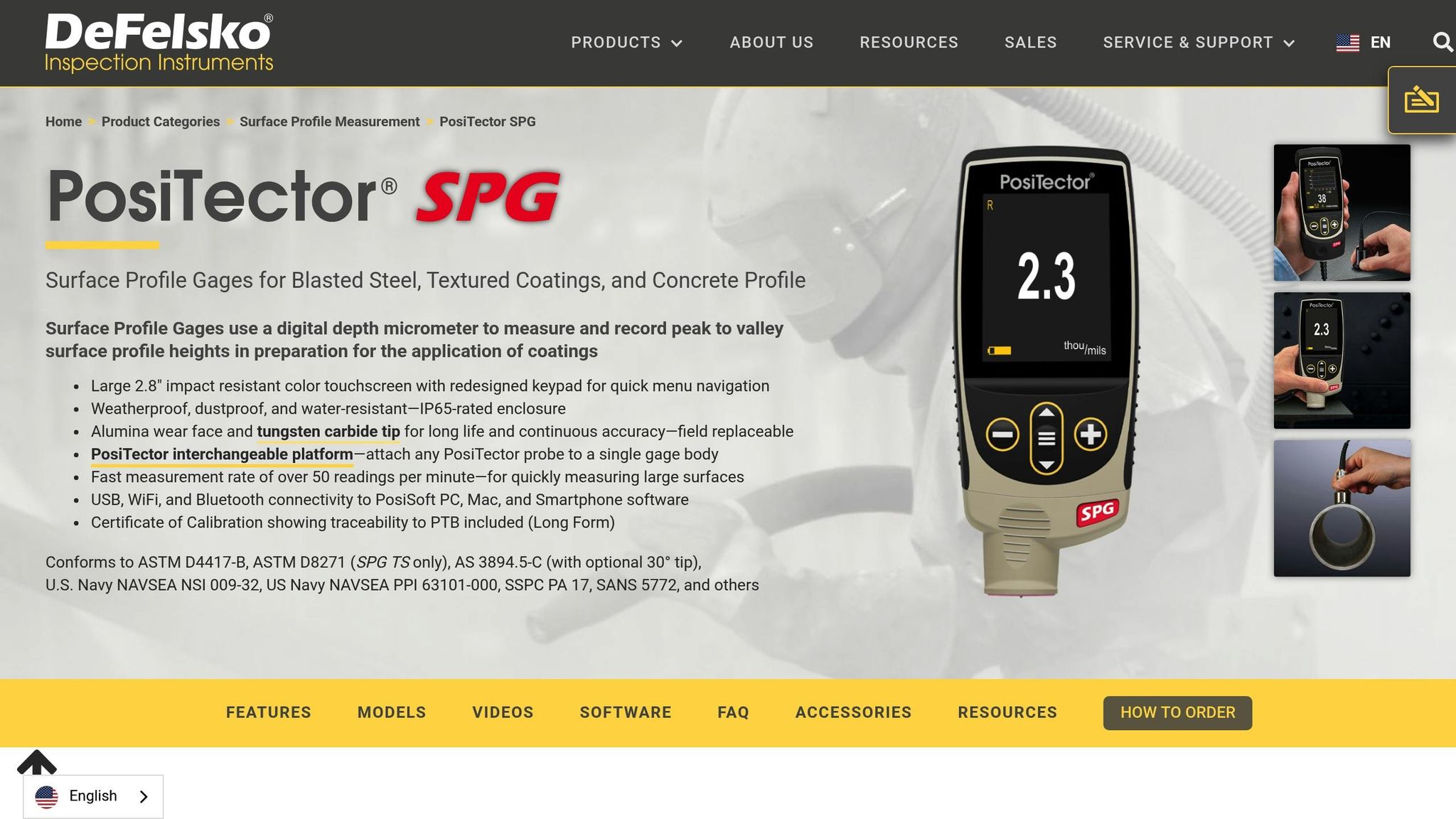
ASTM D8271 outlines a methodical approach for measuring concrete surface profiles using a depth micrometer. Tools like the PosiTector SPG TS employ a 1-inch diameter flat base and a 60° conical, spring-loaded probe. The flat base rests on the highest points of the surface, while the probe extends into the valleys, capturing the peak-to-valley distance.
These digital tools can measure profile heights up to 6 mm (approximately 250 mils) and record over 50 readings per minute. ASTM D8271 specifies taking a minimum of 15 readings within a 6" x 6" area to define a single location. Built-in statistics modes on these instruments automatically calculate averages, simplifying the process.
"The depth of profile is measured using a fine pointed probe at a predetermined number of locations, and the range and arithmetic mean of the maximum peak-to-valley distances is determined." – ASTM D8271
At the 2022 AMPP Conference, David Beamish from DeFelsko and William Corbett from KTA-Tator presented a study correlating qualitative CSP chips with quantitative measurements. Using hardened black epoxy replicas of ICRI CSP chips 1–7, six technicians each took three sets of 15 readings with a PosiTector SPG TS. Their findings revealed that Light Shotblast (CSP 3) corresponds to 11 ± 2 mils, while Heavy Abrasive Blast (CSP 7) measures 48 ± 4 mils. This data provides a clear reference for converting qualitative standards into precise numerical ranges.
Before taking measurements, ensure the surface is clean and free of debris. Position the probe foot level on the surface so the base touches the highest peaks. Unlike methods requiring consumables like replica putty, these instruments offer a cost-effective, reusable solution for ongoing quality control. This makes them indispensable for coating projects where proper surface preparation is critical for adhesion and durability. For tasks requiring even finer detail, profilometer technology may be considered.
Profilometer Technology (ASTM E2157)
While depth micrometers are efficient for field use, profilometers excel at providing laboratory-grade surface analysis. These tools use either stylus or laser technology to map surfaces in greater detail. Stylus profilometers drag a stylus across the surface at a constant speed, measuring vertical deviations to calculate roughness (Ra). Laser or optical profilometers, on the other hand, use laser light to create precise surface maps without any physical contact.
Although these devices produce highly detailed 2D or 3D surface profiles, they are generally better suited for laboratory environments due to their size and cost. Laser profilometers, in particular, are often too expensive for routine field inspections, making depth micrometers the more practical option for on-site work. However, when specifications demand the highest precision or when detailed mapping is required for research, profilometers remain the top choice for concrete surface analysis.
How to Measure Surface Profile with PosiTector SPG Digital Depth Micrometers
Visual vs. Precision Measurement Methods
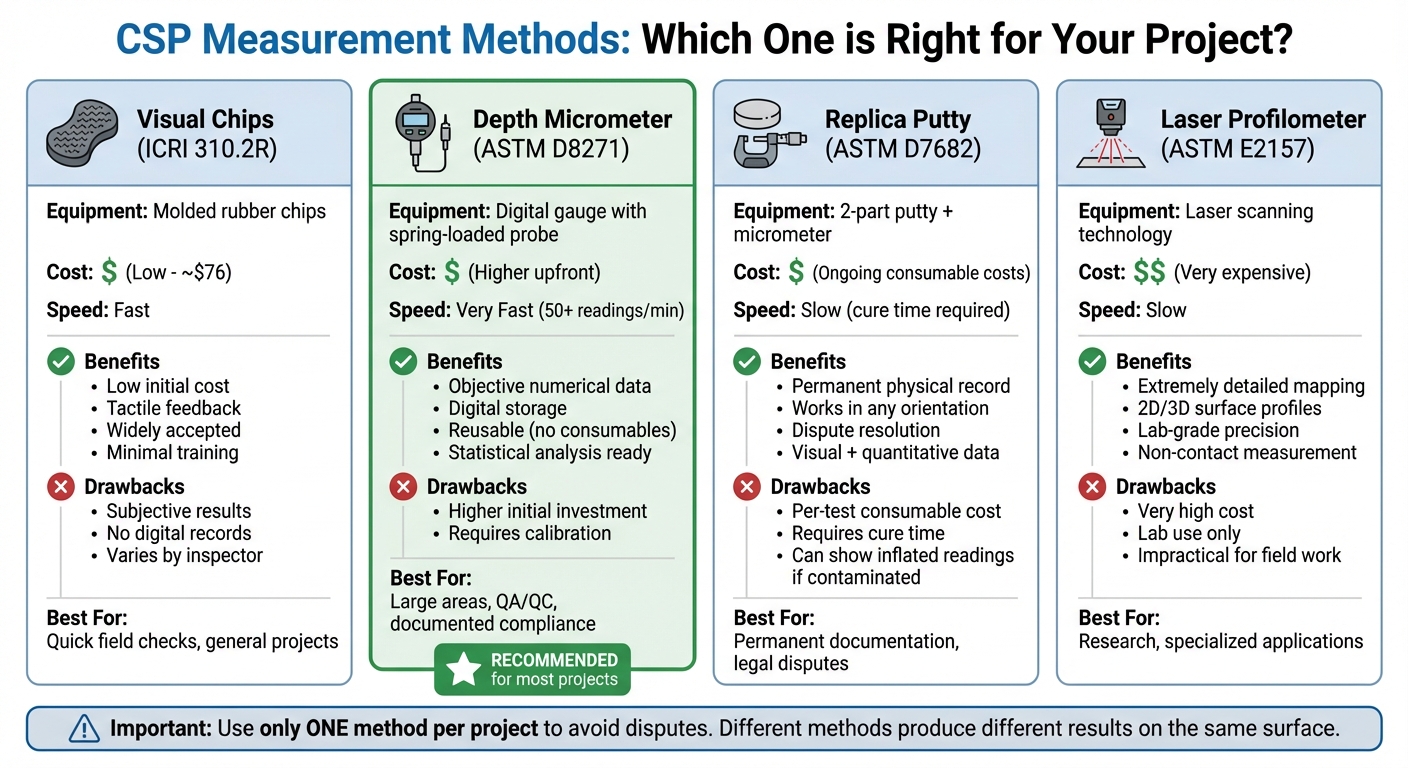
Concrete Surface Profile Measurement Methods Comparison Chart
Selecting the right CSP (Concrete Surface Profile) measurement method is essential to ensure proper coating adhesion and long-lasting durability. The choice between visual assessment and precision tools depends on the specific needs of the project.
Visual methods, like using ICRI CSP chips, are a quick and affordable way to check surface preparation on-site. They’re widely accepted in specifications and allow inspectors to physically compare surfaces. However, these methods can be slightly subjective, as results may vary between inspectors. In contrast, precision tools provide measurable, objective data.
Tools such as digital depth micrometers offer numerical readings that can be stored and analyzed. While these devices require a larger initial investment, they eliminate ongoing per-test costs and can take over 50 readings per minute – making them ideal for quality control on larger projects. Another option, replica putty, provides a permanent physical record along with quantitative measurements, though it involves consumable materials and a waiting period for curing.
It’s important to note that different methods can produce varying results on the same surface. As KTA-Tator explains:
"There will likely be differences in the results when measured using each of these techniques, so it is important that only a single method be specified/used on a single project to avoid potential disputes".
For contracts requiring numerical data, correlation tables can be used to convert CSP chip numbers into mil ranges.
Method Comparison Table
Here’s a breakdown of the benefits and limitations of each method:
| Method | Standard | Equipment | Benefits | Drawbacks | Best For |
|---|---|---|---|---|---|
| Visual Chips | ICRI 310.2R | Molded rubber chips | Low cost, tactile feedback, widely used | Subjective; no digital records | Quick field checks; general projects |
| Depth Micrometer | ASTM D8271 | Digital gauge with probe | Objective data, fast (50+ readings/min), digital storage | Higher initial cost | Large areas, QA/QC, statistical analysis |
| Replica Putty | ASTM D7682 | 2-part putty + micrometer | Permanent record, works in any orientation | Consumable cost; requires cure time | Permanent documentation; dispute resolution |
| Laser Profilometer | ASTM E2157 | Laser scanning device | Extremely detailed surface mapping | Very expensive; lab use only | Research; specialized applications |
For most coating projects, including those handled by Atlas Concrete Coatings, digital depth micrometers strike the best balance between accuracy and practicality. They provide reliable numerical data critical for ensuring proper surface preparation, while remaining efficient and cost-effective for on-site use.
Conclusion: Selecting the Right CSP Measurement Approach
Choosing the right concrete surface profile (CSP) measurement method depends on the specific needs of your project. For smaller jobs, ICRI CSP chips offer a quick, tactile way to assess surface texture. On the other hand, digital depth micrometers provide objective, verifiable data that’s essential for documented compliance.
Contract requirements often dictate the method to use. As Bill Corbett points out, while CSP chips are widely recognized, they rely on subjective judgment. For projects needing precise numerical data, digital tools are indispensable. This highlights the importance of balancing qualitative assessments with quantitative accuracy to meet project demands effectively.
The type of coating system also plays a major role in determining the required CSP. Thin sealers work best on smoother surfaces (CSP 1–2), while rougher profiles (CSP 5–9) are necessary for high-build overlays. It’s worth noting that an inadequate surface profile is one of the main reasons coatings fail on concrete.
At Atlas Concrete Coatings, every project begins with detailed CSP measurements. By adhering to ASTM D8271 and verifying profiles before applying coatings, they ensure the strong mechanical bonds needed for long-lasting results. Combining visual checks with precise tools helps maintain consistency with the industry standards outlined above.
FAQs
What CSP does my coating system require?
To achieve the best results with your coating system, it’s crucial to match the concrete surface profile (CSP) to the recommended roughness for the coating. For epoxy or high-build coatings, the ideal CSP typically falls between 3 and 5. This alignment is essential for ensuring proper adhesion and long-term durability of the coating.
How many CSP readings should I take per area?
To get accurate results, it’s a good idea to take 3 to 5 measurements from different spots within the same area. This approach helps create a more reliable profile of the surface.
Can I mix CSP measurement methods on one project?
Yes, it’s possible to use a mix of methods to measure concrete surface profiles (CSP) on a project. Tools such as replica tape, depth micrometers, stylus instruments, and visual comparators can all play a role in assessing the surface, depending on the specific requirements and standards of the project. Each method offers distinct insights, and combining them can lead to more precise and thorough evaluations.