

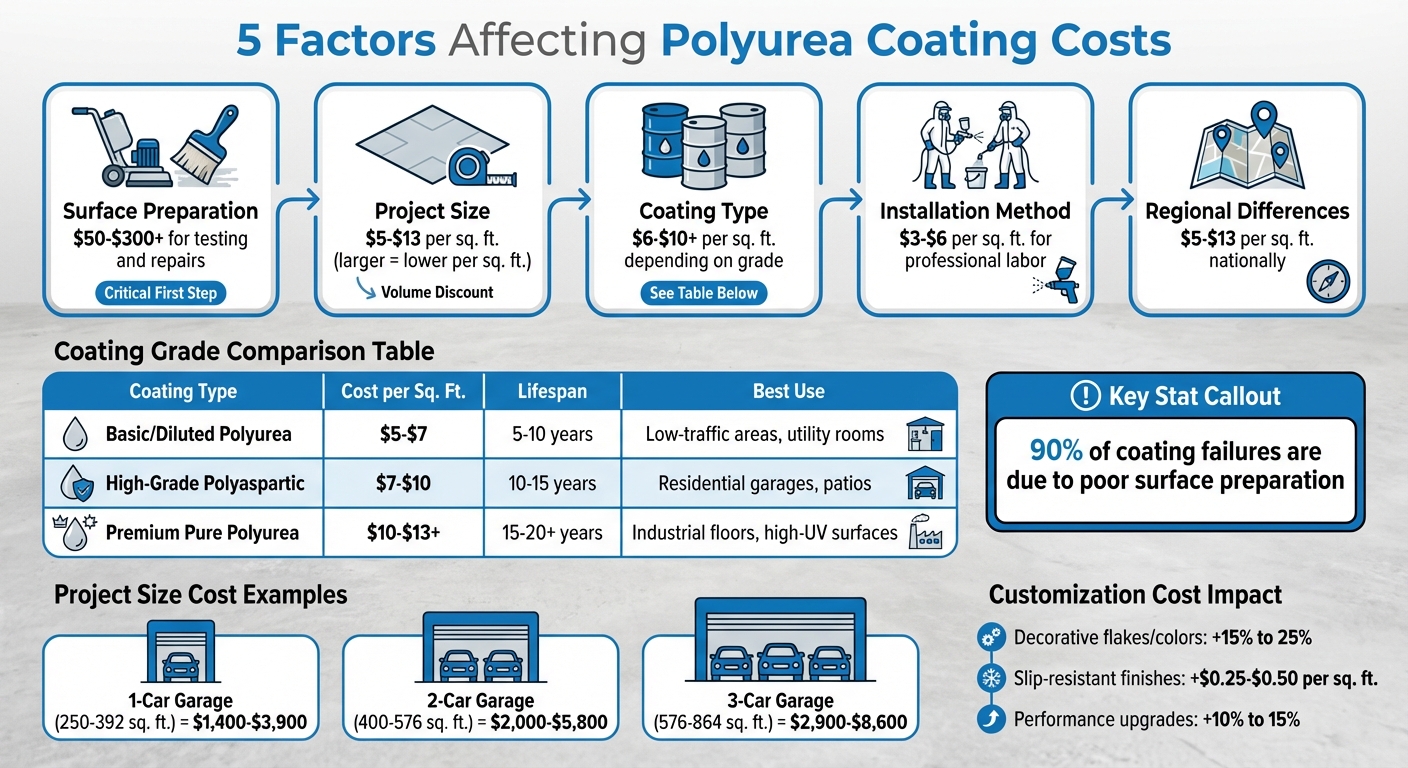
Polyurea coatings are a durable option for protecting floors in garages, kitchens, and industrial spaces, but their costs vary widely depending on several factors. Here’s what impacts pricing:
- Surface Preparation: The condition of your concrete matters. Repairs for cracks, stains, or moisture issues can add $50 to $300 or more to your budget.
- Project Size: Larger areas cost less per square foot due to economies of scale. For example, a 2-car garage (400–576 sq. ft.) typically costs $2,000–$5,800.
- Coating Type: Pure polyurea costs $6–$8 per sq. ft., while polyaspartic polyurea ranges from $6–$10. Customizations like decorative flakes or slip-resistant finishes increase costs by 15%–40%.
- Installation Method: Professional labor adds $3–$6 per sq. ft., with factors like layout complexity and wall coatings affecting the final price.
- Regional Differences: Costs vary by location due to labor rates and climate-related repairs, ranging from $5–$13 per sq. ft. nationally.
Understanding these factors helps you plan your budget and choose a long-lasting solution. For a quick comparison, here’s a cost breakdown by coating grade:
| Coating Type | Cost per Sq. Ft. | Lifespan | Best Use Cases |
|---|---|---|---|
| Basic/Diluted Polyurea | $5–$7 | 5–10 years | Low-traffic areas |
| High-Grade Polyaspartic | $7–$10 | 10–15 years | Residential garages, patios |
| Pure Polyurea | $10–$13+ | 15–20+ years | Industrial floors, high-UV surfaces |
Investing in proper preparation and high-quality materials ensures durability and reduces long-term costs.
Polyurea Coating Cost Factors and Price Comparison Guide
How Much Does A Polyurea Garage Floor Coating Cost In 2023? (3 Factors That Affect Cost)
sbb-itb-4b4bb37
1. Surface Preparation and Condition
The state of your concrete plays a major role in determining the cost of polyurea coatings. In fact, industry experts point out that poor surface preparation accounts for approximately 90% of coating failures. This step is not just essential but also adds to the overall expense, as outlined below.
Impact on Cost
Before starting, installers evaluate the concrete’s hardness and moisture levels. This testing alone can add anywhere from $50 to $300 to your budget. While minor cracks and small repairs are typically included in the base cost of $5 to $13 per square foot, more severe issues – like heavy oil stains, salt pitting, or remnants of DIY coatings – can escalate labor and material expenses.
Older garages and basements often have a high rate of moisture vapor transmission. To address this, a moisture-barrier primer may be necessary, preventing the coating from lifting or blistering. Additionally, filling control joints can cost about $16.50 per linear foot, and coating stem walls (where concrete extends up the walls) requires extra precision and handwork, further adding to the expense.
Relevance to Polyurea Coatings
Polyurea’s fast curing process makes surface preparation absolutely critical. This coating forms a durable bond with the concrete only when both chemical and mechanical adhesion are achieved. Any shortcuts in preparation can compromise the integrity of the coating, as polyurea leaves little room for error during application.
Common Variations and Examples
When getting quotes, it’s important to ask contractors to detail their preparation process. For instance, one contractor might quote $6 per square foot but skip moisture testing, while another may charge $9 per square foot to include thorough testing, crack repair, and primer application. Since factors like concrete hardness, moisture content, and damage levels can only be properly assessed during an in-person inspection, phone estimates often change after an on-site evaluation.
"If your current concrete has damage, is oil stained, is too soft, too moist… [it] will determine how much repair needs to be done which is a variable of cost." – Level 10 Coatings
Next, we’ll explore how project size and coverage area can further impact pricing.
2. Project Size and Coverage Area
After surface preparation, the next major consideration is the size of the project and the total coverage area.
Impact on Cost
The square footage of the area plays a significant role in determining polyurea coating costs. For example, coating a two-car garage (400–576 sq. ft.) typically costs between $2,000 and $5,800, while a three-car garage (576–864 sq. ft.) ranges from $2,900 to $8,600. Larger projects naturally require more materials and labor, which drives up the total cost.
However, as the project size increases, the cost per square foot usually decreases. For instance, a 500-square-foot floor may cost $7–$10 per square foot, but smaller areas like a utility room could reach $13 per square foot. This is because fixed costs – such as equipment setup, travel, and cleanup – are spread across a larger area, making the per-unit cost more economical.
Relevance to Polyurea Coatings
Precision in measurements becomes crucial when working with polyurea due to its fast curing time. Any miscalculation can lead to wasted material and higher expenses. Don’t forget to include vertical surfaces, like stem walls (where concrete extends up the walls), as these add both material and labor costs to the project.
Common Variations and Examples
Here’s a quick overview of estimated costs based on typical garage sizes:
| Garage Type | Typical Square Footage | Estimated Total Cost Range |
|---|---|---|
| 1-Car Garage | 250–392 sq. ft. | $1,400–$3,900 |
| 2-Car Garage | 400–576 sq. ft. | $2,000–$5,800 |
| 3-Car Garage | 576–864 sq. ft. | $2,900–$8,600 |
The complexity of the project also affects pricing. A simple rectangular garage is easier and faster to coat compared to one with multiple corners, built-in storage, or equipment that requires detailed masking. To better understand the pricing breakdown, ask for a detailed estimate that separates material costs from labor.
3. Coating Type and Grade
Impact on Cost
The type of coating you choose has a direct influence on cost. For example, pure polyurea typically costs between $6 and $8 per square foot, while polyaspartic polyurea ranges from $6 to $10 per square foot. These price differences reflect variations in formulation quality and performance.
If you opt for customizations like decorative flake blends, unique colors, or slip-resistant additives, you can expect an increase in cost by 15% to 40%, which translates to an additional $0.25 to $0.50 per square foot. This highlights the importance of selecting the right formulation to meet your specific project requirements.
Relevance to Polyurea Coatings
Pure polyurea is known for its durability and chemical resistance, making it ideal for industrial applications where heavy-duty performance is essential. On the other hand, polyaspartic polyurea cures more slowly, allowing ample time for bonding. This characteristic makes it a popular choice for residential garages and outdoor spaces.
"Polyurea is technically a technology, not a single product, which means different formulations are used for different applications." – Level 10 Coatings
One critical factor to consider is the purity of the formulation. Some products marketed as "polyurea" may only contain 50% actual polyurea, with the rest made up of fillers. While these lower-purity options may seem cost-effective at first, they often lead to issues like peeling or cracking, which can result in expensive repairs later. Investing in a high-purity formulation ensures better performance and longevity.
Common Variations and Examples
Beyond cost, the thickness and purity of the coating significantly affect its durability. Thicker coatings require more material but offer better impact resistance. For outdoor surfaces or areas exposed to sunlight, UV-stable polyaspartic grades are essential to prevent yellowing and degradation over time.
| Coating Type | Average Cost per Sq. Ft. | Estimated Lifespan |
|---|---|---|
| Pure Polyurea | $6 – $8 | 20 – 25 years |
| Polyaspartic Polyurea | $6 – $10 | 20 – 25 years |
| Epoxy (Comparison) | $3 – $10 | 5 – 10 years |
When comparing options, ask your contractor if they are using pure polyurea or a blend, and confirm the formulation’s purity. The right coating type is just as important as proper surface preparation and application techniques. For example, UV-stable polyaspartic topcoats work best for patios and pool decks, while pure polyurea is better suited for industrial spaces exposed to harsh chemicals.
4. Installation Method and Job Site Conditions
Impact on Cost
Hiring professionals for polyurea coating installation typically costs $3 to $6 per square foot of your project. Unlike epoxy, polyurea isn’t suitable for DIY projects due to its extremely fast curing process and the need for specialized spray equipment. The rapid chemical reaction demands skilled installers equipped with the right tools and proper ventilation.
The complexity of your floor layout also affects labor costs. For example, while simple rectangular floors are easier to coat, spaces with obstacles or intricate layouts take more time. If you want vertical surfaces like stem walls (concrete extending up your garage walls) coated, expect additional charges for the extra surface area and the detailed handwork involved. The condition of the concrete further adds to the complexity of the job.
Relevance to Polyurea Coatings
The state of your concrete plays a major role in determining the difficulty of installation. Floors with cracks, spalling, or salt pitting often require significant repairs before the coating can be applied. High moisture levels, which are common in basements or older garages, may necessitate a moisture-barrier primer to prevent future peeling.
"Polyurea requires specialized equipment and expertise to apply before it hardens." – HomeGuide
If your floor has remnants of old epoxy or other DIY coatings, installers must grind or strip these layers before applying polyurea. This additional preparation increases both labor time and equipment costs.
Common Variations and Examples
Polyurea’s rapid curing process can lead to indirect savings. Most residential projects are completed in just 1 to 2 days, with floors ready for foot traffic within 24 hours. This quick turnaround is a significant advantage over epoxy, which can take up to a week to fully cure. For commercial or industrial spaces, the reduced downtime allows operations to resume more quickly.
| Installation Factor | Impact on Cost | Details |
|---|---|---|
| Labor | $3 – $6 per sq. ft. | Includes surface preparation and application |
| Wall Coverage | Increases total cost | Coating vertical surfaces adds material and labor |
| Testing | $50 – $300 | Moisture and hardness testing ensures proper adhesion |
| Cure Time | Indirect Savings | Floors ready in 24 hours reduce downtime compared to epoxy |
Atlas Concrete Coatings uses advanced tools and proven techniques to handle these challenges, ensuring a durable and professional finish every time.
5. Regional Differences and Customizations
Impact on Cost
Where you live plays a big role in what you’ll pay for polyurea coatings. For instance, in areas like Northern Indiana, Chicagoland, and Southwest Michigan, prices typically range from $7 to $13 per square foot. Meanwhile, cities such as Cleveland, OH, and Phoenix, AZ, see costs closer to $6 to $10 per square foot. On a broader scale, the national average hovers around $5 to $10 per square foot.
Why the variation? A lot comes down to factors like local labor costs, material delivery expenses, and even how the climate affects concrete. In the southern U.S., labor tends to be cheaper than in northern states. On the other hand, cold-weather regions face unique challenges – like salt pitting and freeze-thaw damage – that often require extra repair work before applying coatings. This can drive up costs. For example, coating a standard 500-square-foot garage in the Midwest might set you back $3,500 to $6,500, thanks to these climate-driven repairs. When combined with other factors like project size, surface condition, and installation techniques, regional differences paint a clearer picture of what impacts pricing.
Common Variations and Examples
Beyond regional factors, customization options also impact costs. Adding custom features can increase prices by 15%–40%. Some popular upgrades include decorative flake blends in unique colors, slip-resistant finishes (which add about $0.25 to $0.50 per square foot), and UV-stable topcoats for outdoor areas like pool decks. When gathering estimates, it’s worth asking contractors if they account for regional needs, such as moisture-barrier primers for humid environments or UV protection for surfaces exposed to constant sunlight.
Atlas Concrete Coatings offers tailored polyurea chip systems with options like UV resistance and slip resistance to meet these diverse requirements. They ensure both long-term durability and aesthetic appeal for residential and commercial spaces.
Next, we’ll dive into a detailed table comparing these cost variations.
Cost Comparison Table
Here’s a detailed look at polyurea coating grades, their durability, and related cost factors.
Polyurea Coating Grade Comparison
| Coating Grade | Typical Cost (per sq. ft.) | Expected Durability | Best-Fit Applications |
|---|---|---|---|
| Standard (Basic/Diluted Polyurea) | $5 – $7 | 5 – 10 Years | Low-traffic residential storage, indoor utility rooms |
| High-Grade (Professional Polyaspartic) | $7 – $10 | 10 – 15 Years | Standard residential garages, patios, and workshops |
| Premium (Pure Polyurea / High-Solids) | $10 – $13+ | 15 – 20+ Years | Commercial kitchens, heavy-duty industrial floors, high-UV pool decks |
High-grade polyaspartics, with 85–100% solids, tend to last longer, while lower-cost options with 50% polyurea may not hold up as well over time.
Regional and Customization Cost Variations
| Factor | Cost Impact / Variation | Details |
|---|---|---|
| Regional: Northern US/Urban | $7 – $13 per sq. ft. | Higher labor costs and extra prep due to salt pitting |
| Regional: Southern US | $5 – $9 per sq. ft. | Lower labor costs and fewer freeze-thaw-related repairs |
| Customization: Flakes/Colors | +15% to 25% | Adds texture and decorative finishes with vinyl flakes |
| Customization: Performance | +10% to 15% | Includes non-slip additives or moisture-blocking primers |
| Condition: Heavy Repair | +$500 – $1,500+ | Covers extensive grinding, crack filling, or removing old coatings |
This breakdown helps you estimate costs and choose the right coating based on your project’s needs and location.
Conclusion
The five factors we discussed – surface preparation, project size, coating type, installation method, and regional customizations – play a key role in shaping the overall cost of polyurea coating projects. Among these, surface preparation often flies under the radar. It’s not something you’ll typically find in basic online cost breakdowns, but it can have a major impact on your final expenses. On the other hand, larger projects tend to benefit from economies of scale, with lower per-square-foot costs as fixed setup expenses are distributed across a larger area.
The quality of the coating you choose matters just as much as its price. While pure polyurea systems come with higher upfront costs, they offer 15–20 years of durability. In contrast, diluted products with only 50% polyurea content may need replacement much sooner, potentially increasing long-term costs. As Level 10 Coatings aptly states:
"The power of polyurea is that you can do things once and do them right".
When reviewing quotes, focus on the 20-year ownership costs rather than just the initial price. Make sure contractors include details about material purity, moisture testing, and surface preparation in their estimates. These steps ensure your investment holds up over time.
FAQs
What’s included in surface prep, and what costs extra?
Surface preparation for polyurea coatings involves several key steps to ensure the coating adheres properly and performs as expected. This process typically starts with a thorough inspection to identify cracks, spalling, oil stains, or moisture issues that could affect the application. Cleaning the surface with industrial tools is essential to remove debris, dirt, or contaminants. Any damage found, such as cracks or spalling, needs to be repaired, and the surface must be mechanically profiled to create the right texture for the coating to bond effectively.
It’s worth noting that additional costs might come into play if the project requires moisture barriers, extensive repairs, or specialized treatments to get the surface fully prepared for the coating process. Proper preparation is a crucial investment for long-lasting results.
How do I choose between pure polyurea and polyaspartic?
When deciding between pure polyurea and polyaspartic, it’s all about matching the material to your needs. Polyaspartic stands out for its quick curing time – typically 6 to 8 hours – and its strong resistance to UV rays, making it a great choice for outdoor projects. On the other hand, pure polyurea offers outstanding flexibility and chemical resistance, which makes it ideal for high-traffic areas or environments that face heavy wear and tear. Think about factors like how quickly you need it to cure, how durable it needs to be, and whether it will be exposed to sunlight before making your choice.
What should I look for in a polyurea coating estimate?
When looking over a polyurea coating estimate, it’s important to pay attention to a few key details. Start with the size and condition of the surface – larger or heavily damaged areas may require more material or labor. Next, think about any necessary surface preparation, like cleaning or repairs, as this can add to the cost. Lastly, consider the level of customization or extra features, such as color options or added protective layers, which can influence the final price. These factors will give you a clearer picture of what’s included in the estimate and why it’s priced the way it is.