

Polyurea coatings are becoming the preferred flooring option for schools due to their durability, fast installation, and safety features. Unlike other materials like epoxy or vinyl, polyurea offers:
- Strength: Up to 20x stronger than epoxy, withstanding heavy foot traffic and impacts.
- Fast Curing: Ready for use in 2–4 hours, minimizing downtime during renovations.
- Longevity: Lasts 15–25 years, reducing long-term costs compared to frequent replacements of other materials.
- Health Benefits: Non-porous surface resists bacteria, mold, and allergens, supporting cleaner indoor air.
- Chemical and Moisture Resistance: Protects against spills, cleaning agents, and humidity, ensuring safer floors in cafeterias, labs, and restrooms.
While the initial cost may be higher, polyurea’s low maintenance and extended lifespan make it a cost-effective choice for schools looking to invest in durable and safe flooring solutions.
Durability and Impact Resistance in High-Traffic Areas
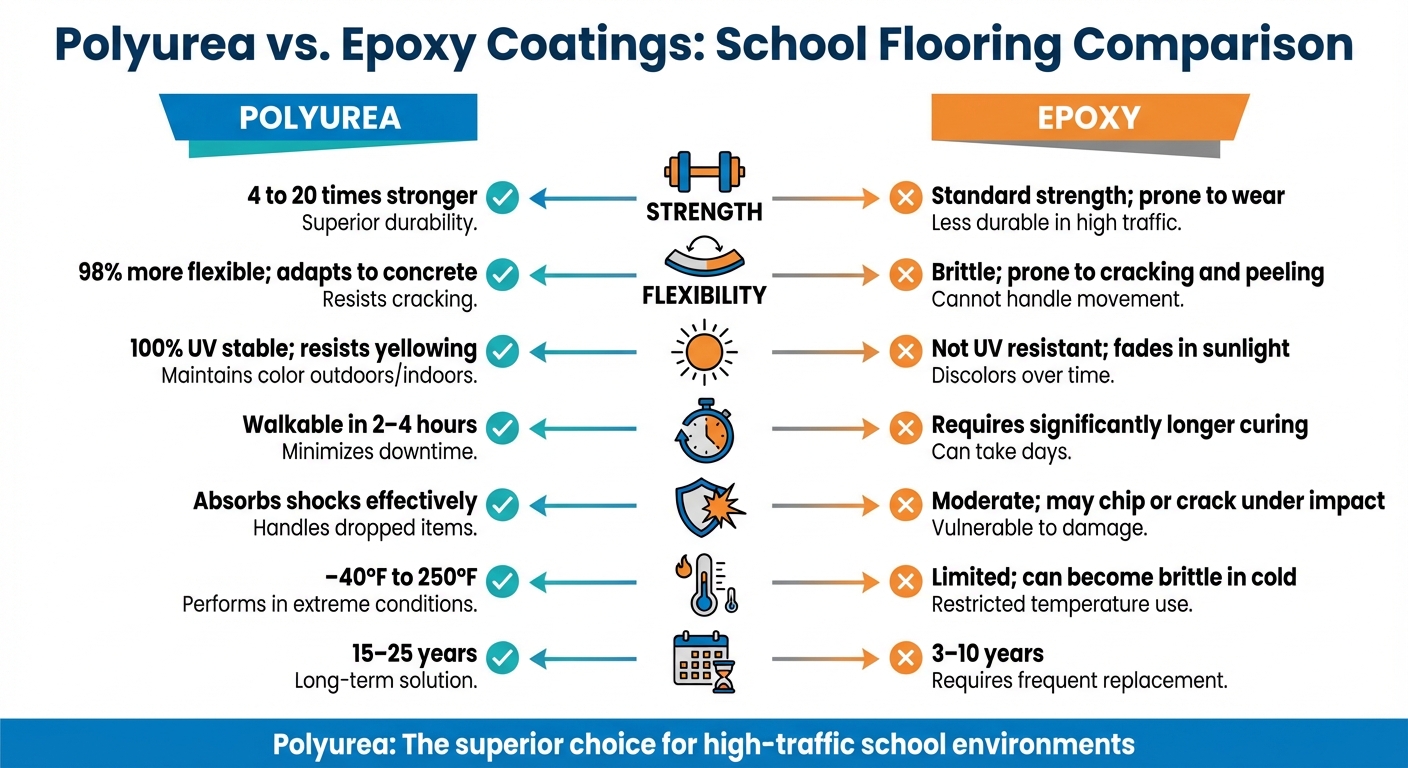
Polyurea vs Epoxy School Flooring Comparison Chart
Performance Under Heavy Use
School floors endure relentless wear and tear from constant foot traffic and the movement of equipment. With its elastomeric structure, polyurea coatings excel at absorbing impacts without cracking. In fact, they are rated to be 4 to 20 times stronger than traditional epoxy systems. This strength allows polyurea to withstand dropped items, furniture impacts, and even athletic equipment, all while maintaining its integrity across extreme temperatures ranging from –40°F to 250°F.
What sets polyurea apart is its flexibility. Unlike brittle epoxy, polyurea can expand, contract, and bridge cracks up to 1/8 inch. This adaptability reduces the need for repairs and extends the floor’s lifespan. Its seamless, non-porous surface also prevents dirt, bacteria, and liquids from seeping in, making it ideal for rigorous cleaning routines. Plus, with 100% UV stability, polyurea floors resist yellowing and fading, even in areas exposed to direct sunlight. This durability means fewer disruptions and lower maintenance demands over time.
Comparison Table: Polyurea vs. Epoxy Coatings
Here’s a quick look at how polyurea and epoxy stack up against each other:
| Property | Polyurea | Epoxy |
|---|---|---|
| Strength | 4 to 20 times stronger | Standard strength; prone to wear |
| Flexibility | 98% more flexible; adapts to concrete | Brittle; prone to cracking and peeling |
| UV Stability | 100% UV stable; resists yellowing | Not UV resistant; fades in sunlight |
| Cure Time | Walkable in 2–4 hours | Requires significantly longer curing |
| Impact Resistance | Absorbs shocks effectively | Moderate; may chip or crack under impact |
| Temperature Range | –40°F to 250°F | Limited; can become brittle in cold |
| Lifespan | 15–25 years | 3–10 years |
This comparison highlights why polyurea is a top choice for high-traffic areas like schools. Its strength, flexibility, and resistance to wear make it a long-lasting and reliable flooring solution.
Fast Installation and Reduced Downtime
Upgrading school facilities without disrupting daily schedules is a top priority for administrators. Polyurea coatings offer a solution with their quick curing times. Unlike traditional epoxy, which can take days to fully cure, polyurea is ready for use just hours after application.
Thanks to its unique chemistry, polyurea cures incredibly fast. When applied with a plural-component spray gun, it sets in under 15 seconds. Newer formulations are dry to the touch in about 4 hours and can support regular foot traffic within 24 hours. This means schools can complete major flooring upgrades over a single weekend or a short holiday break, avoiding any disruption to classes.
Polyurea is applied in a single layer, typically between 60–120 mils, and cures without the need for solvents or evaporation delays. As Mark Glendrange, Technical Director at Versatile Building Products, explains:
"The film thickness wet is equal to the film thickness dry with the polyurea".
Another standout feature is its ability to be applied in a wide range of temperatures – from near freezing to over 100°F. This flexibility allows schools to plan renovations without worrying about seasonal or weather-related limitations. Plus, with minimal VOC emissions and little to no odor, polyurea can even be applied overnight while the facility remains operational. These rapid curing capabilities ensure renovations are completed efficiently and with minimal interruption.
Case Studies: School Renovation Projects
The benefits of polyurea’s fast installation are evident in real-world applications. Rob Loomis, a chemist at Willamette Valley Co., conducted studies on polyurea’s performance in educational settings. His research highlighted a key advantage:
"Our studies showed that you can increase the service life of the facility two to three times what the current technology was able to provide".
This extended durability, combined with the quick installation process, makes polyurea an ideal choice for schools operating within tight maintenance schedules and limited budgets. It ensures facilities remain functional and academic calendars stay on track.
Atlas Concrete Coatings specializes in delivering polyurea solutions that minimize downtime while offering long-lasting performance.
Chemical and Moisture Resistance for School Safety
Schools face daily challenges like spills, moisture, and exposure to strong cleaning agents. Polyurea coatings provide a dense, non-porous barrier that stops water, oils, and chemicals from seeping into concrete surfaces. This protective layer plays a key role in creating safe and hygienic spaces.
Polyurea holds up against a wide range of corrosive substances, including acids, solvents, and the harsh cleaning products commonly used in school sanitation. Research from the International Journal of Industrial Coatings highlights its durability:
"Polyurea was found to maintain its structural integrity even after repeated exposure to strong chemicals, making it ideal for laboratories or technical classrooms where chemical spills are a frequent concern".
Its moisture resistance is equally noteworthy. Polyurea maintains strong adhesion even in conditions of 100% humidity. When enhanced with microtextures, it meets ASTM D2047 slip resistance standards, reducing the risk of accidents. Its seamless application also prevents contaminants from accumulating. As MPU Coatings explains:
"Polyurea’s non-porous nature prevents moisture absorption, avoiding issues like mold growth, which is crucial for maintaining a healthy indoor environment".
This combination of features not only minimizes slip-and-fall accidents – a leading cause of school injuries – but also supports healthier indoor air quality with near-zero VOC emissions.
Performance in Cafeterias, Labs, and Restrooms
The chemical and moisture-resistant qualities of polyurea shine in various school settings. In science labs, the coating withstands constant exposure to harsh chemicals without losing its integrity. Certain formulations even have FDA approval for direct food contact, ensuring cafeterias meet strict hygiene standards.
In restrooms and locker rooms, polyurea creates a seamless barrier that blocks moisture, overflows, and waste from penetrating the concrete. This prevents the growth of fungi and bacteria while standing up to rigorous cleaning methods, including power washing and industrial-grade disinfectants.
Maintenance is simple. Thanks to its impermeable surface, routine cleaning only requires standard cleaning solutions, making upkeep far easier compared to porous materials like vinyl or tile. With proper care, these coatings can last over 15 years.
Atlas Concrete Coatings provides polyurea solutions designed to keep educational facilities clean, safe, and durable, ensuring floors can handle the demands of school environments for years to come.
sbb-itb-4b4bb37
Cost Efficiency and Long-Term Value
School budgets are often stretched thin, making every dollar count. While polyurea flooring has a higher upfront cost, it offers significant savings over time by reducing maintenance, repair, and replacement expenses over a 10–15 year span.
Vinyl flooring, on the other hand, might seem like a budget-friendly choice initially, but it comes with hidden costs. Frequent replacements and higher maintenance requirements quickly add up. Guowei from MPU Coatings puts it succinctly:
"While vinyl flooring may cost less initially, it requires more frequent replacement and higher maintenance costs over its lifetime, making polyurea more cost-effective when considering a 10- to 15-year period".
Polyurea also helps schools save on labor costs. Unlike Vinyl Commercial Tile (VCT), which requires regular waxing, stripping, and buffing, polyurea flooring needs only basic sweeping and mopping to stay in good condition. This ease of maintenance further enhances its overall value for schools.
Lifespan: Up to 25 Years of Performance
Polyurea’s durability is another key advantage. With proper care, these coatings can last up to 25 years in school environments. In comparison, epoxy flooring often needs replacement within just 3 to 5 years. Over a 25-year period, schools could find themselves replacing epoxy multiple times, while polyurea stays intact. Its durability stems from features like UV stability and chemical resistance, which prevent yellowing, cracking, and brittleness over time.
Budget Considerations for Schools
The extended lifespan and low maintenance requirements make polyurea a smart investment for schools. When choosing flooring, it’s important to look beyond the initial installation cost and consider long-term value. A lifecycle cost analysis over 15 years underscores polyurea’s advantages. The table below highlights how it compares to other flooring options:
| Flooring Type | Estimated Lifespan | Maintenance Level | Initial Cost | Long-Term Value |
|---|---|---|---|---|
| Polyurea | 15+ Years | Low (Non-porous) | High | Excellent (High ROI) |
| Epoxy | 5–10 Years | Moderate | Medium | Good |
| Vinyl/Laminate | 5–10 Years | High | Low | Low (Frequent replacement) |
| Urethane | 10+ Years | Moderate | Medium | Moderate |
Conclusion
Polyurea coatings have become a go-to choice for schools, thanks to their ability to withstand heavy foot traffic. Their durability and quick curing times mean minimal disruption to the academic calendar, making them a practical option for busy educational environments.
What really sets polyurea coatings apart is their focus on safety and health. Their seamless, non-porous surfaces help prevent bacteria and mold from taking hold, while slip-resistant textures – designed to meet ASTM D2047 standards – reduce the risk of falls. On top of that, polyurea’s 100% solids and zero-VOC formulas ensure they’re safe for both people and the environment. As Karli Logan from IMC Distributors points out, this makes polyurea coatings a safe choice for schools and even wildlife.
While the initial costs may be higher, the long-term benefits are hard to ignore. With a lifespan of 15 to 30 years and minimal maintenance – just sweeping and mopping – schools can save significantly on upkeep and labor costs.
For schools operating on tight budgets and schedules, polyurea coatings check all the boxes: durability, quick installation, safety, and cost-effectiveness. Atlas Concrete Coatings specializes in delivering solutions tailored to these needs, ensuring school environments remain safe, functional, and budget-friendly.
FAQs
What makes polyurea faster to install compared to epoxy?
Polyurea coatings are known for their fast curing time, making them perfect for projects where speed is key. Due to their rapid chemical reaction, floors coated with polyurea are usually ready for foot traffic and use in just about 36 hours.
On the other hand, epoxy coatings take longer to cure – typically between 24 and 72 hours or more, especially when multiple coats are involved. This longer curing process can extend downtime, which is a major drawback for places like schools that need to quickly reopen classrooms, gyms, or other spaces. Polyurea’s faster turnaround helps minimize these delays.
What are the health advantages of using polyurea coatings in schools?
Polyurea coatings bring valuable health benefits to educational spaces. Made with low-VOC, odor-free resins, they release fewer volatile organic compounds than traditional finishes. This helps create a cleaner, safer indoor environment by minimizing chemical off-gassing and reducing conditions like dust and moisture buildup that can lead to mold.
Thanks to their seamless, non-porous surface, polyurea coatings also promote better air quality and are a breeze to maintain. Plus, their slip-resistant texture and noise-dampening qualities make them ideal for busy areas like hallways, cafeterias, and gyms. These features not only lower the risk of accidents but also reduce noise levels and stress, fostering a healthier and more focused learning atmosphere.
Atlas Concrete Coatings provides durable polyurea-based flooring systems designed with health, safety, and long-term performance in mind, making them a smart option for schools.
Why are polyurea coatings a smart flooring choice for schools?
Polyurea coatings are a smart option for schools, offering a mix of durability and quick installation that keeps disruptions to a minimum. These coatings are tough enough to handle heavy foot traffic, daily wear and tear, and even chemical spills, all while reducing the need for constant repairs.
What makes polyurea even more appealing is its fast curing process, which helps cut down on labor costs and downtime. This makes it a budget-friendly choice for schools aiming to lower long-term maintenance and replacement costs. Plus, with a variety of finish options available, polyurea coatings deliver both functionality and a polished look that suits educational environments perfectly.