

When selecting a warranty-backed floor coating, the goal is long-term durability and peace of mind. A strong warranty ensures protection against common issues like peeling, delamination, and premature failure, while also holding contractors accountable for quality materials and professional installation. Here’s what you need to know:
- Warranty Length: Residential coatings often offer 15-year to lifetime warranties, while commercial warranties may be shorter due to heavier use.
- Coverage Details: Look for protection against moisture damage, UV exposure, and hot-tire transfer. Ensure both labor and materials are included.
- Red Flags: Avoid prorated warranties, vague terms, and non-transferable plans. Exclusions for moisture damage or poor preparation are warning signs.
- Installation Standards: Professional surface preparation (like diamond grinding) and proper moisture testing are critical for warranty validity.
- Maintenance Requirements: Follow care guidelines to keep your warranty intact – such as avoiding harsh cleaners and scheduling periodic inspections.
A warranty-backed coating is a smart investment, but only if you carefully review the terms and ensure proper installation standards are met.
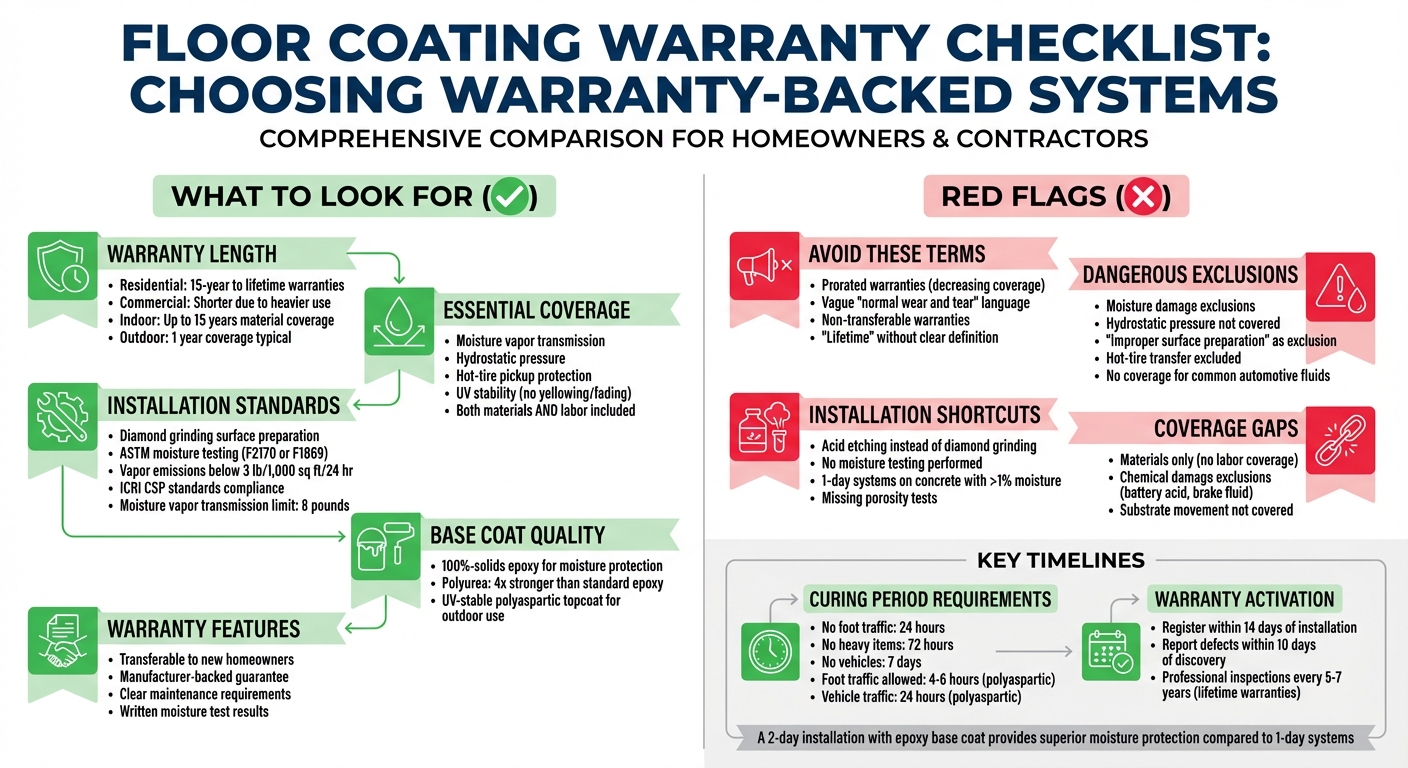
Warranty Coverage Comparison: What to Look For vs Red Flags in Floor Coating Warranties
Warranty Length and Coverage
Typical Warranty Durations
Residential polyurea coatings often come with 15-year warranties that protect against issues like peeling, blistering, and delamination. Some warranties are labeled as "lifetime", but this term can be misleading. Christian Griffith, Founder of Formula Concrete Coating, highlights this ambiguity:
"The word ‘lifetime’ can be ambiguous. Does it mean your lifetime, the lifetime of your home, or, more commonly, the expected functional lifetime of the product itself, which could be significantly shorter?"
For commercial and industrial applications, warranties are generally shorter due to heavier usage. For example, a coating with 15 years of material coverage for indoor use might offer only 1 year for outdoor use, with labor coverage limited to 3 years indoors or 1 year outdoors.
Once the duration is clear, it’s crucial to verify that the warranty addresses all potential failure scenarios.
What Should Be Covered
A good warranty should cover moisture-related failures, such as damage caused by hydrostatic pressure or moisture vapor transmission – two common reasons coatings fail. For garage floors, protection against hot-tire pickup (caused by plasticizer migration from vehicle tires) is another must-have.
UV stability is also critical, particularly for outdoor areas. This coverage ensures protection against discoloration, yellowing, or chalking caused by sun exposure. Always confirm whether the warranty includes both materials and labor, as some plans only replace defective materials, leaving homeowners to cover re-installation costs.
Once you’ve confirmed what the warranty covers, take a close look at the fine print to avoid potential pitfalls.
Warning Signs in Warranty Terms
Be wary of prorated warranties, which offer full coverage initially but decrease significantly over time, potentially leaving you with hefty expenses down the road. Watch out for vague terms like "normal wear and tear" or unclear maintenance requirements – they can make it easier for companies to deny claims.
Moisture damage exclusions are another red flag. As GarageFloorCoating.com puts it:
"Moisture limits and exclusions aren’t protection, they’re pre-planned ways to deny coverage."
It’s also worth checking if the warranty is transferable to new homeowners. Non-transferable warranties can hurt your property’s resale value. Finally, confirm whether the warranty is backed by the coating manufacturer as well as your local installer. A manufacturer-backed warranty adds an extra layer of security, especially if your installer goes out of business.
Environmental and Physical Damage Coverage
Moisture Damage Coverage
Moisture creeping through porous concrete is one of the main culprits behind coating failures. A solid warranty should specifically address moisture vapor transmission and hydrostatic pressure, rather than sidestepping these issues. Many installers set a moisture vapor transmission limit of 8 pounds for the warranty to remain valid. If your concrete exceeds this limit, your warranty could be voided before the installation even starts.
Using a moisture-mitigating epoxy base can make a big difference. These systems act as a thick vapor barrier, potentially providing complete coverage for moisture-related delamination. Before moving forward, ensure your installer tests the concrete for moisture and gives you written confirmation that the warranty includes vapor transmission issues.
Taking these moisture-related precautions lays the groundwork for tackling other types of physical damage.
Hot-Tire and Stain Protection
Hot-tire marks, caused by plasticizer migration – when chemicals from vehicle tires transfer onto the coating – are a frequent headache for homeowners with garage floors.
"Most warranties exclude [hot-tire transfer] entirely, even though hot tires lifting or staining the topcoat is one of the most common issues homeowners face." – Garage Floor Coating of New Jersey
In addition to hot-tire marks, many warranties exclude damage caused by battery acid, brake fluid, paint strippers, and industrial solvents. For garage or industrial floors, it’s important to confirm that your warranty specifically covers hot-tire transfer and common automotive fluids, rather than relying on vague promises of chemical resistance. Otherwise, you might find yourself footing the bill for repairs.
Now, let’s look at how outdoor exposure can affect your warranty.
UV and Weather Protection
For outdoor applications, protection against UV rays and weather-related wear and tear is critical. High-quality polyurea warranties often promise that the coating won’t yellow or fade due to UV exposure for up to 15 years. However, warranties often distinguish between indoor and outdoor use. For instance, a coating with a 15-year indoor warranty might only offer about a year of outdoor coverage due to constant exposure to sunlight and weathering.
Standard polyurea coatings can yellow when exposed to direct sunlight. To combat this, professional systems commonly include a UV-stable polyaspartic topcoat for outdoor surfaces. When reviewing warranty terms, look for a clause that guarantees "no-yellowing" or "no-fading" to avoid ending up with a discolored, chalky surface over time.
For expert installation and warranties that you can count on, Atlas Concrete Coatings follows strict testing protocols to ensure your investment is well-protected.
Base Coat Materials and Installation Quality
High-Performance Base Coat Options
The base coat plays a crucial role in determining whether your warranty truly protects your floor. Polyurea base coats, for example, are up to four times stronger and more flexible than standard epoxy. This flexibility allows the coating to move with the concrete as it expands and contracts due to temperature changes, reducing the risk of cracks. A rigid coating, on the other hand, is far more likely to crack under stress from these natural shifts.
However, strength alone isn’t the full story. Many 1-day systems cure quickly in moist conditions, which can prevent the coating from penetrating deeply into the concrete. This lack of penetration can weaken the bond and increase the risk of delamination.
"1-day systems use a quick-curing polyurea or polyaspartic for their direct-to-concrete base coat. But these quick-cure coatings cure even quicker in the presence of concrete moisture… they fail to deeply penetrate and strongly bond." – Garage Floor Coating of New Jersey
For areas with high moisture, a 100%-solids epoxy base coat is a better choice. It acts as a robust vapor barrier while still penetrating deeply into the concrete. While this method requires a 2-day installation process, it provides superior protection against moisture vapor transmission, which is the leading cause of coating failures. Make sure your warranty specifies the type of base coat being used and whether it covers issues like moisture-related delamination.
Professional Surface Preparation Requirements
Even the best base coat won’t perform well without proper surface preparation. To ensure a durable mechanical bond, the coating must fully absorb into the concrete. Professional installers adhere to International Concrete Repair Institute (ICRI) CSP standards to achieve the correct surface profile for the coating.
Mechanical diamond grinding is widely regarded as the gold standard for preparing concrete surfaces. This process removes the weak top layer (laitance) and opens up the concrete pores for better adhesion. While acid etching is a cheaper alternative, it often fails to create a surface profile aggressive enough for high-performance coatings. After grinding, professionals typically perform a porosity test by spraying water on the prepared surface to confirm proper absorption.
"The epoxy coating’s bond strength and improper surface preparation (which directly affects bond strength) shouldn’t be exclusions in a professionally installed coating." – Mike Mincemoyer, President, STRONGHOLD FLOORS
Your warranty should clearly state that the coating will not peel or delaminate due to poor surface preparation. If "improper surface preparation" is listed as an exclusion, you could be left covering the costs of the installer’s mistakes. Ensure moisture testing is performed according to ASTM standards (F2170 or F1869), with vapor emissions below 3 lb/1,000 sq ft/24 hr. Proper surface preparation is critical for both installation success and long-term warranty coverage.
Installation Timeline and Warranty Terms
Getting the timing right during installation is just as important as choosing the right materials. The speed of installation can directly affect the coating’s performance and your warranty.
1-day polyurea systems cure roughly 70 times faster than traditional epoxy, making them convenient for quick use. However, if the moisture levels in your concrete exceed 1%, applying a 1-day polyurea coating directly to the surface can lead to blistering and peeling. Many warranties for 1-day systems exclude moisture-related issues. Always ask your installer for calibrated moisture meter readings and get the results in writing.
For better durability in challenging conditions, a 2-day system is often the better choice. This method starts with a moisture-mitigating epoxy primer on the first day, followed by polyaspartic topcoats on the second day. This extended timeline creates stronger bonds and offers long-term performance. Typically, these systems allow foot traffic within 4 to 6 hours and vehicle traffic after 24 hours.
Atlas Concrete Coatings combines professional-grade polyurea systems with meticulous surface preparation to ensure your warranty provides real protection – not just empty promises.
sbb-itb-4b4bb37
What is Penntek’s Concrete Coating Warranty? (Length, Coverage, Exclusions)
Warranty Exclusions and Claims Process
Understanding the exclusions and claims process for your warranty is just as important as knowing what’s covered. These details can help you protect your investment and avoid surprises down the road.
Standard Warranty Exclusions
It’s crucial to be aware of what your warranty doesn’t cover. For most polyurea coating warranties, damage caused by issues with the underlying concrete – such as cracking, heaving, shifting, or settling due to ground movement – is excluded. Even if cracks were repaired during installation, their reappearance is typically not covered.
"Cracking due to substrate movement is not under warranty regardless of whether same was repaired during original installation or not." – Precision Concrete Coatings
Chemical damage is another common exclusion. Exposure to substances like battery acid, brake fluid, paint strippers, industrial solvents, and concentrated acids will void your warranty. Physical damage, such as gouging, scratches, fire, or marks from spinning tires, along with normal weathering and oxidation, is also excluded.
Additionally, many 1-day systems won’t cover damage from hydrostatic pressure, moisture vapor transmission, or efflorescence. If moisture vapor transmission exceeds 5%, adhesion warranties are often voided . However, systems with epoxy base coats may sometimes include this type of coverage.
Understanding these exclusions emphasizes the importance of proper care and maintenance to keep your warranty intact.
Maintenance Requirements for Warranty Validity
To keep your warranty valid, you’ll need to follow specific maintenance guidelines. For instance, avoiding traffic and heavy items during the curing period is essential. Most warranties specify no foot traffic for 24 hours, no heavy items for 72 hours, and no vehicles for up to 7 days.
"No warranty work shall be performed if customer returns foot traffic, furniture, equipment, wets the surface, or drives on the surface earlier than specified." – Titan Concrete Coatings
Using the wrong cleaning products can also void your warranty. Stick to pH-neutral cleaners, and avoid acidic substances like vinegar, citrus-based cleaners, or bleach, as they can damage the topcoat. High-pressure washers, scrubbing machines, and abrasive pads are also off-limits. For some lifetime warranties, you may even need to schedule professional inspections and topcoat refreshes every 5 to 7 years.
By following these guidelines, you can ensure your warranty remains intact and your coating stays in great condition.
How to File a Warranty Claim
Activating your warranty starts with submitting the registration form within 14 days of installation. If you discover a defect, notify the coating company immediately – most require written notice within 10 days of noticing the issue.
Documenting the damage with photographs is a critical step, as this evidence is often required to process your claim. An authorized representative will need to inspect the damaged area, and refusing inspection can void your warranty. Make sure the area is accessible and ready for inspection, as some companies may charge a $100 trip fee if they cannot perform the work during their visit.
Before selling your property, check if your warranty is transferable. While many warranties apply only to the original owner, some can be transferred to new owners if they complete the necessary registration steps. For repairs not covered under warranty – such as those caused by customer damage or substrate failure – you can expect service charges starting at around $250.
Conclusion
A warranty-backed coating offers peace of mind by providing a formal guarantee of performance for your flooring investment.
When considering coatings, focus on warranties that explicitly cover issues like delamination, moisture damage, and hot-tire transfer. Make sure the warranty remains valid over time and confirm that the installation process includes essential steps like diamond grinding and moisture testing to minimize the risk of failure. These key factors not only safeguard your floor but also help you identify reliable professionals.
Certified experts ensure durability and quality. For instance, Atlas Concrete Coatings stands behind its work with a 15-year warranty, offering quick, professional service and top-tier polyurea coatings.
Opting for a warranty-backed coating is a smart move to protect both the performance of your floor and your long-term investment.
FAQs
What should I consider when choosing a durable coating with a reliable warranty?
When choosing a coating backed by a reliable warranty, prioritize durability and performance. Opt for coatings that can withstand abrasion, impact, and chemical exposure, while also offering protection against UV rays and temperature changes. Flexibility is another key factor – ensure the coating can handle the level of traffic or usage it will experience.
Proper surface preparation is essential for achieving lasting results, so be sure to understand the requirements before application. Lastly, take the time to thoroughly review the warranty terms. Confirm it covers both material and workmanship defects, and pay attention to any exclusions or limitations that might apply.
Why is proper installation important for maintaining a coating warranty?
Proper installation plays a key role in ensuring that the coating adheres properly and functions as expected. In fact, following the correct installation process is often necessary to maintain the warranty. Essential steps, such as meticulous surface preparation, using appropriate application techniques, and adhering to manufacturer instructions, are critical for safeguarding both material and workmanship coverage.
Taking shortcuts or making errors during installation can result in problems like peeling, bubbling, or early wear – issues that might void the warranty. To achieve durable results and avoid unnecessary risks, it’s always wise to rely on skilled professionals who follow industry best practices.
Why is it important for floor coating warranties to cover moisture damage?
Moisture damage coverage plays a critical role in floor coating warranties. When moisture gets trapped, it can lead to serious problems like blistering, peeling, or even the coating losing its grip on the surface. These issues often require costly repairs, and most warranties won’t cover them unless they specifically include moisture protection.
Opting for a warranty with moisture damage coverage helps protect your investment and ensures your floor coatings last longer. This is especially important in spaces where high humidity or frequent moisture exposure is a concern.