

Sprayers are essential tools for applying polyurea coatings effectively. They ensure precise mixing, consistent thickness, and faster application compared to manual methods like rollers or brushes. Key benefits include:
- Fast Cure Time: Polyurea sets in as little as 15 seconds, making sprayers critical for quick and accurate application.
- Consistent Thickness: Sprayers apply 60–120 mils in a single pass, avoiding weak points from multiple coats.
- Time and Labor Savings: Sprayers can double productivity, reducing downtime and manual effort.
- Durability: Proper application extends coating lifespan by 2–3 times, with results lasting 10–15 years.
Sprayers also simplify the process with automated mixing, handle high-pressure applications (1,850–3,500 PSI), and ensure a smooth, professional finish. Whether for residential, commercial, or industrial projects, sprayers make polyurea coating faster, more efficient, and longer-lasting.
Polyurea Spraying with Graco AP Fusion Gun on a Factory Floor at Coca-Cola
sbb-itb-4b4bb37
Benefits of Using Sprayers for Polyurea Coatings
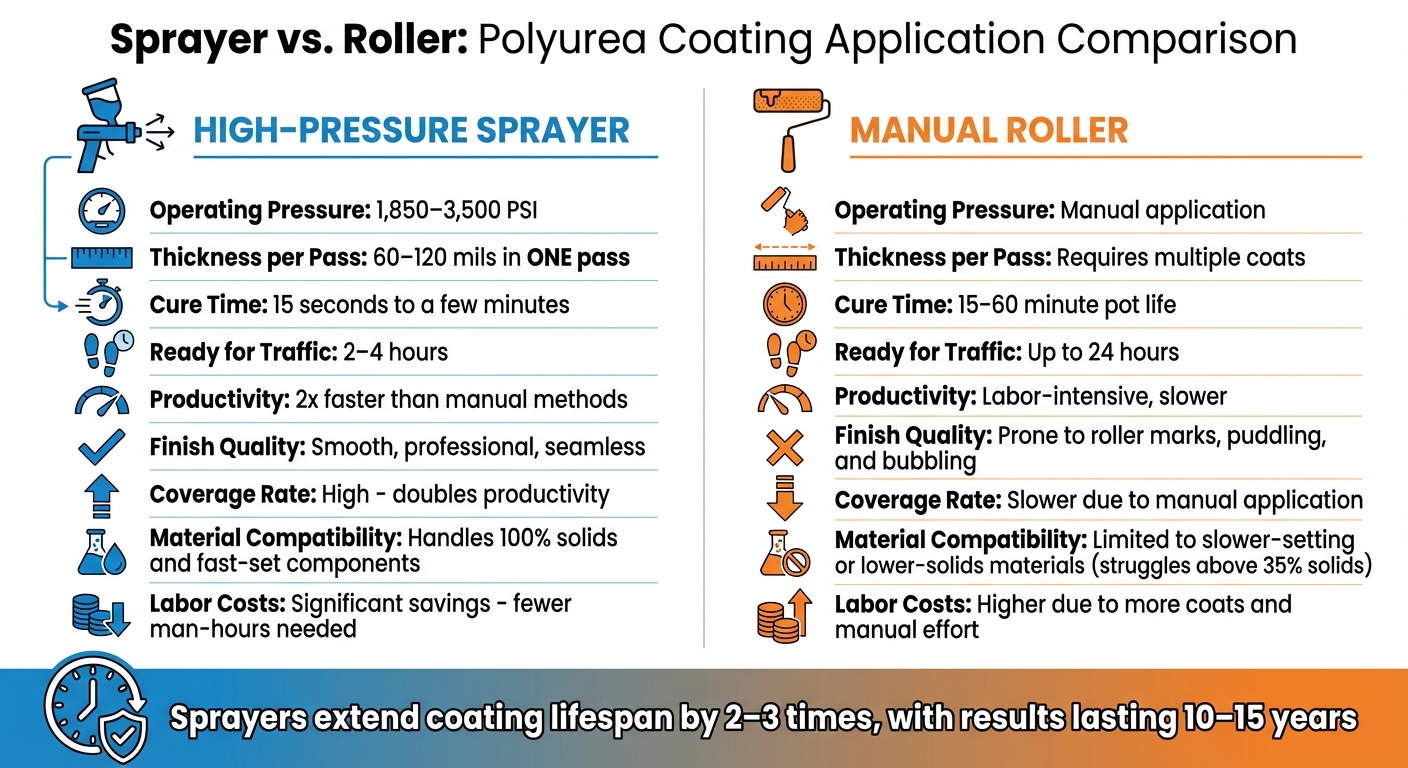
Sprayer vs Roller Comparison for Polyurea Coating Application
Sprayers make applying polyurea coatings faster and more precise, offering a professional finish while cutting down on labor and time. This method not only ensures a seamless application but also boosts the durability of the coating.
Better Precision and Coverage
High-pressure sprayers, operating between 1,850–3,500 PSI, heat materials to temperatures ranging from 100°F to 180°F, achieving the ideal viscosity. They also rely on an automatic plural-component mixer to maintain the correct chemical ratio, which ensures a consistent and uniform coating while minimizing human error.
One of the standout advantages of sprayers is their ability to handle polyurea’s rapid cure time. They apply the full thickness – typically 60 to 120 mils – in a single pass, creating a seamless membrane. This eliminates weak points that often arise when coatings are applied in multiple layers.
"In far less time you can use a roller, Graco floor coating sprayers can lay down a perfect, smooth finish every time." – Graco
In addition to precision, sprayers significantly reduce the time and effort required for application.
Time and Labor Savings
Using sprayers instead of rollers can double productivity, allowing large areas to be coated quickly. This eliminates the need for waiting between coats. Automated mixing also removes the hassle of manual measuring and stirring. Plus, the fast cure times mean less downtime, and cleanup is far easier compared to the mess left by rollers and brushes.
"Compared to applying epoxy paints and plural-component coatings with a roller, you’ll more than double your productivity with a sprayer." – Graco
Longer-Lasting Results
Sprayers ensure consistent density and excellent adhesion, even under challenging conditions like high humidity. This controlled application process extends the lifespan of the coating, often lasting 10 to 15 years. Applying the coating in a single layer reduces the chances of delamination, creating a stronger and more durable surface. This is particularly beneficial for chip floor systems, which rely on a uniform finish.
"Our studies showed that you can increase the service life of the facility two to three times what the current technology was able to provide." – Rob Loomis, Chemist, Willamette Valley Co.
| Feature | High-Pressure Sprayer | Manual Roller |
|---|---|---|
| Thickness per Pass | 60–120 mils in one pass | Requires multiple coats |
| Cure Time | 15 seconds to a few minutes | 15 to 60 minutes |
| Productivity | 2x faster than manual | Labor-intensive |
| Finish Quality | Smooth, professional | Prone to roller marks |
Types of Sprayers for Polyurea Applications
Choosing the right sprayer depends on the size of your project and the required output. Polyurea coating equipment is grouped into categories tailored for specific applications and production needs.
High-Pressure Spray Rigs
High-production spray rigs are built for demanding industrial projects. With a production rate of 30–50 lb/min, these systems are ideal for large-scale tasks such as parking garages, roof coatings, and tank linings. Their powerful pumps ensure consistent spray performance, even when working with thick polyurea materials, delivering smooth and uniform coverage over vast areas.
These rigs are available in electric or hydraulic models. Their robust design allows for continuous operation during high-duty cycles, making them perfect for coating expansive commercial or industrial floors. Additionally, proportioners within these systems provide flexibility for various production needs.
Plural-Component Proportioners
Two-part polyurea sprayers rely on plural-component proportioning systems, which automatically mix materials at the precise ratio required for proper curing. Achieving the correct mix is critical, as improper ratios can lead to curing issues and reduced durability.
Proportioners are available in three output levels:
- Portable or entry-level systems: Deliver 10–25 lb/min, suitable for touch-ups, small garages, or projects needing portability.
- Mid-production systems: Provide 20–30+ lb/min, making them great for truck bed liners, pool waterproofing, and contractors working from trailers.
- High-production systems: Achieve 30–50 lb/min, designed for large industrial floors and other high-demand applications.
| Sprayer Category | Output Range | Best Use Case |
|---|---|---|
| Portable/Entry-Level | 10–25 lb/min | Touch-ups, small garages, low-to-medium output |
| Mid-Production | 20–30+ lb/min | Truck bed liners, pool waterproofing, mobile setups |
| High-Production | 30–50 lb/min | Large industrial floors, parking garages, heavy use |
This range of systems allows contractors to select the best equipment for their polyurea coating projects, ensuring efficient and effective results for any scale.
How Sprayers Improve Efficiency in Chip Floor Systems
Sprayers bring a new level of efficiency to chip floor systems by applying durable, even coatings quickly and effectively. They allow contractors to achieve the required coating thickness – usually between 60 and 120 mils – in just one pass, eliminating the need for multiple layers and saving significant time on the job.
The benefits go beyond faster application. Floors coated with sprayers can be walked on within 2 to 4 hours, a stark contrast to manual methods, which often require a 15–60 minute pot life and up to 24 hours before the floor is ready for traffic.
"Compared to applying epoxy paints and plural-component coatings with a roller, you’ll more than double your productivity with a sprayer."
– Graco
Sprayers also simplify the process by automating the precise mixing of components, reducing setup time and minimizing errors. Additionally, sprayed polyurea systems can extend a facility’s service life by 2 to 3 times compared to older coating methods. This makes investing in spray equipment a smart choice for long-term durability.
Sprayer vs. Roller and Brush Methods
The difference in performance between sprayers and manual methods is clear when you look at key factors:
| Feature | Sprayer Application | Roller and Brush Methods |
|---|---|---|
| Curing Time | Seconds to minutes (ready for traffic in 2–4 hours) | 15–60 minute pot life; 24 hours for traffic |
| Coverage Rate | High; over double the productivity of rollers | Slower due to manual application and mixing |
| Thickness Consistency | Very consistent; 60–120 mils in one pass | Inconsistent; prone to puddling and bubbling |
| Labor Cost Savings | Significant; fewer man-hours needed | Lower due to more coats and manual effort |
| Material Compatibility | Handles 100% solids and fast-set components | Limited to slower-setting or lower-solids materials |
Rollers, for example, often struggle with high-solids materials above 35%, leading to issues like puddling and surface bubbles. In contrast, sprayers operate at pressures between 1,850 and 3,500 PSI, ensuring a smooth, even finish. Sprayers also allow for precise control of wet-film thickness, which matches the dry-film thickness when using 100% solids polyurea. This precision ensures that specifications are met without waste.
"Labor costs for installing polyurea are generally lower because of the ability to apply the full thickness in one layer."
– Mark Glendrange, Technical Director, Versatile Building Products
The advantages of sprayers – speed, precision, and durability – translate into lower labor costs and a more reliable finish for chip floor systems.
Best Practices for Using Sprayers
Sprayer Setup and Maintenance
Make sure your spray equipment is specifically designed for handling polyurea and polyaspartic materials. These fast-setting coatings demand a different approach compared to single-component epoxy paints. Using plural-component proportioners like the Graco XP or Reactor ensures precise, on-ratio mixing of two-part materials. This setup not only eliminates the risk of manual mixing errors but also cuts down on preparation time.
Keep maintenance manuals within reach. These guides provide detailed schematics and part breakdowns, making it easier to order replacement parts and handle routine maintenance. Regular inspections of high-powered pumps are vital, as they ensure the equipment can atomize thick, plural-component materials effectively. This attention to detail helps achieve a smooth, professional finish.
Once your equipment is ready and well-maintained, the next step is to focus on application techniques for a flawless coating.
Application Techniques for Even Coatings
Start by preparing the substrate properly, and determine if a primer or topcoat is necessary. Since polyurea cures quickly, using fast-curing equipment is essential to avoid clogging and to maintain even coverage.
Accurate chemical ratios are key to consistent curing and performance. Ensuring proper on-ratio mixing eliminates soft spots and delivers a uniform texture. After application, assess whether adding a topcoat is needed to meet specific industrial or aesthetic requirements.
Safety Considerations
Once you’ve mastered the application process, prioritize safety to protect both workers and the quality of the coating. All personnel should wear NIOSH-approved paint respirators to guard against strong chemical odors during installation. Operators should also wear gloves and disposable clothing, as polyurea is nearly impossible to remove from skin and fabric once it dries.
A well-ventilated workspace is critical for managing odors and solvent vapors. Additionally, remove all ignition sources from the area during curing, especially in colder conditions. Keep cleaning agents like xylene or mineral spirits on hand for addressing spills while the material is still wet.
Follow local regulations, such as those enforced by the South Coast Air Quality Management District in California, which may impose restrictions on certain coatings. Apply coatings when the temperature is above 50°F, and maintain an ambient temperature around 70°F with proper ventilation. This setup allows solvents to dissipate over three days. Lastly, always include anti-skid additives in the topcoat to prevent slippery surfaces, as spray-applied coatings can become slick when wet.
Conclusion
Sprayers bring a new level of precision, speed, and durability to polyurea chip coatings. With plural-component proportioners ensuring proper mixing ratios and reducing human error, and high-powered pumps atomizing thick materials for a flawless finish, these tools deliver impressive results. Plus, the rapid cure time – often as fast as 15 seconds – minimizes downtime for residential and commercial projects.
"Compared to applying epoxy paints and plural-component coatings with a roller, you’ll more than double your productivity with a sprayer." – Graco
This insight highlights just how much sprayers can improve efficiency. Contractors benefit from being able to cover large areas quickly, maintain consistent film thickness, and achieve strong adhesion.
Atlas Concrete Coatings takes full advantage of advanced sprayer technology to create durable polyurea chip floor coatings for residential, commercial, and industrial spaces. Their professional-grade approach ensures coatings that last, offer customizable finishes, and allow for fast installations. By mastering these techniques, Atlas Concrete Coatings consistently delivers high-quality results that showcase the precision and durability that define modern polyurea applications.
FAQs
Do I need a high-pressure sprayer for polyurea?
Using a high-pressure sprayer is a smart choice for applying polyurea. It ensures even coverage, delivers a smooth finish, and works well with the material’s quick curing process and durable nature. This tool makes it easier to achieve professional-grade results quickly and effectively.
What happens if the two parts aren’t mixed on-ratio?
If the two components of polyurea aren’t mixed in the right ratio, the coating might not cure as it should. This can lead to poor adhesion, decreased durability, and even complete coating failure. Getting the mix ratio right is critical to ensure a strong and durable finish.
How soon can I walk or drive on a sprayed polyurea chip floor?
You can typically walk or drive on a sprayed polyurea chip floor about 24 hours after it’s applied. However, this depends on factors like curing time and environmental conditions, so make sure the surface is completely set before using it.