
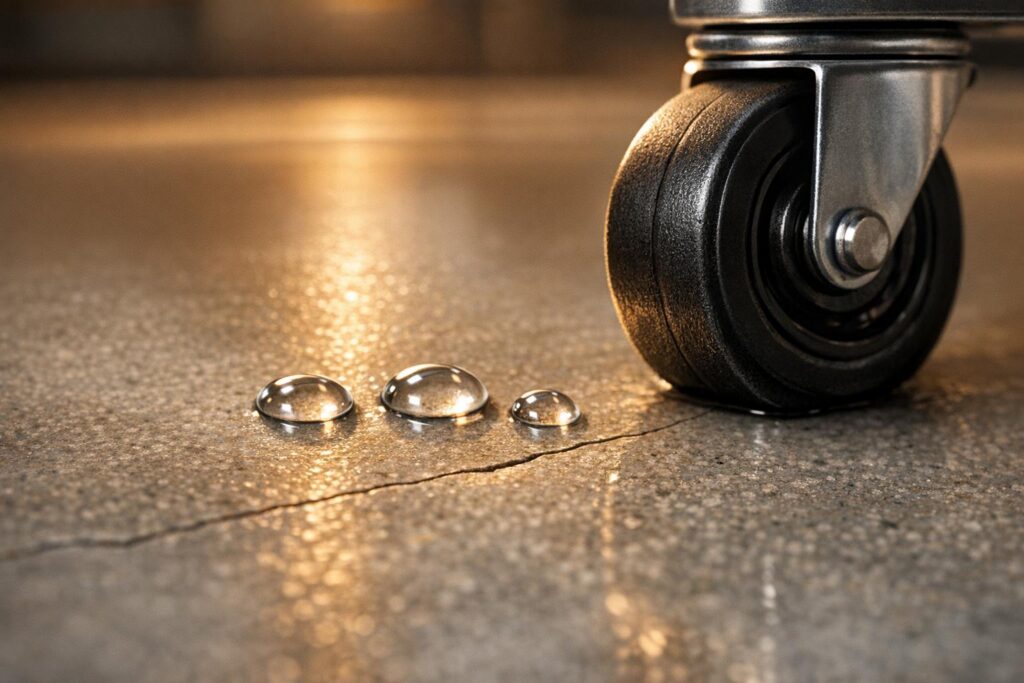
Polyurea coatings are known for their durability and ability to withstand heavy use in spaces like garages, warehouses, and commercial areas. They outperform epoxy in strength, flexibility, and resistance to chemicals, temperature changes, and UV exposure. Key advantages include:
- Durability: Lasts 15–30+ years, compared to epoxy’s 5–10 years.
- Flexibility: Handles impacts and concrete movement without cracking.
- Chemical Resistance: Protects against oils, gasoline, and harsh chemicals.
- UV Stability: Maintains color and finish under sunlight.
- Fast Curing: Ready for foot traffic in 12 hours; vehicle traffic in 24 hours.
Polyurea’s quick curing and strong adhesion make it a reliable choice for both indoor and outdoor applications, offering long-term savings despite higher upfront costs.
Tekno Polyurea Coating Durability | Forklift Test
sbb-itb-4b4bb37
What Makes Polyurea Coatings Durable
Polyurea coatings are created through a chemical reaction between isocyanate and resin, resulting in an incredibly durable elastomer. This unique molecular structure gives polyurea properties that distinguish it from traditional floor coatings. Let’s break down how this composition leads to exceptional flexibility, abrasion resistance, and chemical protection.
Flexibility and Impact Resistance
One standout feature of polyurea is its flexibility. It can withstand the weight of heavy equipment, the impact of dropped tools, and even the natural expansion and contraction of concrete caused by temperature fluctuations – all without cracking. Its elasticity allows it to stretch over 300% of its original length without breaking.
"Polyurea, however, flexes with the substrate, maintaining its integrity and preventing premature failure." – Cleveland Concrete Coatings
This flexibility is further enhanced by its ability to perform in extreme temperatures, ranging from -40°F to 350°F. This makes it a reliable option for areas that experience significant seasonal temperature changes. Unlike more rigid coatings, polyurea resists delamination and cracking, even under challenging conditions.
Abrasion Resistance in High-Traffic Areas
Durability under constant stress is another hallmark of polyurea. Its dense molecular structure makes it highly resistant to wear and tear, whether from heavy foot traffic in commercial settings, rolling tires in garages, or machinery in warehouses. Unlike some coatings, polyurea is engineered to resist "hot tire pickup", a common problem where heat from tires causes coatings to peel.
Industrial-grade polyurea boasts impressive strength, with tensile strengths ranging from 2,400 to 3,600 psi and tear strengths reaching up to 420 lbs/in. These characteristics ensure that the coating maintains its performance, even after years of demanding use.
Chemical and Stain Resistance
Polyurea also excels in protecting against chemical spills and stains. Its seamless, non-porous surface prevents liquids from seeping into the concrete below. It effectively resists substances like oils, gasoline, brake fluid, battery acid, and road salts, all without compromising its bond to the surface.
High-performance polyurea systems have water absorption rates of less than 2% after seven days of immersion. Cleaning is hassle-free – spills can be wiped up easily with soap and water, as nothing penetrates the coating.
How Polyurea Performs in Extreme Conditions
Extreme weather and temperature changes can wreak havoc on standard floor coatings, but polyurea is built to withstand these challenges. Originally engineered for demanding industrial uses – like pipeline linings, bridges, and military vehicles – this material brings that same level of durability to both residential and commercial flooring. Its ability to endure even under direct sunlight is a standout feature.
UV Stability for Outdoor Use
Sun exposure is one of the toughest tests for outdoor coatings. Traditional epoxy coatings often fail here, showing signs of yellowing, chalking, and brittleness due to UV radiation – a process commonly known as "ambering." Polyurea polyaspartic coatings, on the other hand, are naturally UV stable. They resist fading and discoloration, ensuring the surface maintains its color and finish over time. This makes polyurea a top choice for outdoor spaces like pool decks, patios, and walkways, where longevity and appearance are key.
Temperature Changes and Thermal Expansion
Temperature swings pose another challenge for floor coatings. Concrete naturally expands and contracts with temperature fluctuations, especially in areas with extreme seasonal changes – from freezing winters to blazing summers. Rigid coatings like epoxy often crack or peel under this stress. Polyurea, however, is flexible enough to move with the concrete, maintaining its bond and preventing damage.
"The coating adjusts to seasonal temperature shifts without breaking apart. It maintains a seamless look no matter the climate." – Brian Deas, Owner, DEAS Garage Floors
Whether it’s the intense heat of a summer garage or the freeze-thaw cycles of winter, polyurea holds strong, preserving both its protective barrier and its polished appearance.
Fast Curing and Strong Adhesion
Polyurea’s quick curing process doesn’t just save time – it creates a powerful, chemical bond with concrete that helps avoid common coating failures. While traditional epoxy takes 3 to 7 days to cure, polyurea is ready for foot traffic in just 12 hours, vehicle traffic in 24 hours, and some formulations fully cure in as little as 15 to 30 minutes. This speed also enhances the quality of adhesion.
The rapid chemical reaction allows polyurea to deeply penetrate the tiny pores and capillaries in the concrete before it sets, forming what experts describe as a "quasi-inseparable" bond. Unlike coatings that sit on the surface, polyurea integrates into the concrete with a dense, chemical-level seal. This results in an impressive tensile strength of over 4,000 PSI, compared to the 1,200–1,500 PSI typical of epoxy coatings. Such a strong bond significantly reduces the impact of external factors.
"Because polyurea sets so rapidly, there’s no time for moisture or air to interfere. This prevents peeling, bubbling, or delamination." – Brian Deas, DEAS Garage Floors
The fast curing process also limits the chance for environmental elements – like moisture, air pockets, or dust – to disrupt the bond. Additionally, the aromatic base coat acts as an instant moisture vapor barrier, stopping water from rising through the concrete and causing delamination.
To fully benefit from polyurea’s rapid curing and strong adhesion, proper surface preparation is key. Concrete should be mechanically profiled using diamond grinding to open up surface pores. Moisture levels must stay below 4%, and the pH should be between 6 and 9. Since polyurea cures so quickly, professional installation with specialized multi-component spray equipment is crucial to ensure accurate mixing, heating, and application before it fully sets.
Polyurea vs. Epoxy: Wear and Tear Performance
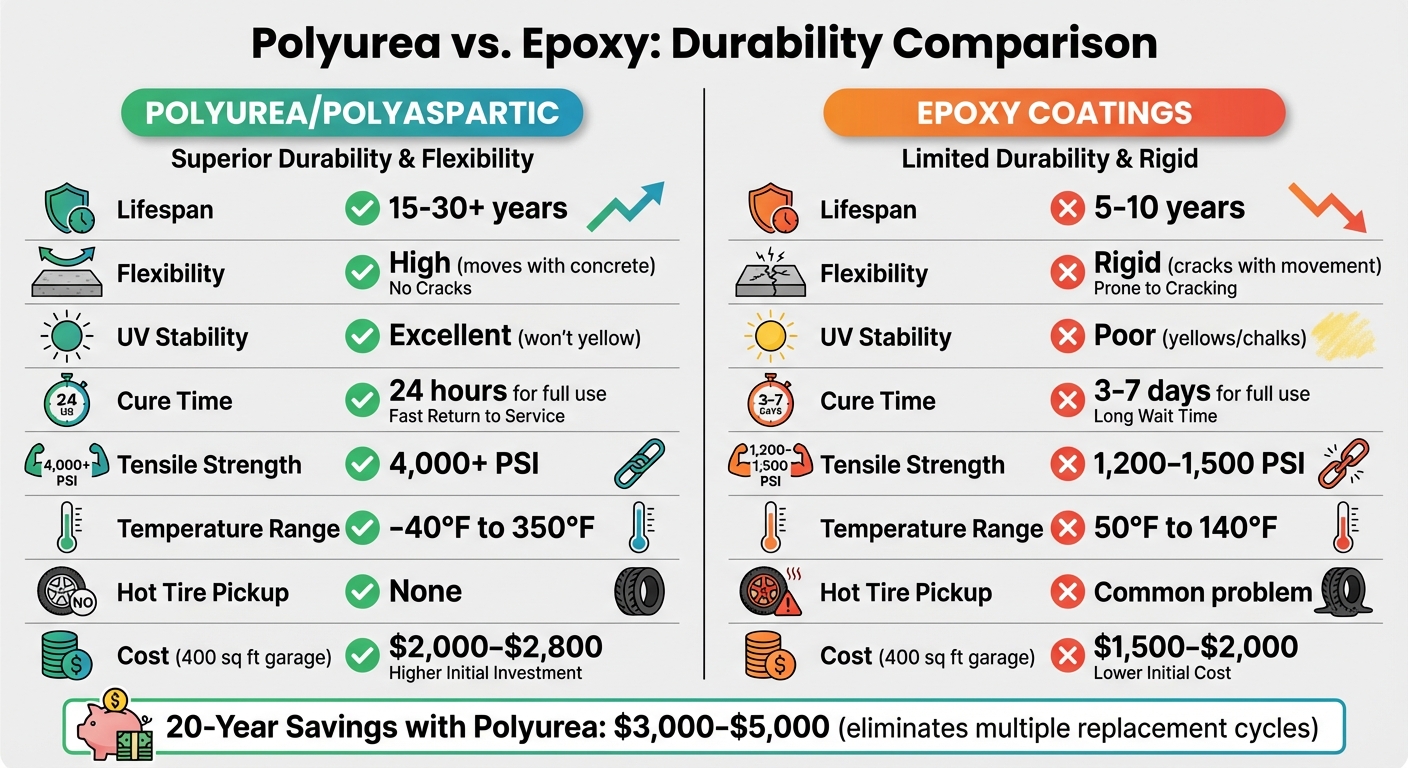
Polyurea vs Epoxy Coatings Performance Comparison
When it comes to durability, polyurea outshines epoxy coatings in several key areas. While epoxy forms a hard, brittle shell that can crack under stress, temperature changes, or heavy impacts, polyurea’s flexibility allows it to absorb these forces without breaking down.
"Epoxy is like a hard shell that can crack under stress. Polyurea is like a flexible armor that moves with your concrete, absorbing impacts and temperature fluctuations without breaking down." – Jake Lowry, MotorCity Floors and Coatings
Polyurea’s tensile strength exceeds 4,000 PSI, far surpassing epoxy’s 1,200–1,500 PSI. It’s also up to 10 times more flexible, enabling it to bridge hairline cracks and adapt to substrate movement without chipping. This flexibility, combined with its durability, gives polyurea a lifespan of 15–30+ years, compared to epoxy’s shorter 5–10 years.
One of epoxy’s major weaknesses is hot tire pickup, where heated tires soften the coating, causing it to peel. Polyurea, with its ability to withstand temperatures up to 300°F–350°F, avoids this issue entirely. Additionally, epoxy tends to yellow and chalk when exposed to sunlight, whereas aliphatic polyurea maintains its clarity and gloss over time. The table below highlights these differences.
Comparison Table: Polyurea vs. Epoxy
| Feature | Polyurea / Polyaspartic | Epoxy Coatings |
|---|---|---|
| Lifespan | 15–30+ years | 5–10 years |
| Flexibility | High (moves with concrete) | Rigid (cracks with movement) |
| UV Stability | Excellent (won’t yellow) | Poor (yellows/chalks) |
| Cure Time | 24 hours for full use | 3–7 days for full use |
| Tensile Strength | 4,000+ PSI | 1,200–1,500 PSI |
| Temperature Range | -40°F to 350°F | 50°F to 140°F |
| Hot Tire Pickup | None | Common problem |
Though polyurea has a higher upfront cost – around $2,000–$2,800 for a 400-square-foot garage versus $1,500–$2,000 for epoxy – the long-term savings make it a worthwhile investment. Over 20 years, polyurea can save $3,000–$5,000 by eliminating the need for multiple replacement cycles required with epoxy.
Atlas Concrete Coatings: Durability and Lifetime Warranty
Atlas Concrete Coatings takes the proven strength of polyurea and pairs it with industry-leading warranty coverage, setting a high standard for durability.
For residential installations, Atlas offers a 15-year warranty that ensures the floor won’t peel or fail over its lifespan. This commitment highlights the advanced durability of their coating system, which outlasts traditional epoxy floors that typically hold up for just 5–10 years.
The secret to this durability lies in the polyurea base coat. It penetrates deeply into the concrete’s pores, forming a permanent mechanical bond. The multi-layer system includes a high-adhesion base coat, a decorative chip layer, and a tough clear coat, creating a floor that’s 4 times stronger and more flexible than epoxy. This flexibility is key – it prevents cracking during temperature changes, making it ideal for both indoor and outdoor use.
"The polyurea solution bonds to the concrete and is stronger and more flexible than epoxy. The base coat penetrates the open pores in the concrete and adheres deep into the concrete becoming a permanent part of the floor." – Atlas Concrete Coatings
Another standout feature is the speed of installation. The entire process is completed in just 24 hours, which is 70 times faster than traditional epoxy systems. Certified professionals, trained by Penntek, handle every installation to ensure the floor meets strict warranty standards. Plus, the coating is UV-stable, so it holds up beautifully even in outdoor settings.
Pricing is calculated per square foot and includes all materials, professional preparation, and installation. To keep the warranty intact, avoid using harsh chemicals, pressure washers, or abrasive scrubbing. However, the warranty does not cover damage caused by ground shifting, foundation movement, or spinning tires.
Conclusion
Polyurea coatings are known for their exceptional resistance to wear and tear, thanks to their flexibility, chemical protection, and UV stability. Their elastomeric properties allow them to adapt to concrete’s natural expansion and contraction, reducing the risks of cracking or peeling. Plus, their seamless, non-porous surface resists oil, gasoline, road salt, and harsh chemicals without leaving stains. Unlike other coatings, polyurea doesn’t yellow or become brittle over time, offering decades of dependable performance.
With the ability to endure extreme conditions – ranging from freeze-thaw cycles to temperatures as high as 266°F – polyurea proves to be a versatile choice for both indoor and outdoor applications. Its fast curing time means surfaces can handle heavy traffic within just one day, saving on maintenance costs and minimizing disruptions over the coating’s lifespan. These qualities make it a practical solution for a broad range of needs.
"Polyurea stands out as the go-to choice for floors that see a lot of action. Here’s the deal: it’s insanely durable, it kicks in fast, and it’s got longevity that makes it a smart pick for both your wallet and peace of mind." – ICS Concrete Coatings
Atlas Concrete Coatings takes these benefits to the next level by offering professional installation for residential, commercial, and industrial spaces. Backed by a lifetime warranty, their polyurea systems are expertly applied by certified technicians who ensure proper surface preparation. The result? Floors that are four times stronger than epoxy, with the flexibility to handle everyday challenges. Whether it’s a garage floor standing up to hot tire pickup or a pool deck exposed to constant sun and water, Atlas delivers durable, long-lasting solutions tailored to real-world conditions.
FAQs
Can polyurea be installed over existing concrete cracks?
Yes, polyurea can be applied over existing concrete cracks. However, before the coating is installed, the cracks need to be repaired using specialized materials like polyurea crack fillers. These fillers work quickly to seal the cracks, creating a smooth and durable surface that ensures the coating adheres properly and performs as intended.
What maintenance keeps a polyurea floor looking new?
To keep your polyurea floor in top condition, start with regular sweeping to remove dirt and debris. Clean up spills as soon as they happen to prevent staining, and steer clear of harsh chemicals that could damage the surface. For added protection, use furniture pads to avoid scratches. It’s also a good idea to schedule professional cleaning every 6 to 12 months. These simple steps will help preserve both the durability and the look of your floor over time.
How does surface prep affect polyurea coating longevity?
Proper surface preparation plays a key role in extending the life of polyurea coatings. It ensures strong adhesion, which helps prevent issues like peeling, blistering, or delamination. Skipping this step can drastically reduce the coating’s durability, but when done correctly, it can last 15–20 years or even longer.