
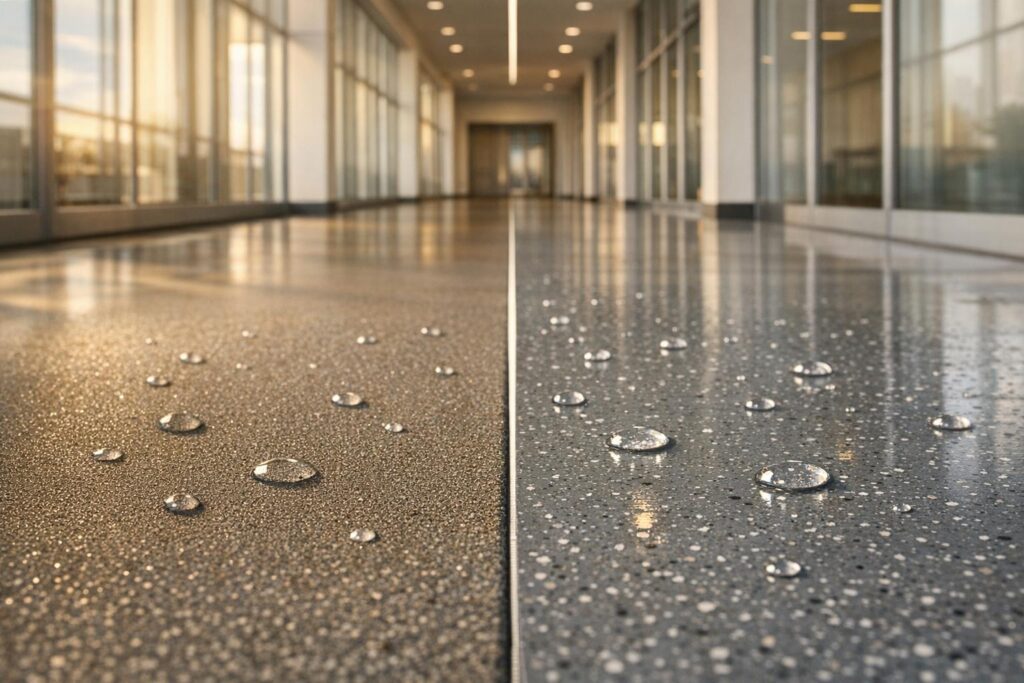
When choosing slip-resistant flooring for commercial spaces, polyurea and epoxy are two popular options. Here’s the key takeaway: polyurea offers a longer lifespan, faster curing time, and better durability, while epoxy is cheaper upfront but requires more frequent maintenance and reapplications.
Key Points:
- Epoxy costs $5–$12 per square foot but lasts 5–10 years. It needs additives for slip resistance and yellows under UV exposure. Installation downtime is 2–7 days.
- Polyurea costs $7–$13+ per square foot but lasts 15–20+ years. It’s naturally slip-resistant, UV-stable, and cures in 4–24 hours, minimizing downtime.
Quick Comparison:
| Feature | Epoxy Coating | Polyurea Coating |
|---|---|---|
| Cost per Sq. Ft. | $5–$12 | $7–$13+ |
| Lifespan | 5–10 years | 15–20+ years |
| Curing Time | 2–7 days | 4–24 hours |
| Slip Resistance | Requires additives | Built-in texture |
| UV Resistance | Poor | Excellent |
| Maintenance | High | Low |
Epoxy may suit budget-conscious projects with limited traffic, but for long-term savings and durability, polyurea is the better investment for commercial spaces.
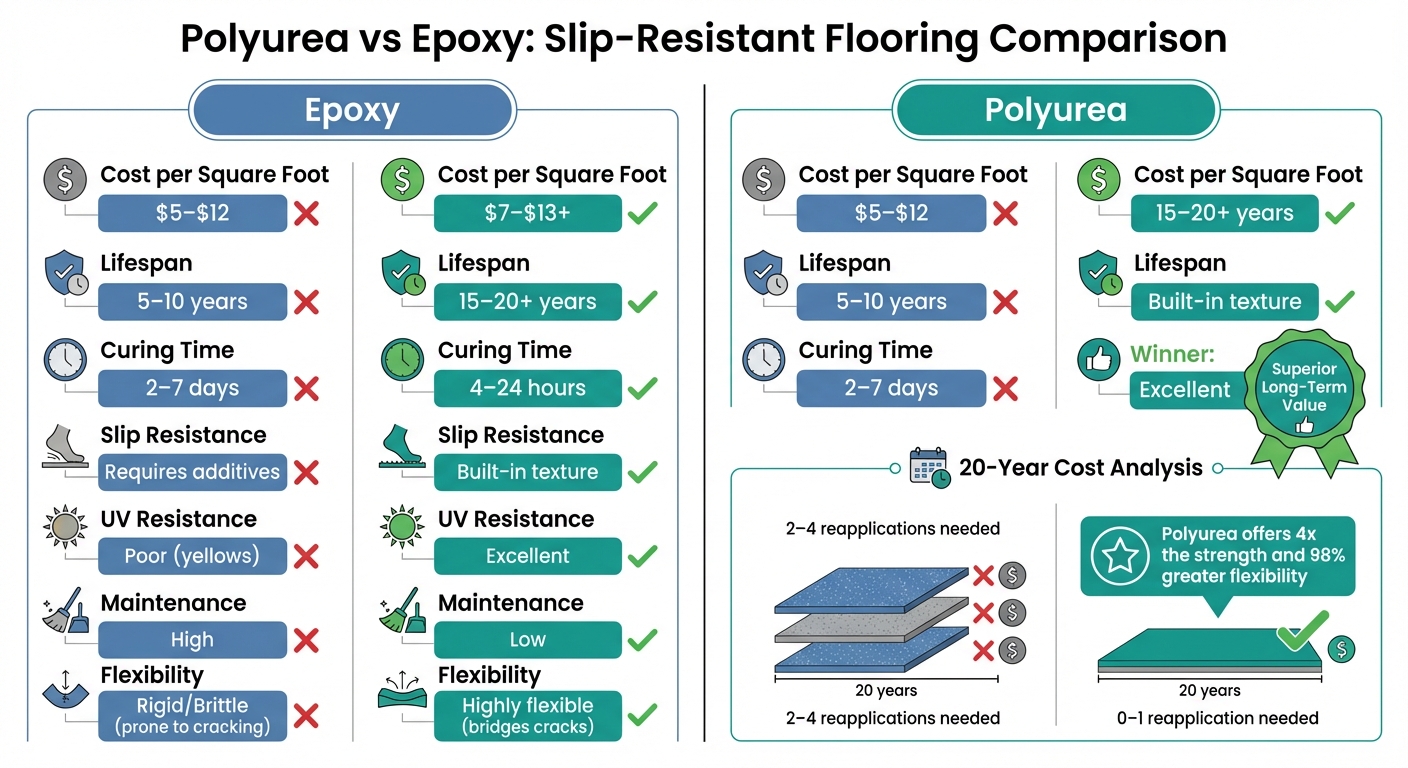
Polyurea vs Epoxy Flooring Cost Comparison Chart
Polyurea VS. Epoxy. Why? When? Who? What is best? // 4 TIMES STRONGER //
sbb-itb-4b4bb37
Epoxy Slip-Resistant Coating Costs
Let’s break down the costs associated with epoxy slip-resistant coatings. While epoxy flooring might seem affordable at first glance, the total expense hinges on factors like the type of epoxy, the condition of the floor, and the slip-resistant features you need.
Epoxy Material Costs
Epoxy prices vary widely depending on the formulation:
- Water-based epoxy: Typically costs $30–$50 per gallon. It’s suitable for light residential use but may not hold up in commercial settings.
- Solvent-based epoxy: Priced around $45 per gallon, it offers better chemical resistance, making it a good choice for industrial applications.
- 100% solids epoxy: This heavy-duty option, ideal for commercial floors, ranges from $45–$150 per gallon or about $4–$7 per square foot.
Epoxy Labor and Installation Costs
Hiring professionals for installation adds $3–$7 per square foot to the project. Labor typically accounts for 33% to 60% of the total cost. A key cost factor is surface preparation. If the floor has cracks or uneven areas, grinding or leveling may be necessary, which can cost anywhere from $240 to $1,200 depending on the condition.
According to Chris Lavin, Owner of National Concrete Polishing, "labor should run you about the same [as materials] and typically the profit, if contracting, should be 50% to 100% or double the cost of the materials and labor".
Now, let’s look at what it takes to make epoxy slip-resistant.
Slip-Resistance Add-On Costs
Standard epoxy can be slippery when wet, so additives are often required for safety. Here’s a breakdown of common options:
- Aluminum oxide: Costs $31–$65 per container.
- Silica sand: Priced between $29.95 and $50 per bag.
Adding anti-slip textures or custom colors generally increases the cost by $1–$3 per square foot. For specific environments, different systems are recommended. For example:
- Quartz sand epoxy systems: Ideal for commercial kitchens with floor drains, as they maintain slip resistance during grease spills.
- Vinyl chip systems: Better suited for areas without drains, as they provide texture and are easier to clean with a mop or squeegee.
While these add-ons raise initial costs by $1–$3 per square foot, they are essential for meeting safety standards in many settings. These costs provide a foundation for comparing epoxy with polyurea solutions later in the article.
Polyurea Slip-Resistant Coating Costs
While polyurea coatings may come with a higher upfront price tag compared to epoxy, they stand out for their durability and ability to minimize downtime. Let’s break down where your money goes and why this investment often pays off in the long run.
Polyurea Material Costs
Polyurea materials typically cost between $1 and $6 per square foot, depending on the formulation and quality. This coating is created by combining an isocyanate (Part A) with a resin blend (Part B), resulting in a fast-curing, flexible surface.
Not all polyurea products are created equal. Some are diluted with fillers, containing only 50% actual polyurea. High-quality options, on the other hand, use pure polyurea paired with a polyaspartic top coat for better performance.
"The power of polyurea is that you can do things once and do them right. It offers long term value because it does not crack easily and is much more flexible than epoxy." – Level 10 Coatings
When reviewing quotes, be cautious of unusually low prices. These could indicate the use of diluted products or inexperienced installers, both of which can compromise the coating’s effectiveness.
Polyurea Labor and Installation Costs
Professional installation adds another $3–$6 per square foot to your project. This brings the total cost for a polyurea coating to approximately $7–$13 per square foot. For a commercial space of 500 square feet, you’re looking at a price range of $3,500 to $6,500.
Labor costs can vary based on location and the condition of your concrete. In regions like Chicagoland or Michigan, where salt pitting and freeze-thaw cycles are common, additional repair work can drive up costs. Issues like cracks, oil stains, or moisture in the concrete also impact preparation time and expenses.
One major advantage of polyurea is its quick curing time. Unlike epoxy, which requires 24–72+ hours to set, polyurea hardens within hours. This means your commercial space can return to operation much faster, reducing revenue loss from downtime.
"Polyurea systems are tack-free in hours, while epoxies take 24–72+ hours. Polyurea costs more initially but often saves money long-term through reduced downtime and longer lifespan." – Cleveland Concrete Coatings
Beyond the basic material and installation costs, additional upgrades can enhance both safety and durability.
Polyurea Slip-Resistant Enhancements
Adding slip resistance is a customizable upgrade that can impact the overall cost. Unlike epoxy, which requires separate additives, polyurea systems can integrate slip-resistant textures directly into the application process. Custom flake blends and extra protective layers not only improve safety but also enhance the appearance of the floor, though they do add to the final price.
Thanks to its UV and impact resistance, along with its flexibility, polyurea coatings can last 10+ years in commercial settings. This far exceeds the typical lifespan of epoxy, which ranges from 5 to 10 years. Over time, this durability translates into lower ownership costs.
Atlas Concrete Coatings offers polyurea-based chip floor systems that combine long-lasting performance with customizable finishes. Their slip-resistant surfaces, UV protection, and lifetime warranty on chip systems make them a dependable choice for commercial spaces that demand high performance and safety.
With these cost details in mind, the next step is to compare polyurea and epoxy side by side to see how they stack up.
Polyurea vs Epoxy: Side-by-Side Cost Comparison
When comparing polyurea and epoxy coatings, the differences in upfront costs and long-term performance become clear. Factors like cost per square foot, lifespan, curing time, and maintenance reveal the overall value each option offers.
Comparison Table
| Feature | Epoxy Coating | Polyurea Coating |
|---|---|---|
| Cost per Sq. Ft. | $5–$12 | $7–$12+ |
| Lifespan | 5–10 years | 15–20+ years |
| Curing Time | 2–7 days (full cure) | 4–24 hours (full cure) |
| Slip Resistance | Requires additives; smooth finish is slippery when wet | Naturally "grippier" elastomer; easily textured with aggregates |
| UV Resistance | Poor; yellows and chalks in sunlight | Excellent (Aliphatic/Polyaspartic versions) |
| Maintenance | High; prone to cracking, peeling, and frequent recoats | Low; highly resistant to chemicals, salt, and impact |
| Flexibility | Rigid/Brittle; prone to cracking with substrate | Highly flexible; bridges hairline cracks |
While epoxy coatings may initially seem more affordable, their lower cost advantage – typically $2–$5 less per square foot – comes with trade-offs. The 15–20+ year lifespan of polyurea far outpaces epoxy’s 5–10 years, meaning fewer reapplications and reduced labor costs over time. Additionally, polyurea’s quick curing time of just 4–24 hours can significantly reduce downtime compared to epoxy’s 2–7 days. For businesses, this shorter downtime could mean avoiding lost revenue during installation, making the upfront investment in polyurea worthwhile.
"Polyurea coatings, by contrast, often last 10–15 years or more." – Marvel Coatings
Polyurea also stands out for its flexibility, which allows it to adapt to concrete shifts and prevents cracking. In contrast, epoxy’s rigid nature makes it more prone to damage, leading to higher maintenance costs over time. This flexibility, combined with its durability and resistance to chemicals, salt, and impact, makes polyurea a more cost-effective option in the long run.
The next step is to explore how these differences impact overall expenses, especially in commercial applications.
20-Year Cost Analysis for Commercial Spaces
When it comes to flooring investments for commercial properties, examining the 20-year outlook reveals some notable cost differences. While epoxy may seem like an affordable option initially, its shorter lifespan often turns it into what experts refer to as a "recurring expense". On the other hand, polyurea is frequently seen as a "one-time investment" over the same period.
This comparison underscores how long-term maintenance can significantly impact the overall value of your investment.
Reapplication and Maintenance Costs
The real cost difference lies in the reapplication cycle. Epoxy typically requires recoating every 5–10 years, which translates into 2–4 cycles over 20 years. Each reapplication also involves the additional expense of removing the old coating. By contrast, polyurea systems often last 10+ years, with many lasting 15–25 years or more in commercial settings, resulting in 0–1 reapplication during the same timeframe.
"This comparison highlights polyurea’s advantage as a one-time, long-lasting solution".
The numbers become even more striking when you factor in the labor, downtime, and material costs associated with multiple epoxy reapplications. According to Cleveland Concrete Coatings, "When you factor in a 20+-year lifespan, the polyaspartic system offers the lowest annual cost of ownership". Beyond the planned recoating, epoxy’s brittleness often leads to earlier repairs caused by cracking, peeling, or issues like "hot-tire pickup", where heat causes the coating to delaminate. In contrast, polyurea’s flexibility – up to 400% more than epoxy – allows it to adapt to concrete expansion and contraction, preventing many of these costly failures.
These ongoing expenses make it clear why investing in polyurea upfront can lead to significant savings in the long run.
Why Polyurea Works Better for Commercial Floors
In addition to saving on reapplication costs, polyurea also reduces operational downtime, which is a critical factor for businesses. For commercial operations, downtime equals lost revenue. Epoxy’s 7-day cure time before it can handle vehicle traffic often forces extended closures during both initial installation and subsequent reapplications. Polyurea, on the other hand, offers a 24–48-hour return to service, minimizing business interruptions. Over two decades, this reduced downtime translates into significant indirect cost savings.
Polyurea also handles the challenges of commercial environments more effectively. Its flexible, elastomeric properties allow it to bridge hairline cracks and endure freeze–thaw cycles, which often cause rigid epoxy coatings to crack and fail prematurely. With bond strengths reaching 1,350 PSI – far exceeding the industry standard of 500 PSI – polyurea requires fewer emergency repairs and maintenance calls.
Why Polyurea Outperforms Epoxy for Slip-Resistant Floors
Polyurea delivers 4x the strength and 98% greater flexibility compared to epoxy, making it a game-changer for dynamic commercial flooring. Unlike epoxy, which can crack under the stress of concrete expanding and contracting, polyurea adapts to these changes, maintaining its integrity over time. This flexibility not only prevents damage but also contributes to its long-term cost efficiency.
Another key advantage is its resistance to UV damage. While epoxy tends to yellow with prolonged exposure to sunlight, polyurea retains its appearance. As Epic Concrete Coatings aptly puts it, "Polyurea is the SPF 100 of floor coatings". Its non-porous surface also resists stains, simplifying maintenance in high-traffic areas. This combination of durability and ease of upkeep translates to significant savings over time.
Polyurea doesn’t just excel structurally – it also raises the bar aesthetically and functionally. For slip-resistant applications, polyurea-based chip systems provide excellent traction while offering a customizable, natural stone-like finish. Businesses can choose from a variety of decorative chip options to match their branding needs, all while meeting rigorous safety standards.
Atlas Concrete Coatings, a leader in commercial polyurea-based chip systems, backs their work with a lifetime warranty, underscoring the material’s durability. Their meticulous approach to surface preparation, including mechanical profiling and moisture testing, ensures the best possible adhesion and performance. Even better, polyurea’s quick application process allows businesses to resume operations within 24–48 hours.
As Epic Concrete Coatings puts it, "Epoxy = band-aid fix. Polyurea = lifetime armor". For commercial spaces requiring slip resistance, durability, and minimal downtime, polyurea emerges as the clear long-term solution.
Conclusion
Polyurea coatings stand out with their 10+ year lifespan, quick curing process, and resilience against cracking, UV damage, and heavy traffic. While epoxy coatings may appeal to budget-conscious indoor projects with limited UV exposure, polyurea offers greater durability and long-term value, making it ideal for commercial spaces.
From a cost perspective, polyurea proves its worth over time. Unlike epoxy, which takes 24–72+ hours to cure and often requires recoating every 5–10 years, polyurea systems are ready for use in just hours and can last over a decade, even in demanding environments. Though the upfront cost is higher, the reduced downtime and extended lifespan translate into lower lifecycle costs and fewer interruptions for businesses. These advantages make polyurea a practical investment for those prioritizing efficiency and durability.
Professional installation further enhances the benefits of polyurea. Atlas Concrete Coatings specializes in polyurea-based chip systems, offering superior slip resistance, customizable designs, and a lifetime warranty to underscore their confidence in the product’s durability. Their careful approach to surface preparation, including mechanical profiling and moisture testing, ensures a strong bond and long-lasting performance.
For commercial floors and outdoor applications, polyurea is the clear choice when durability and minimal downtime are priorities. Its ability to bridge small cracks, resist UV yellowing, and handle thermal cycling makes it a dependable, long-term solution.
Atlas Concrete Coatings provides free consultations to help design a fast-curing, durable polyurea solution tailored to your commercial needs.
FAQs
Which coating is cheaper over 20 years?
Polyurea coatings prove to be a more economical choice over a 20-year span compared to epoxy. While epoxy typically costs between $4 and $7 per square foot and lasts about 5–10 years, polyurea comes in at $7 to $12 per square foot but offers a lifespan exceeding 20 years. This extended durability means fewer replacements and repairs, making the higher upfront cost of polyurea a worthwhile investment in the long run.
How soon can my business reopen after installation?
The time it takes for a floor to be ready depends on the type of coating used. Polyurea coatings cure much faster, often allowing businesses to reopen within just 24 hours. They can handle light foot traffic in as little as 6–8 hours. On the other hand, epoxy coatings need significantly more time – about 4–7 days – to fully cure. During this period, the floor must remain dry and unused. For businesses looking to minimize downtime, polyurea is the quicker option.
How do I choose the right slip-resistant texture?
To find the best slip-resistant texture for your space, think about the specific conditions and safety requirements. Polyurea coatings stand out for their strong slip resistance, particularly in wet or oily areas. This is due to the inclusion of additives like quartz or polymer flakes. Unlike epoxy, which can lose traction over time, polyurea maintains its grip for longer periods. While epoxy can be enhanced with slip-resistant finishes, polyurea’s strength and naturally textured surface make it a better option for areas with heavy foot traffic or tougher environments.