

Polyurea and epoxy coatings are two popular solutions for protecting concrete surfaces, but they differ significantly in performance, durability, and cost. Here’s what you need to know:
- Polyurea: Offers superior flexibility, allowing it to handle substrate movement without cracking. It resists moisture, chemicals, and extreme temperatures, lasting 15–20 years with minimal maintenance. Suitable for outdoor areas and high-traffic spaces.
- Epoxy: A rigid coating that’s more affordable upfront but prone to cracking under stress or temperature changes. It requires a dry substrate for application and frequent maintenance, with a lifespan of 3–7 years. Best for indoor, controlled environments.
Quick Comparison
| Feature | Polyurea Coatings | Epoxy Coatings |
|---|---|---|
| Flexibility | High; bridges cracks | Low; prone to cracking |
| Moisture Tolerance | Can bond to damp surfaces | Requires a dry substrate |
| Chemical Resistance | Strong; handles harsh chemicals | Moderate; limited durability |
| Temperature Range | -30°F to 140°F | 50°F minimum for curing |
| Lifespan | 15–20 years | 3–7 years |
| Cost (per sq. ft.) | $6–$12 | $2–$7 |
Polyurea is ideal for demanding environments, while epoxy works well for simpler indoor applications. Choose based on your specific needs and conditions.
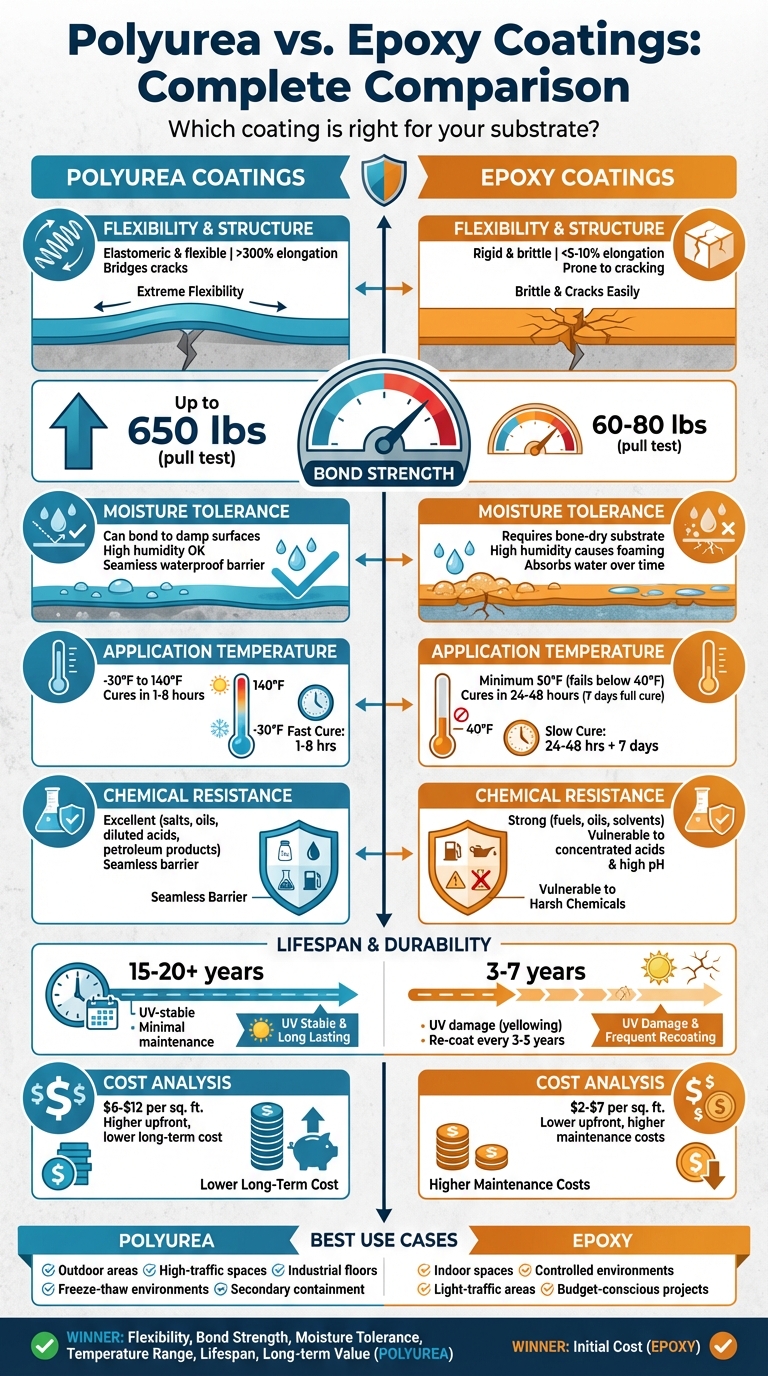
Polyurea vs Epoxy Coatings: Complete Performance Comparison
Epoxy Versus Polyurea Flooring (Which is Better?)
Flexibility vs. Rigidity in Structural Performance
Concrete naturally expands and contracts as temperatures rise and fall. This constant movement creates stress that protective coatings must endure without breaking down. The key difference between polyurea and epoxy lies in how each material responds to these shifts, making it essential to choose the right coating for long-term performance.
Polyurea: Adaptable and Crack Resistant
Polyurea’s elastomeric properties allow it to flex and move along with the concrete. When temperatures cause the concrete to expand or shrink, polyurea stretches and contracts without losing its seal. This adaptability helps it bridge hairline cracks and even prevent new ones from forming.
The strength of this bond is evident in testing. Epoxy coatings typically achieve a pull test rating of 60 to 80 pounds, while advanced polyurea systems can hit an impressive 650 pounds. This demonstrates a much stronger mechanical bond, capable of withstanding the stresses of movement.
"Polyurea’s flexibility allows the coating to remain intact when concrete expands or contracts as a result of changes in temperature, while epoxy is very rigid and can crack." – GSC Concrete Coatings
Beyond flexibility, polyurea also absorbs impacts from tools, machinery, or vehicle traffic. This resilience prevents delamination and chipping, common issues with rigid coatings. For outdoor areas like patios or driveways that experience temperature swings, polyurea proves to be a reliable option, maintaining its integrity year after year. In contrast, epoxy’s rigidity makes it far less adaptable in such conditions.
Epoxy: Strong but Brittle
Epoxy, by design, forms a rigid and hard structure. While this gives it surface durability, it struggles to handle the movement of concrete. Under stress, such as thermal expansion or contraction, epoxy often cracks or chips. This is particularly evident in garages, where hot-tire pickup occurs – heat from vehicle tires softens the epoxy, leading to peeling and degradation. In environments with heavy equipment or fluctuating temperatures, stress points in epoxy coatings can quickly become visible damage.
Comparison Table: Structural Performance
The following table highlights how these two materials differ when subjected to structural stress:
| Feature | Polyurea Coatings | Epoxy Coatings |
|---|---|---|
| Structural Nature | Elastomeric and flexible | Rigid and brittle |
| Response to Movement | Expands/contracts with substrate | Prone to cracking and chipping |
| Crack Bridging | High; moves with concrete shifts | Low; cracks when concrete shifts |
| Impact Resistance | High; absorbs energy and impacts | Low; brittle nature leads to chips |
| Bond Strength | Deep mechanical lock (up to 650 lb) | Surface bond (60–80 lb) |
| Long-term Durability | Remains flexible over time | Becomes more brittle as it ages |
Moisture Tolerance and Application Requirements
Dealing with moisture in concrete substrates is a common challenge during coating installations. How a coating handles moisture significantly impacts both its application process and its ability to protect the substrate over time.
Polyurea: Handles Moisture with Ease
Polyurea stands out because it can adhere to slightly damp surfaces without losing its bond strength. It cures without reacting to ambient moisture, which helps avoid issues like gas bubbles or blistering.
This moisture-friendly quality allows polyurea to be applied even in less-than-ideal conditions, such as high humidity or rainy weather. Its wide temperature range for application – from -30°F to 140°F – makes it versatile for various environments, including extreme cold or heat.
"Polyurea’s fast cure and flexibility give it distinct advantages in many demanding industrial applications… [it] can be applied in extreme cold or hot and even high humidity or slightly damp substrates." – Marvel Coatings
Once applied, polyurea forms a seamless and durable waterproof barrier. This barrier not only prevents water intrusion but also resists chemical seepage, contributing to a service life of 15–20 years – far longer than the 3–5 years typical of epoxy coatings.
Epoxy: Demands a Dry Surface
Epoxy coatings, on the other hand, require a completely dry substrate for proper adhesion. Any moisture during application can lead to issues like osmotic blistering, pinholes, or even total adhesion failure.
Epoxy also has stricter temperature requirements. It generally needs temperatures above 50°F to cure properly, and at 40°F or below, curing may not occur at all. This makes epoxy less ideal for outdoor or unheated spaces where environmental conditions are harder to control.
"High humidity is also another factor that can cause many epoxies to cure too quickly and foam." – Floor Shield Coatings
Even after curing, epoxy is more vulnerable to moisture-related problems. Over time, it can absorb water, which weakens its bond with the concrete. This can lead to peeling or delamination – especially in areas where keeping the substrate completely dry is nearly impossible.
Comparison Table: Moisture Tolerance
| Feature | Polyurea Coatings | Epoxy Coatings |
|---|---|---|
| Substrate Condition | Can be applied to slightly damp surfaces | Must be bone-dry for adhesion |
| Humidity Tolerance | Performs well in high humidity | High humidity can cause foaming |
| Moisture Sensitivity | Minimal during curing | Moisture leads to blistering |
| Application Temperature | -30°F to 140°F | Minimum 50°F |
| Risk of Blistering | Very low | High (if moisture is present) |
| Long-Term Moisture Protection | Seamless waterproof barrier | Absorbs water over time |
| Permeability | Extremely low | Moderate (prone to micro-cracks) |
Chemical Resistance and Substrate Protection
When it comes to protecting concrete floors, chemical exposure presents an additional challenge alongside moisture. Coatings must withstand substances like oil, acids, and solvents to ensure the long-term durability of the substrate.
Polyurea: A Strong Shield Against Chemicals
Polyurea creates a seamless, non-porous layer that acts as a formidable barrier for concrete surfaces. Its resistance spans a wide range of chemicals, including salts, oils, diluted acids, and alkalis. It excels in handling petroleum-based substances like gasoline, diesel, hydraulic fluid, and motor oil.
What sets polyurea apart is its flexibility. With elongation exceeding 300%, it can stretch and move with the substrate, even bridging small cracks. This ensures a continuous protective layer, maintaining chemical resistance even if the concrete develops hairline fractures.
"Polyurea coatings… can withstand exposure to a wide range of chemicals, providing a robust protective barrier against corrosive substances." – Floor Shield Coatings
Polyurea is particularly suited for secondary containment systems and wastewater treatment facilities, where even a tiny crack could lead to hazardous leaks. Its low permeability and seamless application create a monolithic barrier, keeping chemicals on the surface and preventing penetration.
"From oil spills to acidic cleaners, polyurea shrugs off harsh chemicals with ease, maintaining its pristine appearance." – Sean Hakes, CEO, Keas Concrete Coatings
This combination of flexibility and chemical resistance makes polyurea a reliable choice for demanding environments.
Epoxy: Durable but with Limits
Epoxy coatings also offer strong resistance to fuels, oils, and various solvents, making them a popular option for manufacturing facilities and indoor garages. However, they have limitations when exposed to concentrated acids or high-pH conditions.
"Standard epoxy may be attacked by prolonged exposure to very high pH (alkaline) or concentrated acids unless designed for it." – Marvel Coatings
One key drawback of epoxy is its rigidity. With elongation typically under 5–10%, it behaves more like a hard plastic shell rather than a flexible membrane. This lack of flexibility makes epoxy prone to cracking when the substrate shifts, which can allow chemicals to seep through and damage the concrete.
For extreme chemical resistance, specialized formulations like Novolac epoxy are available, though these come with a higher price tag.
Comparison Table: Chemical Resistance
| Feature | Polyurea Coatings | Epoxy Coatings |
|---|---|---|
| General Resistance | Excellent (salts, oils, diluted acids) | Strong (fuels, oils, solvents) |
| Weaknesses | Highly concentrated acids | Concentrated acids, high pH, UV light |
| Structure | Seamless, flexible membrane | Rigid, cross-linked plastic layer |
| Crack Bridging | High (adapts to movement) | Low (prone to cracking) |
| Permeability | Very low | Low to moderate |
| Elongation | >300% | <5–10% |
| Best Use Case | Secondary containment, industrial floors | Labs, manufacturing, indoor garages |
sbb-itb-4b4bb37
Performance in Temperature Extremes
Concrete surfaces naturally expand and contract as temperatures shift, so any coating applied to them must be able to flex and move in tandem. This is where the distinction between polyurea and epoxy coatings becomes especially important.
Polyurea: Temperature Flexibility
Polyurea works as a flexible, elastomeric barrier that adjusts to the movement of the surface it’s applied to. Thanks to its high elongation properties, it can handle the stresses of freeze–thaw cycles without cracking or peeling.
In colder conditions, it prevents water from seeping into the substrate, which could otherwise cause damage. When exposed to high heat, polyurea remains stable, offering a smooth, non-tacky surface that avoids problems like "hot tire pickup".
"Polyurea’s resistance to heat ensures that polyurea-coated surfaces do not become tacky or deform under the sun, a common problem with epoxy in high-temperature environments." – FloorTech Concrete Coatings
Epoxy: Temperature Limitations
Epoxy, on the other hand, is far less forgiving when it comes to temperature changes. Its rigid structure, with an elongation rate typically below 5–10%, doesn’t allow it to flex with the surface. This rigidity makes it prone to cracking as the substrate expands and contracts with temperature shifts.
Epoxy also has strict temperature requirements for application and curing. A substrate temperature of at least 50°F is necessary for it to cure properly, and even then, it takes 24–48 hours for light use and up to 7 days for full curing. If temperatures drop below 40°F, the curing process halts completely. In high temperatures, epoxy tends to soften, become tacky, or even peel. Over time, especially after repeated freeze–thaw cycles, epoxy coatings often crack or separate from the surface due to thermal stress.
"At 40 degrees or lower, epoxies will not cure at all." – Floor Shield Coatings
These temperature-related challenges significantly impact the durability and performance of epoxy coatings, especially in regions with fluctuating climates.
Comparison Table: Temperature Performance
| Feature | Polyurea Coatings | Epoxy Coatings |
|---|---|---|
| Application Temperature | –20°F minimum; cures to handle –30°F to 140°F | Minimum 50°F; fails below 40°F |
| Elongation (Flexibility) | >300% | <5–10% |
| Freeze–Thaw Response | Expands and contracts with substrate | Brittle; prone to cracking and peeling |
| High Heat Performance | Stays intact; non-tacky surface | Softens, becomes tacky, and may peel |
| Cure Time | 1–8 hours | 24–48 hours for light use; up to 7 days for full cure |
| Expected Lifespan | 15–20 years | 3–7 years |
| Best Use Case | Outdoor areas; freeze–thaw cycles | Indoor spaces with controlled climates |
These differences in temperature performance highlight why polyurea is often the better choice for outdoor or variable environments, while epoxy is better suited for stable, indoor conditions.
Long-Term Costs and Maintenance Requirements
When evaluating coating systems, the long-term costs provide a clearer picture of their overall value. These costs go far beyond the initial installation price, factoring in durability, maintenance, and replacement needs over time.
Polyurea: Lower Long-Term Costs
Polyurea installation typically ranges from $6 to $12 per square foot. While this upfront cost is higher, the payoff comes in its impressive lifespan and minimal maintenance. A well-installed polyurea coating can last 15 to 20+ years without needing major repairs or replacement. Its flexibility allows it to adapt to temperature changes, bridging small cracks and protecting against moisture, chemicals, and physical stress.
"Polyurea’s flexible durability means fewer shutdowns for maintenance, which is a major life-cycle cost advantage." – Marvel Coatings
Another advantage is its rapid cure time, usually within 24 hours, which minimizes downtime for commercial or industrial spaces. For property owners aiming to reduce long-term costs, Atlas Concrete Coatings offers polyurea-based chip floor coatings designed to protect substrates with minimal upkeep.
Epoxy coatings, however, tell a different story.
Epoxy: Higher Maintenance Frequency
Epoxy coatings are more budget-friendly upfront, costing $2 to $7 per square foot. While this makes them appealing for indoor projects, their rigidity – elongation rates of less than 5 to 10% – leaves them vulnerable to cracking. These cracks allow moisture and chemicals to seep in, leading to faster deterioration. Additionally, epoxy coatings are prone to UV damage, which causes yellowing and chalking over time. In high-heat conditions, they can even become tacky or peel, a problem known as "hot tire pickup".
Maintenance is another drawback. Epoxy coatings often require re-coating every 3–5 years, with full replacement needed after 5–7 years. Over a 20-year span, this could mean replacing an epoxy floor 4 to 6 times.
"Even quality epoxy coatings require fresh top coating within 3-5 years to avoid tire pickup issues… Polyurea floor owners enjoy double or triple that projected lifespan." – Waylinl, Author, SpriteShield
Comparison Table: Costs and Maintenance
| Feature | Polyurea Coatings | Epoxy Coatings |
|---|---|---|
| Initial Cost (per sq. ft.) | $6–$12 | $2–$7 |
| Expected Lifespan | 15–20+ years | 5–7 years (full replacement) |
| Maintenance Interval | Minimal; roughly 2–3× epoxy lifespan | Re-coat every 3–5 years |
| Flexibility | >300% elongation; excellent crack-bridging | <5–10% elongation; prone to cracking |
| UV Resistance | UV-stable; maintains color | Tends to yellow and fade over time |
| Return to Service | 24–48 hours | 6–8 days |
| Substrate Protection | High; continuous flexible barrier | Moderate; cracks can expose substrate |
For spaces exposed to heavy traffic, fluctuating temperatures, or outdoor conditions, polyurea’s higher initial cost is offset by its durability and reduced maintenance. Meanwhile, epoxy is better suited for controlled indoor environments where its lower upfront price can balance the need for more frequent maintenance. These differences are critical when deciding which coating aligns with your long-term goals.
Conclusion: Selecting the Right Coating for Substrate Protection
When deciding between polyurea and epoxy, it all comes down to the conditions your substrate will face and your long-term protection goals. Polyurea stands out with its flexibility, allowing it to bridge cracks and adapt to temperature changes. It’s stronger than epoxy, cures quickly – often within 24 hours – and resists UV damage, maintaining its appearance over time. With a lifespan of 15 to 20+ years and minimal upkeep, polyurea is perfect for high-traffic areas like garages, outdoor patios, and industrial floors.
On the other hand, epoxy is better suited for controlled indoor environments with stable conditions. While it’s more budget-friendly upfront, its rigidity – with less than 10% elongation – makes it prone to cracking. Plus, exposure to sunlight can cause yellowing, limiting its use outdoors. Its lower cost comes with a trade-off: frequent maintenance and the need for replacement every 5 to 7 years.
"In applications once thought to require high‑solids epoxies, polyureas are winning at every turn because of their superior elongation and impact resistance." – Marvel Coatings
For projects demanding long-lasting substrate protection, polyurea’s durability and adaptability make it a smarter investment over time. Choosing the right coating means evaluating your environment’s specific demands and the potential for substrate movement. Atlas Concrete Coatings specializes in polyurea-based chip floor coatings, offering tailored solutions for residential, commercial, and industrial applications.
Whether it’s your garage, patio, or industrial floor, the right coating can keep your substrate protected for decades. For expert advice and a free consultation, visit Atlas Concrete Coatings. Explore durable, customizable flooring options backed by a lifetime warranty on chip systems.
FAQs
Why are polyurea coatings better than epoxy for protecting outdoor concrete surfaces?
Polyurea coatings are a fantastic choice for outdoor concrete surfaces, thanks to their strong resistance to UV rays. This feature helps protect against yellowing and damage caused by prolonged sun exposure. Their flexibility is another major plus, as it allows them to handle temperature changes without cracking – perfect for outdoor settings. Plus, polyurea stands up well to harsh weather, offering dependable, long-term protection for your concrete.
Why is polyurea more durable than epoxy when it comes to protecting concrete surfaces?
Polyurea stands out for its ability to handle temperature changes with ease. It expands and contracts as temperatures shift, without cracking. This flexibility means it can endure wear and tear over time, making it tougher than epoxy, which tends to be more rigid and susceptible to cracking under similar conditions. Thanks to this resilience, polyurea is a solid option for protecting concrete surfaces in both homes and commercial spaces.
Why is polyurea often considered a more cost-effective option over time, despite its higher upfront cost?
Polyurea stands out as a cost-effective option over time, thanks to its durability and long lifespan. While it comes with a higher upfront cost compared to epoxy, polyurea coatings can last 15–20+ years, significantly outpacing epoxy’s typical lifespan of 5–10 years. This extended longevity means fewer replacements and reduced maintenance costs in the long run.
What makes polyurea even more appealing is its strong resistance to cracking, peeling, and chemical damage. These qualities minimize the need for frequent repairs, making it an excellent choice for safeguarding concrete surfaces in residential, commercial, and industrial environments.