
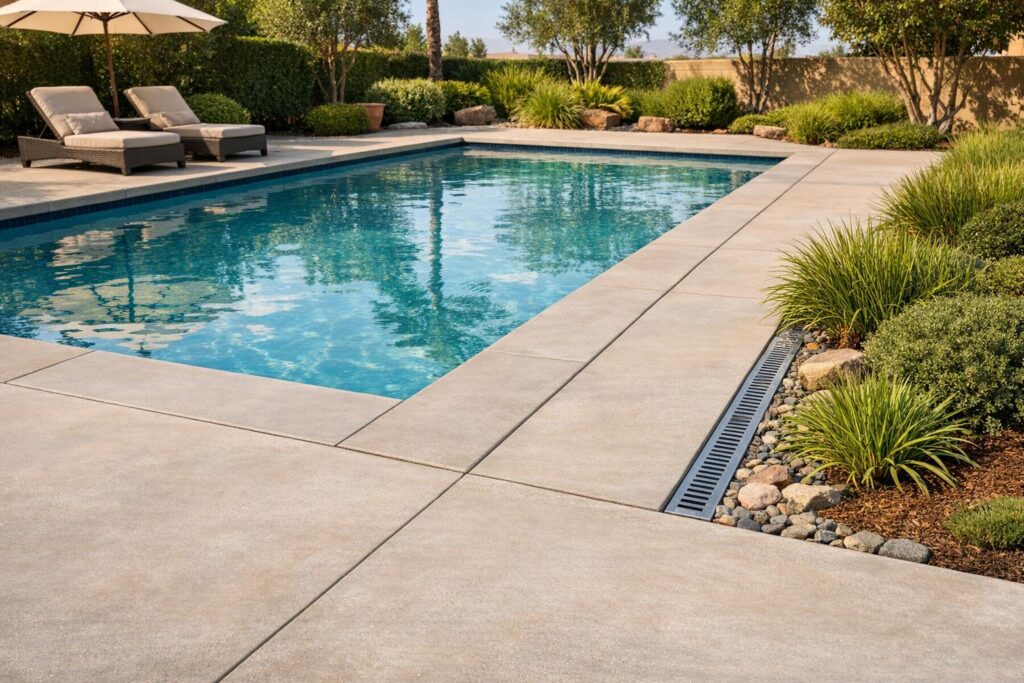
Your pool deck endures daily wear from sunlight, water, and foot traffic. Ignoring small cracks can lead to costly repairs and safety risks like tripping hazards or slippery algae buildup. Regular maintenance is key to keeping your deck safe, durable, and visually appealing.
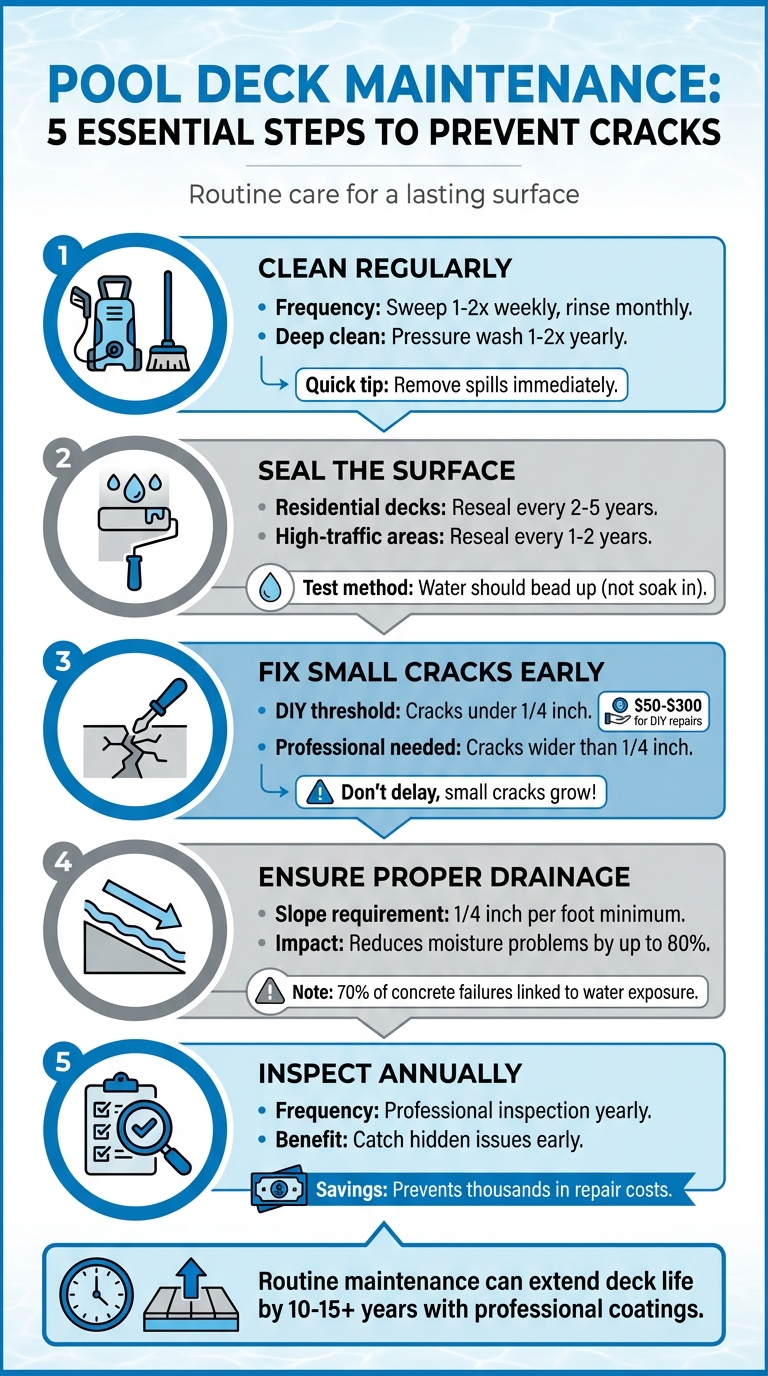
Here’s how you can prevent cracks and extend your pool deck’s lifespan:
- Clean regularly: Sweep weekly, rinse monthly, and pressure wash once or twice a year to remove debris, algae, and stains.
- Seal the surface: Reseal every 2–5 years (or 1–2 years for high-traffic areas) to protect against water, UV rays, and chemicals.
- Fix small cracks early: Repair hairline cracks under 1/4 inch with outdoor fillers or epoxy before they worsen.
- Ensure proper drainage: Adjust slopes, install drains, and clear clogs to prevent water pooling and freeze-thaw damage.
- Inspect annually: Schedule professional checks to catch hidden issues like sinking slabs or structural cracks.
Key takeaway: Routine care, timely repairs, and addressing drainage problems can save you from expensive repairs and keep your pool deck safe and functional for years.
5 Essential Pool Deck Maintenance Steps to Prevent Cracks
Pool Deck Cracking – Why Does This Happen?
What Causes Pool Deck Cracks
Understanding the reasons behind pool deck cracks is key to preventing them. Various environmental and physical factors place stress on concrete, eventually leading to cracks. Let’s explore the main culprits.
Temperature Changes and Weather
Shifts in temperature can wreak havoc on concrete, causing it to expand and contract under stress until cracks form.
In colder regions, freeze-thaw cycles are particularly damaging. Water seeps into the tiny pores of the concrete. When temperatures drop below 32°F, this water freezes, expands, and breaks the concrete from within. Each winter, the damage worsens as this cycle repeats.
Even in warmer areas, rapid temperature changes can cause problems. Imagine a hot summer day when a sudden rainstorm cools the concrete too quickly. This abrupt temperature drop creates stress fractures because the material doesn’t have enough time to adjust gradually.
But weather isn’t the only factor – poor drainage also plays a major role in weakening your pool deck.
Poor Drainage and Standing Water
Water that lingers on your pool deck for more than 48 hours can seep into the porous concrete, gradually undermining its structure.
Research shows that around 70% of premature concrete failures are linked to water exposure, and effective drainage systems can reduce moisture-related problems by up to 80%. When water seeps below the deck, it erodes the supporting soil, leaving hollow spaces beneath the concrete. Without proper support, the deck begins to settle, sink, and crack.
In areas with high groundwater levels, hydrostatic pressure pushes upward on the deck, forcing the concrete to shift or heave. Additionally, water that penetrates the concrete and reaches internal steel reinforcement can cause the steel to rust and expand, leading to internal cracks.
Heavy Use and Wear
Excessive weight on pool decks often leads to cracking, especially if the deck wasn’t built to handle heavy loads. John Chavez, Founder of Sublime Pools & Spa, highlights this issue:
Heavy loads: Parking vehicles or placing heavy objects on your pool deck can cause cracking, especially if the deck wasn’t designed to handle such loads.
Even regular use takes a toll. High-traffic areas, such as those near ladders, diving boards, or pool entrances, experience concentrated stress. Add the weight of pool furniture, planters, and equipment, and the strain on the deck increases significantly.
Chemical exposure compounds the problem. Substances like chlorine, bromine, salt, and fertilizers from nearby landscaping gradually eat away at the concrete’s surface. Over time, this chemical wear causes pitting, flaking, and other surface damage, making the deck more susceptible to cracking.
Maintenance Practices to Prevent Cracks
Keep your pool deck in top shape by following these essential maintenance steps. These practices can help extend the life of your pool deck and minimize the risk of cracks.
Clean Regularly and Remove Debris
Regular cleaning is your first line of defense against cracks. Sweeping weekly helps prevent debris from trapping moisture, which can damage the concrete over time. Justine Guidry from Concrete Network advises that "a pool deck should be cleaned thoroughly at least once a year". However, routine upkeep is just as important.
For deeper cleaning, use a low-pressure washer once or twice a year to eliminate algae and mold. A simple solution of warm water and dish soap works well for everyday cleaning – just steer clear of harsh chemicals that might break down the concrete or its protective sealer.
Quickly clean up spills like oils, pool chemicals, or organic matter to avoid permanent stains and surface damage. In the fall, remove leaves that can block drainage, and during winter, clear snow and ice promptly. Skip de-icing salts, as they can worsen freeze-thaw damage. Instead, opt for sand or non-corrosive de-icers.
After cleaning, sealing the deck provides an extra layer of protection against the elements.
Seal the Concrete Surface
Sealing your pool deck safeguards it from water, UV rays, and chemicals. For residential decks, resealing every 2 to 5 years is usually sufficient, while high-traffic public decks may need resealing every 1 to 2 years.
Wondering if it’s time to reseal? Pour a little water on the deck. If it beads up, the sealer is still doing its job. If the water soaks in, your deck is vulnerable to moisture damage. For cold climates, penetrating sealers are ideal since they protect the concrete’s pores from freeze-thaw cycles without leaving a slippery surface. On the other hand, acrylic sealers are great for decorative pool decks, offering a glossy finish and strong protection against UV rays and chemical stains.
Before resealing, pressure wash the deck thoroughly to remove oil, grease, and any old sealer. For safety, choose a sealer with a non-slip additive or mix in a grit solution to prevent slippery surfaces when wet. A combination of cleaning, sealing, and joint maintenance will keep your deck in excellent condition.
Install and Maintain Expansion Joints
Expansion joints are critical for allowing natural movement in the concrete, which helps prevent stress cracks. These flexible gaps absorb the expansion and contraction caused by temperature changes.
Inspect your expansion joints annually for signs of wear, such as peeling or gaps in the sealant. Flexible sealants like Deck-O-Seal, mastic, or silicone-based caulking are excellent options for filling joints. Clean Krete notes that these materials "work quite well where the cracks or joints show some kind of movement. Their nature involves accommodating expansion and contraction of concrete while providing the seal flexibly and durably". If the sealant has failed or pulled away, clean the joint and apply fresh filler to restore a watertight barrier.
Inspect and Fix Small Cracks Early
Catching cracks early can save you from expensive repairs down the road. Learning to identify the difference between minor and structural cracks is key to maintaining your pool deck.
How to Spot Minor Cracks
Minor cracks are usually less than 1/4 inch wide and appear as thin, hairline fractures on the surface. They often form in spark-like patterns and don’t penetrate deeply.
Structural cracks, on the other hand, are more serious. John Chavez, Founder of Sublime Pools & Spa, explains:
Hairline cracks are those thin, barely visible fractures that seem harmless enough… While they may not be a major structural concern initially, they can still be a potential entry point for water.
Keep an eye out for cracks wider than 1/4 inch, stair-step patterns, or rust stains near the cracks. Rust stains often indicate that water has reached the steel reinforcement beneath the concrete. Additionally, if your pool’s water level drops significantly beyond normal evaporation, it could signal a structural crack allowing water to escape through the shell.
To monitor a crack, mark both ends with a pencil and check after a few weeks to see if it’s growing. If a crack results in an uneven walking surface, it may point to poor soil support under the deck.
Fix Small Cracks Yourself
After sealing your pool deck, addressing small cracks promptly can extend its life. For hairline cracks under 1/4 inch, a DIY repair is often sufficient and costs between $50 and $300. Start by chiseling out any loose debris, cleaning the crack thoroughly, and applying a flexible outdoor-rated filler with a caulk gun. Smooth the filler and allow 24–48 hours for it to cure.
For slightly wider cracks nearing 1/4 inch, use a two-part epoxy or polyurethane caulk. These materials are flexible enough to handle the natural movement of the concrete. If the crack is deep, apply the filler in layers, letting each layer cure before adding the next. Once the repair is complete, seal the entire deck with a UV-resistant sealer to protect it from water damage. DIY repairs typically last 1–3 years.
When to Call a Professional
While small cracks can often be managed on your own, some situations demand professional expertise. Cracks wider than 1/4 inch, stair-step patterns, sinking slabs, or uneven surfaces are signs you should bring in a professional.
Professional repairs are far more durable, often lasting 10 to 20 years, compared to the 1–3 years you might get from DIY fixes. Polyurea coatings, in particular, can last 5 to 10 times longer than DIY epoxy applications . Companies like Atlas Concrete Coatings offer specialized pool deck resurfacing with tough, UV-resistant polyurea coatings that hold up well in harsh poolside conditions. These professional-grade solutions address both structural problems and cosmetic concerns, delivering a seamless finish that DIY methods simply can’t achieve.
If your deck has multiple cracks, widespread surface scaling, or water seeping through, resurfacing the entire deck may be a more effective and economical solution than patching individual spots.
sbb-itb-4b4bb37
Improve Drainage Around Pool Decks
Pooling water can wreak havoc on pool decks. It erodes the soil beneath the concrete, causes cracks, and exerts hydrostatic pressure – especially in clay-heavy soils. Poor drainage also invites freeze-thaw damage. When water seeps into the porous concrete and freezes, it expands, leading to flaking and peeling. Over time, this moisture can corrode the steel reinforcement bars inside the concrete, weakening the entire structure. As Jon Blair from A.L. Blair Construction explains:
When rain or pool water seeps through cracks in the concrete, the moisture penetrates the soil under the concrete deck. This will inevitably lead to more cracking.
To combat these issues, adjusting the slope of your pool deck to guide water away is essential.
Create Sloped Surfaces
A pool deck should slope at least 1/4 inch per foot away from both the pool and your home’s foundation. This gentle incline uses gravity to channel water toward designated drainage points. For new decks, this slope is established during the initial pour. If an older deck has water pooling in certain areas, a cement-based overlay can be applied to restore the proper angle. The overlay can range in thickness from 4 inches to less than an inch, depending on how much adjustment the deck needs.
If your deck has settled over time, creating low spots, methods like slabjacking or polyurethane injection (such as PolyLevel) can lift the concrete back into position and reestablish the correct slope. For more persistent drainage problems, contractors can cut sloping channels into the concrete and fill them with decorative stone or install metal trench drains. Always ensure that water is directed away from your home, walkways, and landscaping to avoid damage from chlorinated runoff.
Install or Maintain Drains
In addition to adjusting slopes, a reliable drainage system plays a key role in preventing water buildup. Different types of drains serve specific purposes:
- Slotted drains: Ideal for placement along pool edges.
- Spot drains: Circular drains suited for low points where water tends to collect.
- French drains: Perforated pipes buried in gravel that manage runoff over larger areas and protect nearby plants from chlorinated water.
Dura Trench underscores the importance of drainage:
A good drainage system that is working properly will drain off standing water and you should never have puddles of water standing on your deck surface.
To keep your drainage system functioning, clean drain openings monthly to prevent clogs. Use a hose to flush out silt and debris once or twice a year. Additionally, check that roof gutters and downspouts don’t discharge directly onto your pool deck, as this can overwhelm even a well-designed system and lead to the very pooling you’re trying to avoid.
Professional Resurfacing Solutions for Pool Decks
When regular maintenance and small-scale repairs no longer suffice to address significant cracking or surface wear, professional resurfacing emerges as a practical and budget-friendly alternative to full replacement. Resurfacing typically costs $3–$5 per square foot, compared to $6–$10 for pouring new concrete. This makes it an appealing choice when the underlying concrete remains structurally sound but the surface has deteriorated due to prolonged exposure to pool chemicals, UV rays, and harsh weather conditions. Among resurfacing options, polyurea coatings stand out for their durability and performance.
Benefits of Polyurea Coatings
Polyurea coatings offer a reliable solution to concrete’s common vulnerabilities, such as cracking and peeling, by providing a flexible surface that adapts under pressure.
The longevity of polyurea coatings is impressive. They last 3 to 4 times longer than traditional concrete decks, and professionally applied polyurea coatings can outlast DIY epoxy kits by 5 to 10 times. High-quality professional polyurea blends can deliver 10 to 15+ years of protection, while DIY epoxy alternatives generally hold up for only 2 to 5 years.
John Reynolds, a Technical Expert at Brickform, highlights the transformative potential of these coatings:
Cementitious coatings like Cem-Coat Plus are the go-to solution for complete pool deck makeovers. They give you so many options for color, allowing worn-out surfaces to be transformed into beautiful, long-lasting finishes.
Polyurea coatings also excel at protecting against UV damage, chlorine, salt, and water infiltration. They help maintain a cooler surface, enhancing both safety and comfort. Additionally, their fast 24-hour cure time means your pool deck can be ready for use the very next day, minimizing downtime.
Atlas Concrete Coatings‘ Pool Deck Resurfacing Services
Atlas Concrete Coatings leverages the benefits of polyurea by offering expert resurfacing services tailored to pool decks. Their process begins with meticulous surface preparation, such as grinding or chemical treatments, to open the concrete pores and ensure a strong bond that prevents delamination.
Their services include customizable finishes with slip-resistant textures, designed for safety in wet and high-traffic areas. Unlike older epoxy resins, their polyurea systems avoid releasing harmful airborne compounds during application. With quick installation times, Atlas minimizes disruption while delivering durable, visually appealing results. For pool decks showing significant wear or cracking, their resurfacing solutions provide both an immediate facelift and long-term structural integrity.
Set Up a Regular Maintenance Schedule
Taking care of your pool deck goes beyond basic cleaning – having a structured maintenance routine can make a big difference in its longevity. A consistent schedule helps prevent small problems from turning into expensive repairs. Aim to sweep the deck 1–2 times a week and give it a thorough rinse every month to clear away debris and surface chemicals.
How often should you reseal your deck? It depends on your climate and how often the area is used. For most residential decks, resealing every 2–3 years works well. However, if you live in a high-UV area like the Southwestern U.S., you’ll likely need to reseal annually. A quick water test can help you check your deck’s sealer: if water soaks in and darkens the surface, it’s time for a fresh coat. For public or high-traffic decks, resealing every 1–2 years is often necessary to maintain proper protection.
Adjust your maintenance tasks to fit the seasons, addressing the unique challenges each one brings.
Seasonal Maintenance Tips
Different seasons bring different challenges, so tailoring your care can keep your pool deck in top shape. During spring and summer, focus on deep cleaning with a mild detergent and applying a UV-resistant sealant to protect against sun damage. Check your outdoor furniture for scratches, and add felt or nylon pads under heavy items to prevent damage – avoid rubber pads, as heat and pressure can cause rubber to stick to the deck coating.
In the fall, act quickly to remove debris. Fallen leaves can stain the surface, so clear them regularly. Pressure wash dirt buildup before winter to avoid long-term damage. Winter care is especially important in colder climates. Freeze-thaw cycles are responsible for up to 80% of pool deck cracks. Clear snow and ice promptly, but skip the salt or chemical de-icers – they can cause pitting. Instead, use sand or kitty litter for better traction.
Annual Professional Inspections
While regular cleaning and seasonal care handle most day-to-day issues, a yearly professional inspection can catch problems you might miss. Scheduling an annual inspection helps spot structural concerns early, saving you from costly repairs later. As Mathieu Robert from Guy Robert Landscape explains:
Conducting an annual check of your pool deck can save thousands of dollars in long-term repair costs.
Professionals can identify hidden issues like drainage problems, ground movement, or hydrostatic pressure. They’ll also determine whether your deck needs minor patching, poly-foam injections to lift sunken areas, or even full resurfacing. Companies like Atlas Concrete Coatings offer detailed inspections, checking everything from drainage systems to sealer effectiveness and overall structural stability. This ensures your deck stays safe and durable for years to come.
Conclusion
Keeping your pool deck in good shape doesn’t have to be complicated. With regular cleaning, timely resealing, and quick crack repairs, you can prevent water from seeping in and causing foundation damage. These straightforward steps can save you from dealing with costly structural issues down the road.
In addition to routine maintenance, it’s important to address drainage and seasonal challenges. Proper drainage is key, and seasonal care – like clearing fall debris, avoiding salt de-icers in winter, and applying UV-resistant sealers in summer – helps protect your concrete from wear and tear. This kind of proactive care ensures your pool deck stays safe, functional, and visually appealing.
As Extreme Concrete Makeover wisely says:
An ounce of prevention is worth a pound of cure. Taking these steps to care for your pool deck now can prevent costly repairs and keep your outdoor space looking its best.
If cracks or surface damage start to appear, professional resurfacing can add 5 to 15 years to the life of your deck. Scheduling annual professional inspections is also a smart move – they can catch hidden problems like poor drainage or ground shifts before they turn into bigger headaches. For long-lasting resurfacing solutions, Atlas Concrete Coatings offers polyurea-based coatings specifically designed for pool decks.
FAQs
How often should I reseal my pool deck to keep it crack-free?
To keep your pool deck looking its best and to prevent cracks, it’s a good idea to reseal it every 2–3 years. How often you need to do this depends on factors like the local climate, how much the deck is used, and the type of sealer applied. Regular resealing helps shield the surface from water damage, UV rays, and everyday wear.
If you’re looking for a tougher, longer-lasting solution, resurfacing your pool deck with premium coatings can be a great option. Companies like Atlas Concrete Coatings offer products that not only improve the durability of your deck but also give it a polished, professional appearance.
How can I tell if my pool deck needs resurfacing?
If you’re wondering whether your pool deck needs some attention, there are a few clear signs to watch for. Keep an eye out for visible cracks, stains or discoloration, chipping or flaking, and uneven or crumbling surfaces. Another red flag is if the protective coating looks worn out or has disappeared entirely. Addressing these issues with resurfacing not only improves the look of your pool deck but also ensures it’s safe for everyone to enjoy.
What can I do to improve drainage and prevent cracks in my pool deck?
Proper drainage plays a crucial role in keeping your pool deck crack-free. To start, ensure the deck has the correct slope – roughly 1–2% (or about 1/4 to 1/2 inch per foot) – to channel water away from the pool. If the deck is too flat or has areas where water collects, a professional can either re-grade the surface or apply an overlay to fix the slope. Additionally, installing or maintaining drainage systems like French drains or weep holes can help eliminate standing water, which can lead to soil pressure and eventually damage the concrete.
Routine upkeep is just as important. After heavy rainfall, remove debris and confirm that water is flowing toward the drainage points rather than pooling. If puddles continue to form, applying a high-quality water-repellent sealer – like polyurea-based coatings from Atlas Concrete Coatings – can minimize water absorption and offer added protection. By keeping your deck properly sloped, sealed, and maintained, you’ll ensure it drains effectively and stays in good condition, reducing the likelihood of cracks over time.