
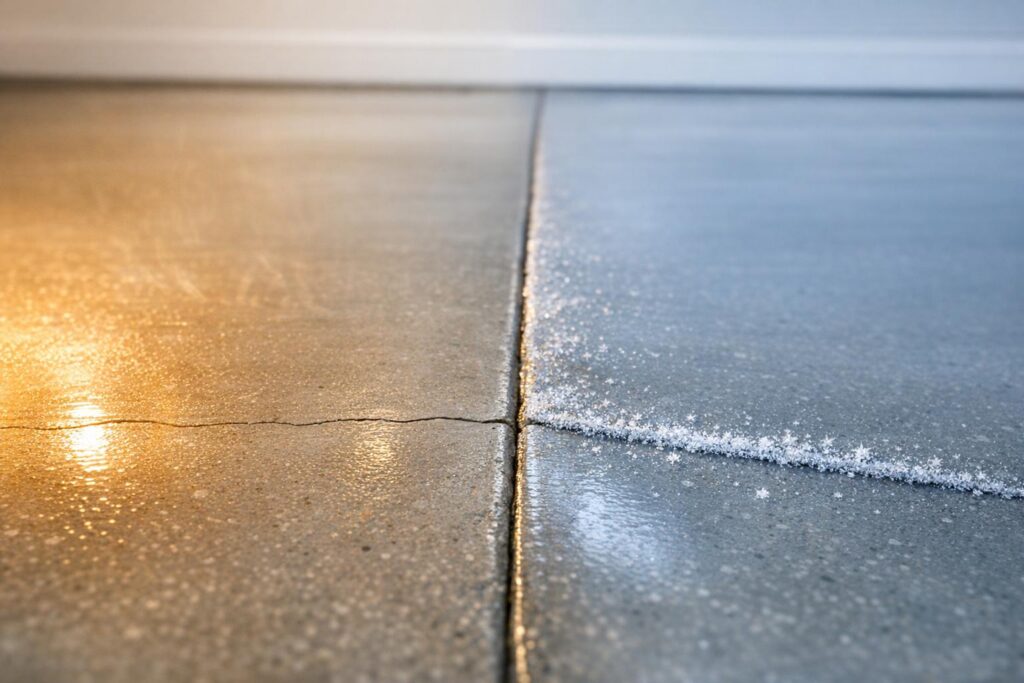
Concrete expands and contracts with temperature changes, which can cause cracks and damage over time. Rigid coatings like epoxy often fail under this stress. Polyurea coatings, however, offer a flexible and durable solution. Here’s why:
- Flexibility: Polyurea can stretch over 300%, accommodating concrete’s movement without cracking.
- Temperature Range: Performs reliably from -40°F to 350°F, handling extreme conditions.
- Durability: Lasts 15–30+ years, far outpacing epoxy’s 5–10 years.
- Quick Cure Time: Ready for use within 24 hours, minimizing downtime.
- Thermal Cycling Resistance: Withstands repeated heating and cooling without damage.
Polyurea is ideal for garages, patios, industrial floors, and pool decks, offering long-term protection against thermal expansion, moisture, and wear. It’s the go-to choice for managing concrete’s natural movement while ensuring lasting performance.
Polyurea Joint Fillers for concrete crack repair
sbb-itb-4b4bb37
The Science Behind Polyurea’s Thermal Expansion Performance
Polyurea stands out for its ability to handle thermal expansion and contraction, thanks to its molecular structure. Its design combines flexible polyether chains with strong urea bonds, allowing it to stretch and recover without cracking. This makes it an excellent choice for protecting concrete surfaces exposed to fluctuating temperatures.
High Flexibility and Elongation
Polyurea’s elongation capabilities far surpass those of epoxy. While epoxy coatings typically stretch between 2% and 10%, polyurea can exceed 300%, with some formulations reaching up to 500%. This flexibility enables it to bridge hairline cracks in concrete, adapting as cracks expand and contract due to temperature changes.
Alan Cain, Group Leader and Research Chemist at Chemline Inc., highlights polyurea’s versatility:
"Unlike polyurethanes, polyureas are not sensitive to humidity and can withstand extremely low temperatures (-20°F) during application while retaining desirable properties like abrasion resistance, high cure speed, water resistance, and ability to withstand many chemicals".
A real-world example of this flexibility comes from the U.S. Army Corps of Engineers. They applied a polyurea liner to a concrete reservoir, where it successfully handled crack movements and outlasted rigid coatings, even under hydraulic pressure. The liner acted as a flexible bridge, ensuring durability over decades.
Temperature Tolerance Range
Polyurea performs reliably across a wide range of temperatures. Its glass transition temperatures fall between -40°F and +480°F, with a safe working limit of +350°F under no load. It can even be applied in conditions ranging from -30°F to 140°F, making it suitable for installations across diverse U.S. climates. This temperature resilience during application also minimizes the risk of blistering, a common cause of coating failure during thermal shifts.
Resistance to Thermal Cycling
Polyurea doesn’t just handle extreme temperatures – it thrives under continuous thermal cycling. Laboratory tests show that 7-day cured polyurea coatings increased tensile strength by 9.8% after 40 days of alternating temperatures between -4°F and 122°F. Additionally, low-temperature bending tests revealed no cracking after 168 hours at -4°F.
This durability is not just theoretical. Major infrastructure projects have demonstrated polyurea’s thermal cycling resilience. For instance, in the San Francisco Bay Area, polyurea was applied to 3.2 million square feet of precast concrete. Its ability to endure repeated thermal cycles supports a projected 125-year lifespan.
Another practical example comes from municipal manhole linings. In many cities, epoxy linings failed within 1–2 years due to cracking caused by environmental stress and freeze-thaw cycles. By switching to polyurea liners, municipalities found a long-term solution, as the material flexed with the substrate instead of cracking.
Polyurea vs. Epoxy: Performance in Thermal Expansion
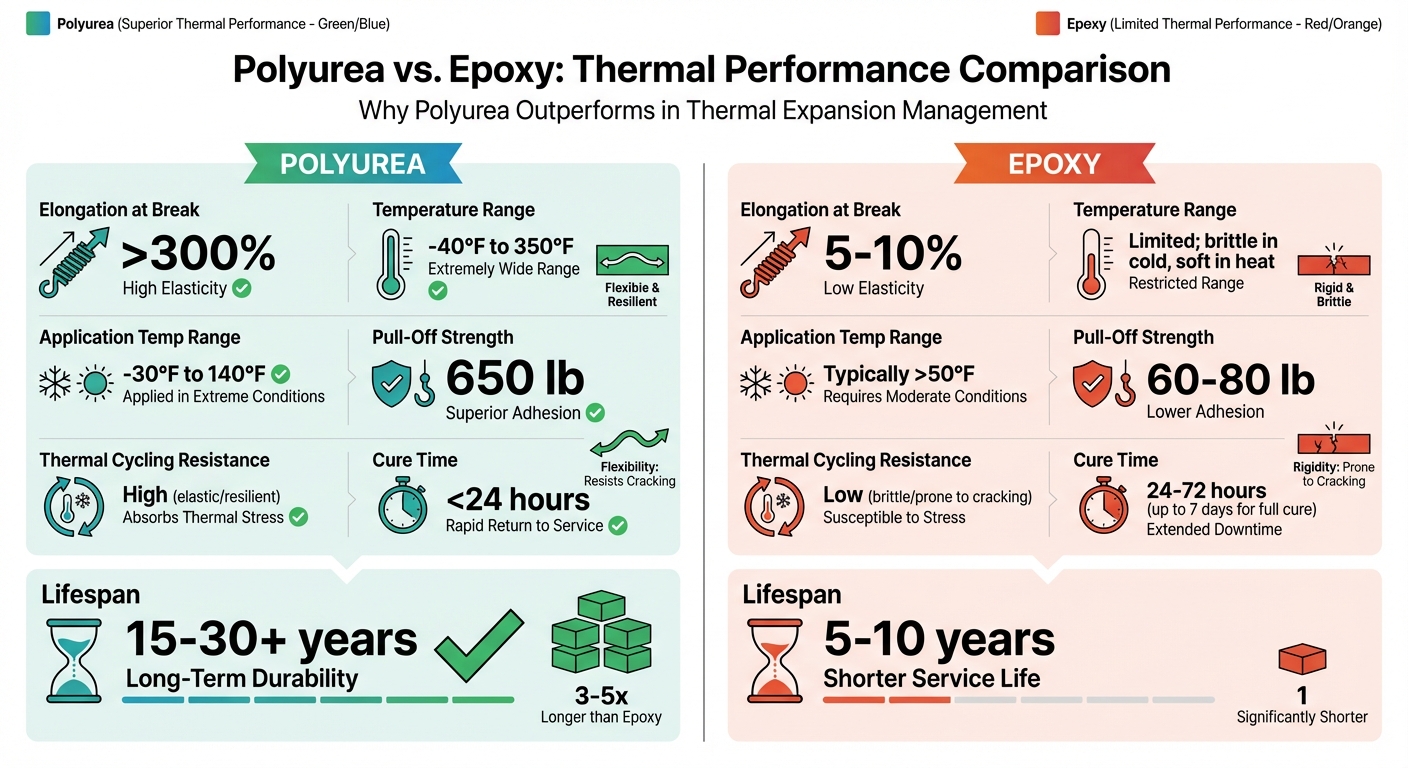
Polyurea vs Epoxy Coatings: Thermal Performance Comparison
Concrete naturally expands and contracts with temperature changes, and the coating applied to it must adapt to this movement to avoid cracking or peeling. Polyurea and epoxy respond to this challenge in fundamentally different ways, and knowing these distinctions can help you avoid expensive repairs.
Epoxy coatings struggle to accommodate concrete’s movement, often leading to stress cracks and delamination. Hayley Shahbazi, Manager at Galaxy Concrete Coatings, highlights this limitation:
"Traditional epoxy is rigid and brittle – it doesn’t flex with your concrete as temperatures change throughout the day and night. The result? Cracks, chips, and a coating that looks worn out in just a few years".
On the other hand, polyurea’s flexibility makes it a better fit for handling thermal expansion. Thanks to its elastomeric properties, polyurea stretches and rebounds as the concrete moves, forming a strong mechanical bond with the surface. This bond achieves a pull-off strength of 650 lb, significantly higher than epoxy’s 60–80 lb. This enhanced adhesion ensures the coating stays intact, even under thermal stress.
Beyond flexibility, epoxy coatings become increasingly brittle over time due to ongoing curing, limiting their lifespan to 5–10 years. In contrast, polyurea maintains its resilience, lasting 15–30+ years. This durability makes polyurea a superior choice for managing thermal expansion and ensuring long-lasting protection for concrete surfaces.
Comparison Table: Polyurea vs. Epoxy
| Property | Polyurea | Epoxy |
|---|---|---|
| Elongation at Break | >300% | <5–10% |
| Temperature Range | -40°F to 350°F | Limited; brittle in cold, soft in heat |
| Application Temp Range | -30°F to 140°F | Typically >50°F |
| Pull-Off Strength | 650 lb | 60–80 lb |
| Thermal Cycling Resistance | High (elastic/resilient) | Low (brittle/prone to cracking) |
| Cure Time | <24 hours | 24–72 hours (up to 7 days for full cure) |
| Lifespan | 15–30+ years | 5–10 years |
Applications of Polyurea in Temperature-Extreme Environments
Polyurea is a standout solution for managing thermal expansion in environments with extreme temperature fluctuations. Whether it’s a residential garage or a large industrial facility, polyurea coatings excel at protecting concrete surfaces where traditional, more rigid options often fail.
Residential Applications: Garages and Patios
Home garages experience constant temperature changes. During summer, concrete floors can get scorching hot, while winter brings freezing conditions. Polyurea’s ability to expand and contract with the concrete helps prevent cracking and peeling, ensuring long-term durability.
A common issue in garages is hot tire pickup, where inferior coatings peel off under the heat of tires. Polyurea resists this problem, making it an ideal choice for garage floors. On patios and outdoor spaces, its resistance to freeze–thaw cycles prevents water penetration and the resulting damage when moisture freezes and expands.
For example, Atlas Concrete Coatings applies polyurea systems to residential garages and patios across Pennsylvania and New Jersey, areas known for significant seasonal temperature swings. Their systems include UV-resistant topcoats that maintain color stability even under direct sunlight. While this is a boon for homeowners, the same principles apply to larger-scale applications requiring durability under harsh conditions.
Commercial and Industrial Applications
Industrial settings pose unique challenges, with rapid temperature shifts, heavy machinery, chemical exposure, and constant foot and vehicle traffic. Facilities like warehouses, manufacturing plants, and distribution centers – many lacking climate control – demand coatings that can handle extreme conditions year-round.
A notable example is the San Mateo-Hayward Bridge Widening Project completed in September 2002. The California Department of Transportation used a multi-coat polyurea system to cover 3.2 million square feet of precast concrete. Engineered for a 125-year lifespan, this 60-mil coating system exceeded requirements for thermal stability and chemical resistance, as noted by Alan Cain of Chemline Inc..
In addition to thermal performance, industrial polyurea coatings protect against exposure to harsh substances like battery acid, hydraulic fluids, and de-icing salts. These coatings create a seamless, waterproof barrier, critical during freeze–thaw cycles. While such durability is essential in industrial environments, the same qualities benefit outdoor leisure spaces.
Pool Decks and Outdoor Spaces
Pool decks are among the most demanding environments for concrete coatings. They face constant moisture, UV exposure, chemical treatments, and rapid temperature changes. Under the sun, pool decks can heat up quickly but cool down just as fast when exposed to water.
Aliphatic polyurea formulations are designed for UV stability, ensuring surfaces resist yellowing, chalking, or fading even after prolonged sun exposure. This makes polyurea a popular choice for pool deck resurfacing, where both aesthetics and performance are vital. Additionally, textured finishes enhance slip resistance, improving safety in wet conditions.
Atlas Concrete Coatings specializes in polyurea-based pool deck resurfacing, combining UV resistance, slip resistance, and thermal flexibility. These systems typically last over 15 years in outdoor environments, far outpacing the 3–5 year lifespan of traditional coatings in extreme climates.
These applications highlight polyurea’s exceptional ability to manage thermal expansion and maintain performance in challenging environments.
Why Choose Polyurea Coatings for Thermal Expansion Management
Key Benefits of Polyurea Coatings
Polyurea coatings are a standout choice for managing thermal expansion on concrete surfaces. Thanks to their elastomeric flexibility, these coatings expand and contract alongside the concrete substrate. This prevents cracks and peeling while maintaining durability for over 30 years with proper maintenance – lasting 3 to 5 times longer than traditional epoxy coatings.
Polyurea’s performance is impressive: it boasts 4× the strength and 10× the flexibility of epoxy, enduring extreme temperature ranges from -40°F to 350°F. Plus, it cures quickly, allowing vehicle traffic within just 24 hours, which minimizes downtime.
In addition to its thermal resilience, polyurea offers complete UV stability in aliphatic formulations. This ensures that both color and structural integrity remain intact under direct sunlight. The coating also creates a seamless, waterproof barrier that resists chemicals, impacts, and abrasion. While the initial costs may be higher, its extended lifespan and low maintenance needs make it a smart long-term investment.
These technical strengths are the foundation of Atlas Concrete Coatings’ expert installations.
Atlas Concrete Coatings‘ Expertise
Atlas Concrete Coatings specializes in applying polyurea systems designed to handle demanding thermal cycling conditions. Serving Pennsylvania and New Jersey, they start with diamond grinding to optimize surface adhesion and reduce the risk of delamination.
Using advanced plural-component spray equipment, Atlas applies multi-layer systems that include a high-bond polyurea basecoat paired with UV-stable topcoats. They offer customizable finishes, such as decorative flakes and slip-resistant additives, which enhance both the appearance and functionality of the coating. These tailored solutions ensure the coatings perform well under temperature extremes while balancing aesthetics and safety. To reinforce their confidence in polyurea’s durability, Atlas provides a lifetime warranty on their chip systems.
Whether it’s garage floors built to resist hot tire pickup or pool decks designed to handle constant moisture and temperature changes, Atlas delivers solutions tailored to each unique environment. Their efficient one-day installation process minimizes disruptions while providing the thermal expansion management that concrete surfaces need to endure decades of seasonal shifts.
Conclusion
Polyurea coatings stand out for their ability to handle thermal expansion far better than rigid alternatives. With flexibility that’s 10 times greater than epoxy, polyurea adapts to the substrate as it expands and contracts, avoiding the cracking and delamination issues often seen with more rigid coatings. Its operating temperature range, from -20°F to 350°F, makes it a reliable choice for areas that endure extreme seasonal temperature changes.
Additionally, polyurea forms a seamless, moisture-resistant barrier that protects concrete from freeze–thaw cycles, a common cause of damage. Its fast curing process allows surfaces to be ready for use within just 24 hours, minimizing downtime without compromising quality. In fact, polyurea systems have been designed to meet the rigorous demands of large-scale infrastructure projects, such as the San Mateo-Hayward Bridge Widening Project, with a projected lifespan of 125 years.
Experts in the field highlight its resilience:
"Polyurea spray coatings can be applied in a broader range of conditions and endure in harsher environments." – Alan Cain, Group Leader/Research Chemist, Chemline Inc.
Whether you’re safeguarding a garage floor from hot tire pickup, resurfacing a pool deck exposed to constant moisture and UV rays, or coating an industrial floor that endures heavy traffic and chemical spills, polyurea delivers the durability and thermal adaptability your concrete needs.
Atlas Concrete Coatings brings this advanced solution to Pennsylvania and New Jersey, offering installations backed by a lifetime warranty on chip systems. Their process includes diamond grinding, multi-layer applications, and customizable finishes, ensuring your surfaces remain durable and visually appealing for decades. Interested in protecting your concrete? Visit Atlas Concrete Coatings to schedule a free consultation and explore how polyurea can enhance your space.
FAQs
Will polyurea hide or bridge existing concrete cracks?
Polyurea is highly flexible, making it an excellent choice for addressing existing concrete cracks. Its ability to move with the substrate during thermal expansion and contraction helps minimize the risk of cracks widening or new ones developing.
Does polyurea need a UV-stable topcoat outdoors?
Yes, applying a UV-stable topcoat is a smart choice for outdoor polyurea applications. This layer helps protect the surface from yellowing, fading, and other damage caused by extended exposure to sunlight. It ensures the coating maintains its appearance and durability over time.
What preparation does concrete need before applying polyurea?
Proper preparation plays a key role in ensuring polyurea coatings stick well to the surface. Start by inspecting the concrete for any cracks, spalling, stains, or moisture problems. Next, clean the area thoroughly to remove debris, grease, or remnants of old coatings. Once cleaned, repair any visible damage, and mechanically profile the surface – using methods like grinding or shot blasting – to create the right texture for adhesion. Before applying the coating, double-check that the surface is clean, completely dry, and matches the required conditions to prevent issues like peeling or delamination.